
September 6, 2026
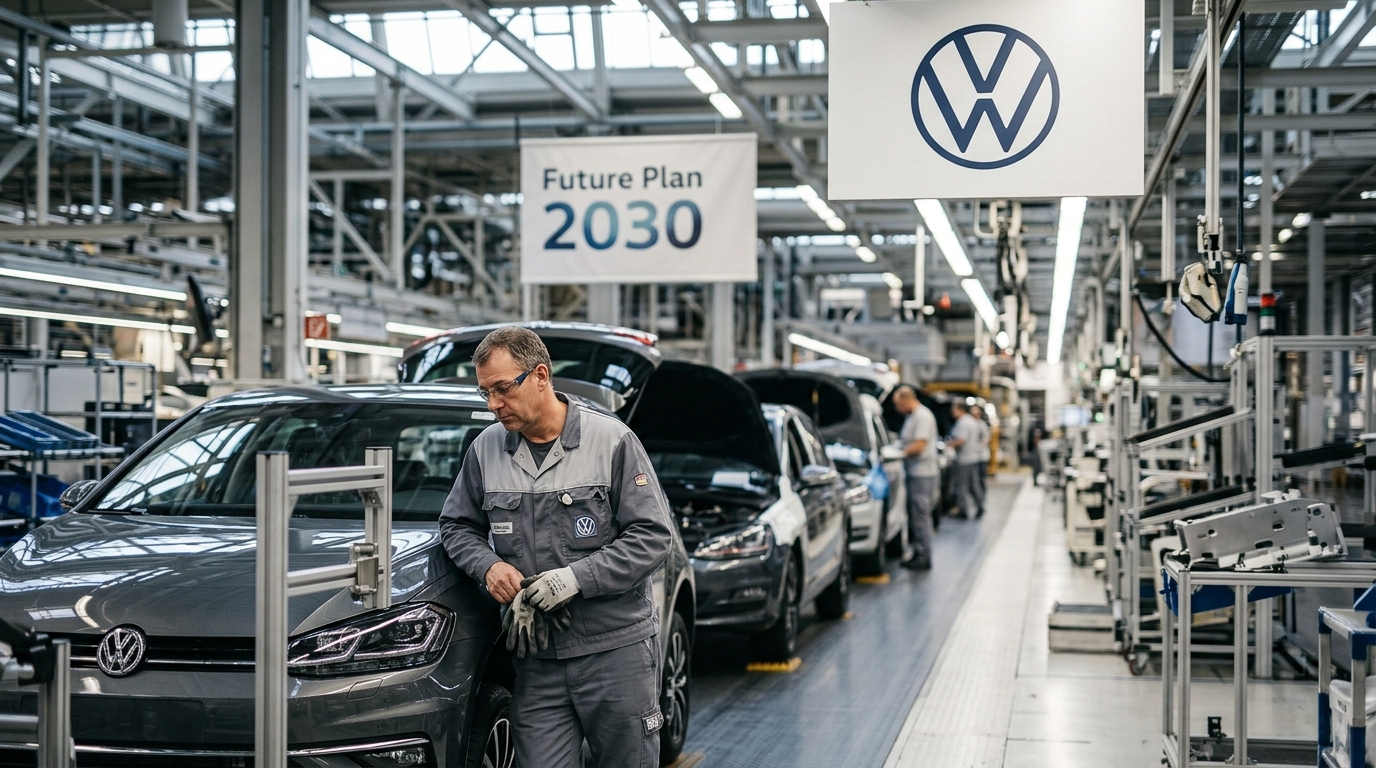
Volkswagen Stock Jumped 6% on Job Cuts.
The cheer around Future Plan 2030 shows how low the bar fell at Europe’s biggest carmaker.
When a company announces 50,000 additional layoffs and its stock jumps 6% in a single session, the instinct is to call that a sign of confidence. The more honest read is that the market had fully written off Volkswagen’s ability to make any difficult decision at all.
Big Tech is bidding against itself for dead mines
Google quietly backstopped a bitcoin miner for 1.8 billion dollars.
Amazon signed 5.5 billion with a second one. Microsoft wired 9.7 billion to a third.
Roughly 63 billion dollars of Big Tech money landed on bitcoin miners inside a single year.
None of it is about bitcoin.
They are bidding for something the miners picked up cheap in 2021, and once a site is taken it is gone for twenty years.
Analysts at one bank described the unanimous board approval as “a fundamental breakthrough and a much better-than-feared outcome,” noting that virtually every investor they had spoken to in the preceding days still viewed Volkswagen as simply “not fixable.” That is the context behind the rally, and it is worth sitting with. The stock did not move because the plan is obviously going to work. It moved because the plan exists.
What the Board Actually Approved
Volkswagen’s supervisory board unanimously approved on September 3 a transformation plan that includes cutting another 50,000 jobs in its attempt to counter tariffs, overcapacity, and Asian rivals. The plan, described by Reuters as the most extensive restructuring in Volkswagen’s 89-year history, includes phasing out auto production at four German plants.
Volkswagen said “a further fundamental adjustment of the global workforce capacity” was needed, with a reduction of around 50,000 positions worldwide, in addition to a 50,000-job reduction already underway. The group’s twelve initiatives target annual sales of 9 million vehicles and an operating margin of 9% by 2030, equal to an operating result of about €31 billion.
Jim Rickards: “AI Meltdown Could be 10 Times Bigger than Lehman”
After correctly predicting the last two major stock market meltdowns, Jim Rickards is now predicting we’re about to see an AI version of the dotcom bust…
When the stock market crashed almost 80%…
Ruining the retirement of millions of Americans.
Click here to see the FIVE STEPS he’s recommending you take to prepare…
Because he believes the most important AI company in the world is about to go bust…
In a meltdown that will be 10 times bigger than Lehman Brothers.
That last number is the one that matters. Volkswagen produced €5.9 billion in operating profit in the first half of 2026. Doubling that gives an €11.8 billion annualized figure. The 2030 target stands €19.2 billion higher and requires a 2.6-fold increase. The governance discount is gone. The earnings gap is not.
Margin gaps of this magnitude are rarely closed on schedule, and the market’s history of repricing stocks the moment a credible path appears is instructive. how a doubling in gross margin rewrote the investment case for a company still missing revenue targets offers a useful parallel: the market did not wait for full delivery — it moved on the direction of the margin line alone. Volkswagen’s investors appear to be making the same bet, pricing in trajectory rather than destination.
Why Investors Cheered Anyway
The board’s unanimous backing came as a surprise given the panel’s history of internal division. A critical element driving the positive market reaction was the labor-side buy-in signaled around the supervisory board meeting, including IG Metall’s public statement after the vote. Getting labor and management into the same room and out with a yes vote was the real signal. Everything else is arithmetic that still needs proving.
The margin starting point is demanding. First-half revenue held near €158.1 billion, yet operating profit fell 11.6%. Volkswagen said its operating return on sales was 3.8% in the first half of 2026. Reaching 9% from there requires the job cuts to land on schedule, the model simplification to hold, and Chinese market pressure not to deepen further. Perhaps the biggest challenge is China, formerly a major source of profits, where the overall market has slumped by about 20% this year as local competitors launch a flood of new models amid fierce price competition.
The competitive pressure from Chinese automakers does not exist in isolation from the broader geopolitical backdrop reshaping trade flows and corporate strategy across industries. analysis of how China’s position at the G20 is forcing markets to price new geopolitical fallout provides context for why the pressure on Volkswagen’s China business may be structural rather than cyclical. If Beijing’s posture hardens further, the 20% market slump Volkswagen is already absorbing could prove to be a floor rather than a peak.
Inside the Nuclear Revival Reshaping Energy Markets
Governments worldwide are investing billions to revive a proven energy source. Supply chains are tightening, demand is rising, and select companies stand to benefit. The Nuclear’s Second Act report explains what’s happening next.
What Investors Are Missing
The broader implication runs well past Wolfsburg. The agreement could have implications beyond Volkswagen as European automakers grapple with slower growth, excess manufacturing capacity, Chinese competition, and pressure on returns. BMW, Mercedes-Benz, and Stellantis are similarly experiencing the painful transition of slowing EV demand and intensifying cost pressures.
If the investment committee question is whether Volkswagen is a turnaround or a value trap, the honest answer is still both. The four German plants at the heart of the dispute, in Emden, Zwickau, Hanover, and Neckarsulm, survived this vote in the sense that Volkswagen is still exploring alternatives for the sites. Their futures remain formally uncertain, with Volkswagen now on the clock to deliver a viable European production strategy by the end of June 2027. The 9% margin target is real. So is the distance to it.
Stocks to Watch
- VOW3 / VWAGY: The obvious focus. The restructuring catalyst is now priced in at the governance level. Execution over the next four quarters determines whether the gap between €11.8 billion and €31 billion in operating profit narrows or widens.
- PAH3 (Porsche SE): Holds a majority stake in VW and trades at a persistent discount to NAV. A successful VW restructuring compresses that discount. A stumble widens it further.
- STLA (Stellantis): Facing its own version of the same structural problem. Volkswagen, Stellantis, and Renault are all grappling with similar challenges as investors reassess the sector’s long-term growth prospects. Watch whether the VW template pressures Stellantis management to accelerate its own cost response.
- BorgWarner / Aptiv: Component suppliers to VW’s four plants under review. If Emden or Zwickau loses production in the early 2030s, supplier revenue tied to those lines goes with it. Neither stock has priced that risk clearly yet.
The question of which legacy automaker moves first — and whether moving first is even an advantage — sits at the center of the sector’s repricing. the profit event thesis that could reshape competitive dynamics among major auto and tech players explores how a single catalyst can reset investor expectations across an entire peer group. For Stellantis watchers, the VW vote may have just started that clock.