August 3, 2026
The $400B Pharma Deal Wall Street Can’t Figure Out
First a note from Stansberry Research
Dear Reader,
I’m writing to share our #1 stock to buy right now as the U.S. power grid cracks.
This company’s new tech is already live in remote fields in West Texas.
It can generate round-the-clock power without waiting years for the public grid to catch up.
This tech is now backed by Elon Musk.
And Meta, Microsoft, and Google are getting in too.
Satellite images have surfaced – that could soon show everyone what’s going on. So before the average person hears about this…
Click here to learn all about the #1 power grid stock to own right now.
Regards,
Joel Litman
Chief Investment Officer, Altimetry
The $400B Pharma Deal Wall Street Can’t Figure Out
There is one question sitting at the center of every healthcare investment committee meeting this Monday morning. Not “will this deal happen” — that’s a binary most serious investors won’t bet on this early. The real question is more uncomfortable: if the smartest pipeline in the pharmaceutical industry just raised its hand for an acquisition it probably doesn’t need, what does that tell you about where large-cap pharma goes from here?
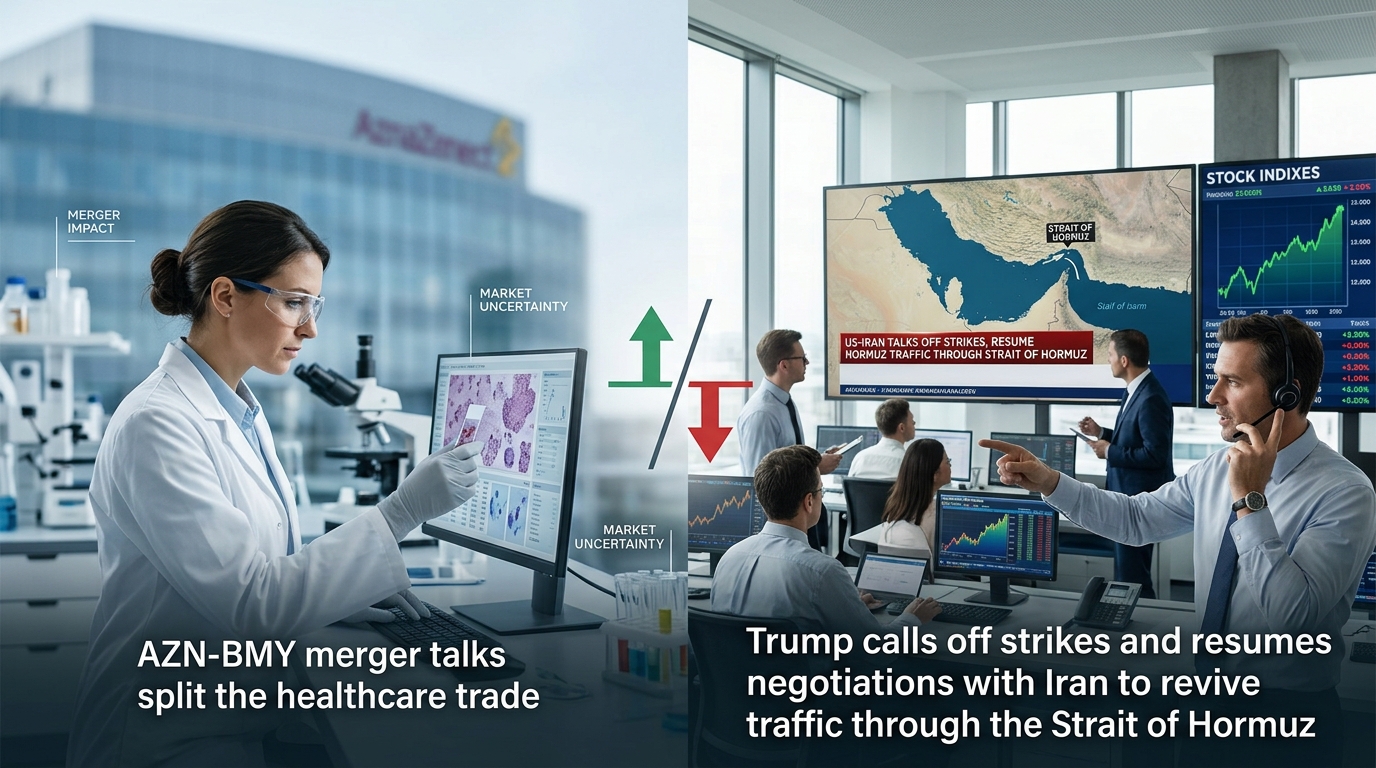
The Financial Times broke the story Sunday. AstraZeneca is considering a deal to merge with Bristol Myers Squibb in a transaction that would value the combined company at roughly $400 billion, with discussions having taken place over the last few months. Neither company has confirmed the report. Reuters could not determine whether talks are still ongoing. And yet the market responded instantly, and the direction of that response is the whole story.
AstraZeneca shares dropped as much as 7% on Monday after the news broke — a striking single-session move for one of the pharmaceutical industry’s strongest growth stories. Bristol Myers Squibb rose 6% in U.S. premarket trading. That divergence is not random. The market is delivering a verdict: BMY wins, AZN pays.
Anthropic’s Project Glasswing: The AI “Too Dangerous” for the Public
Anthropic’s Project Glasswing gives a select group of companies early access to an advanced form of AI that has been deemed “too dangerous” for the public. With this in their arsenal, these companies could become the most powerful businesses in the world this year.
Why Wall Street Is Paying Attention
The scale alone makes this unmissable. AstraZeneca carries a NYSE market cap of approximately $263 billion; Bristol Myers Squibb is valued at approximately $133 billion. Combined, they approach $400 billion in market value — already the largest combined pharmaceutical entity ever reported, before any acquisition premium. For context, BMS’s own Celgene acquisition set records in 2019 by valuing the target at approximately $74 billion. This would dwarf it completely.
But the reason institutional investors are engaged goes beyond size. AstraZeneca under Pascal Soriot has been one of the cleanest growth stories in global equity markets. In 2014, Soriot argued AstraZeneca could generate greater long-term value as an independent company rebuilding its pipeline through oncology. That argument proved correct: the company’s shares have more than quadrupled since. So when a company with that record starts exploring a transaction this complicated, it demands an explanation.
The Bull Case
Start with BMY’s side of the ledger, because the strategic logic there is straightforward. Bristol Myers has been doing smaller deals to gain new drugs as it faces declining sales of older medicines. In 2019, it bought Celgene for about $80 billion, acquiring its flagship blood cancer drug Revlimid. Revlimid has already lost patent protection, and its current top sellers — cancer immunotherapy Opdivo and blood thinner Eliquis — could lose patent protection by 2028. That is a serious cliff for a company of this size to absorb organically.
Merging into AZN’s pipeline solves that problem cleanly. While the companies overlap in oncology, cardiovascular disease, and immunology, their pipelines are largely complementary — with AstraZeneca stronger in solid tumors and Bristol Myers Squibb more focused on blood cancers and cell therapies.
For AZN, the argument is about America. AstraZeneca’s U.S. sales accounted for 42% of total sales in the first half of 2026, and the company has been methodically pushing that number higher. AstraZeneca’s $80 billion 2030 revenue target requires growth at a pace that organic development alone may not achieve, particularly with China revenue declining structurally due to government pricing programs. Bristol Myers Squibb, with a $133 billion market cap, could provide AstraZeneca with a much bigger foothold in the U.S. market.
Jefferies framed the most interesting bull argument. The combined company would generate roughly $100 billion in annual sales with the deepest oncology portfolio in the industry. “The strategic rationale may be extending beyond cost synergies to a competition for larger portfolios of complementary assets that can support complex combination regimens,” Jefferies wrote. That is a genuinely different way to think about the deal. The value isn’t just what you own — it’s what you can build internally without cross-licensing negotiations slowing the clock.
Elon’s $480 Trillion Currency Masterplan
He’s waited 27 years for this moment. Elon Musk just launched his biggest disruption ever, which could totally reset how millions of people access their money and even pay tax.
The Bear Case
The antitrust problem is real, and most serious investors are not dismissing it. Oncology drugs accounted for over 40% of AstraZeneca’s overall sales in the first six months of 2026, and the two companies’ cancer immunotherapies directly compete. BMS generated $10 billion in 2025 revenue from its Opdivo cancer therapy, while AstraZeneca’s oncology portfolio includes competing immunotherapies such as Imfinzi.
Here is the piece of history that deserves more attention than it’s getting this morning. BMS actually sued AstraZeneca over this overlap in 2022, alleging Imfinzi infringed Opdivo’s patents, and AstraZeneca paid $510 million to settle all related lawsuits in 2023. A merged entity controlling both drugs — plus Yervoy and Imjudo in the CTLA-4 class — would dominate every major checkpoint inhibitor mechanism except Merck’s Keytruda. Regulators will notice that.
The FTC precedent matters too. The FTC’s standard remedy is divestiture of overlapping marketed products; in the BMS-Celgene case, that meant selling Otezla for $13.4 billion. The checkpoint immunotherapy divestiture question here is far larger and more structurally complex. If the deal’s core strategic logic rests on oncology scale, and regulators force the company to shed oncology assets to get it approved, how much of the original rationale survives?
Then there is the political dimension. Jefferies pointed out that “AstraZeneca would effectively become a UK-based acquirer of one of the largest U.S. pharmaceutical companies, at a time when U.S. politicians are focused on domestic production and strategic sectors.” A merger would likely be assessed by the Trump administration’s antitrust authorities, who have sought to increase domestic investment. That adds friction to an already complicated process.
The Evidence
The analyst reaction this morning is unusually direct. Jefferies wrote that “given the strength of AZ’s growth and innovation profile, we are a bit perplexed.” They added: “Of course financial accretion can look good and maybe more cash generation would allow for more R&D. But if there is one company that doesn’t need financial engineering, it’s AZ.”
Citi analysts said that if the merger talks report were true, it would be a “surprise” given AstraZeneca’s “best-in-class pipeline.” BMO Capital Markets wrote Sunday evening: “Based on significant business overlap, we believe a deal is less likely to materialize.” Bernstein’s analysts wrote flatly: “It seems unlikely that the potential merger between AstraZeneca and Bristol Myers Squibb will go ahead.”
Bloomberg Intelligence analysts noted that AstraZeneca is projected to generate double-digit earnings growth through 2030, whereas BMS faces margin pressures from upcoming patent expiries on core blockbusters. That asymmetry is what the stock prices are reflecting. One company has the growth. The other has the need.
The Mavens’ View
What serious investors appear to believe right now is not that this deal collapses — it’s that it gets much messier than the initial headlines suggest. The working hypothesis among the more experienced healthcare portfolio managers is something like this: AZN’s strategic interest in expanding U.S. revenue is genuine. BMY’s interest in solving the patent cliff is equally genuine. The overlapping oncology franchises are not a dealbreaker in principle — but they require divestitures that could gut the core rationale.
Slight tangent, but it matters. This is the second time AstraZeneca has found itself at the center of a transformational M&A moment. In 2014, Soriot famously turned away Pfizer’s $106 billion hostile bid. That decision made AZN shareholders significantly wealthier over the decade that followed. The calculus has now changed. AstraZeneca’s $80 billion 2030 revenue target requires growth at a pace that organic development alone may not achieve, particularly with China revenue declining structurally. Whether a deal of this complexity is the right answer to that problem is an open question. The market’s 7% drop on AZN shares suggests investors aren’t convinced yet.
What Investors Are Missing
Here is the second-order story almost nobody is discussing this morning. If the deal does manage to overcome all the hurdles in front of it, analysts suspect it could reset the current deal environment. “A successful AZN-BMS merger could trigger a new wave of M&A among large global pharma companies,” Jefferies wrote.
That matters enormously for how you position across the sector. If AZN-BMS succeeds — even in a diluted form after divestitures — it signals that $100 billion-plus pharma combinations are politically and regulatorily viable in this environment. That changes the calculus for every large-cap pharmaceutical company sitting on a pipeline gap and a patent problem. The M&A premium across the sector doesn’t go up because of one deal. It goes up because one deal proves the door is open.
The assets that get divested are the other piece. If forced divestitures become a condition of approval, mid-tier oncology franchises get shopped at scale. That is a significant opportunity for the companies positioned to acquire them — and a very different conversation than the one focused entirely on AZN and BMY themselves.
Stocks to Watch
- Bristol Myers Squibb (BMY): The cleaner side of this trade. Opdivo and Eliquis face potential patent expiry by 2028, and a combination with AZN’s pipeline directly addresses that problem. The 6% move higher this morning reflects that logic accurately. The risk is deal collapse — which sends BMY back to its standalone patent cliff story.
- AstraZeneca (AZN): Down as much as 7% on Monday, leaving analysts puzzled. AZN had a clean, self-funded growth story before this report. The market is selling uncertainty. Whether the selloff creates an entry or confirms the strategic concern depends entirely on what comes out of the antitrust process. Worth watching closely over the next several weeks.
- Eli Lilly (LLY): Reports August 5. Wall Street expects Lilly to post quarterly earnings of $6.71 per share on revenue of $20.26 billion, up 30.2% from the year-ago quarter. In Q1 2026, Lilly beat revenue estimates by over 11% and topped adjusted EPS consensus by nearly 26%, with Mounjaro and Zepbound driving the surprise. If the AZN-BMY situation stalls or gets messier, Lilly becomes the cleanest large-cap healthcare growth story with no complexity attached.
- Merck (MRK): The quiet winner in all of this. A merged AZN-BMS entity would dominate every major checkpoint inhibitor mechanism except Merck’s Keytruda. But if divestitures are required, Keytruda’s competitive position only strengthens. Merck doesn’t need to do anything. The deal drama works in its favor either way.
Louis Navellier: Don’t buy OR sell another AI stock…
Until you’ve heard this urgent AI warning from the man who called Nvidia before its 44,000% rise…
According to Louis, a massive reset is coming in an obscure corner of the AI market.
This $100 trillion disruption could send some of the world’s biggest AI stocks to zero… and one off-the-radar stock soaring… starting now.
The week starts with a potential $400 billion transaction that the majority of analysts think is unlikely, a market that sold the acquirer hard on day one, and Lilly earnings in 48 hours that will tell us a great deal about whether healthcare’s momentum story is still intact. Neither the deal nor the broader sector picture is settled. The most interesting moves this week will probably come from names that aren’t in the headline.