July 20, 2026
Fast Food’s Value War, Round 2
Are deals rebuilding demand, or just renting traffic?
Heads up –
I just set you up with a temporary link that skips the order page for my Simple Options Trading For Beginners guide. No cart. No checkout. It lets you skip ahead to the download page.
This same book sells for $29.97 on my website right now, but your temporary link gets you free access while it’s still active.
The only catch?
The link expires soon. Once it goes, you have to pay $29.97.
Use the backdoor link below to get free access before it closes.
Simple Options Trading For Beginners << BACKDOOR LINK
Good Trading,
Bill Poulos
The big question showing up in consumer and staples meetings is simple, and it is not about who has the best new sandwich.
It is this: are the big value pushes in fast food actually rebuilding underlying demand, or are they just buying a few weeks of traffic that disappears the moment the deal does?
Because if it is the second one, then the industry is not growing. It is just moving the same customers around while margins quietly get bargained down.
Why Wall Street cares
Fast food is supposed to be the steady corner of consumer: repeat purchases, habit, scale, and a pretty tight grip on price. What has changed is the customer has gotten pickier and more deal trained, even in categories that used to be less elastic.
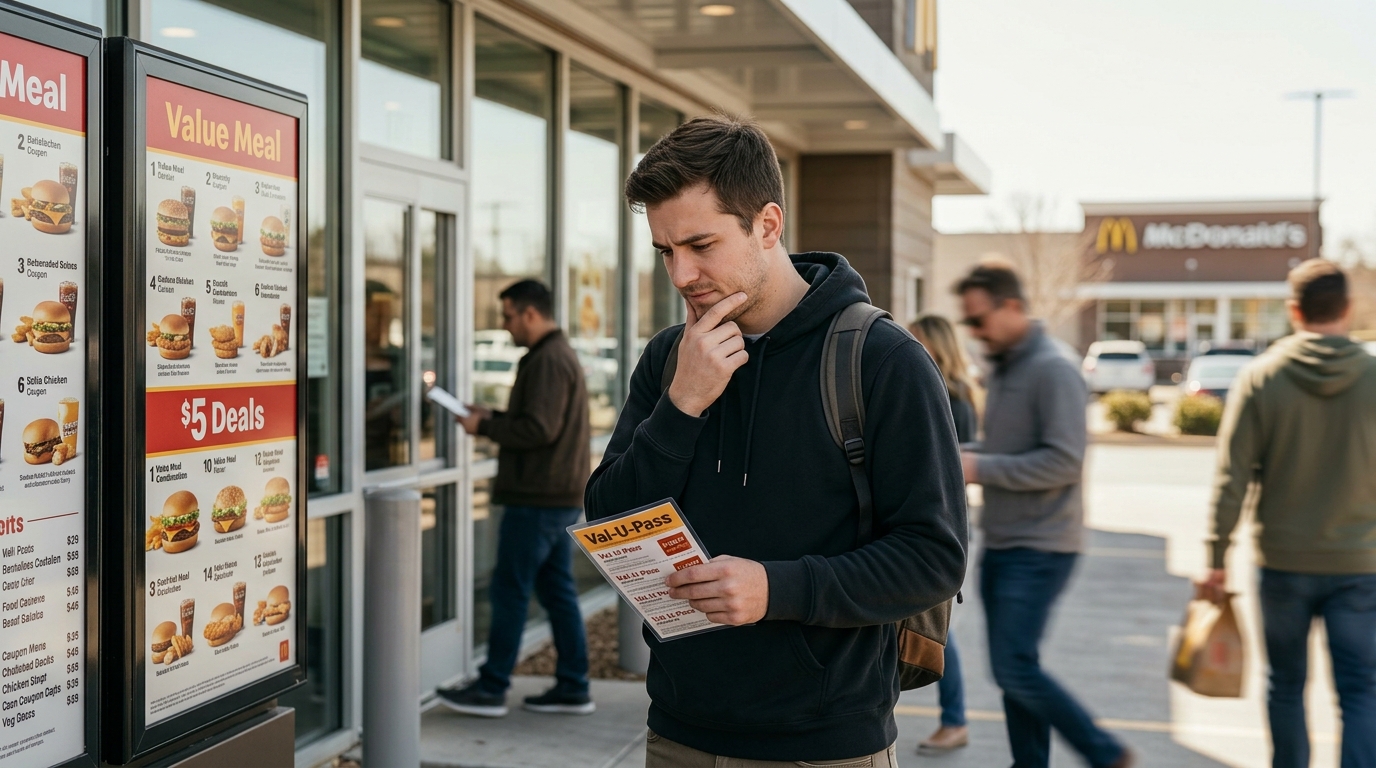
McDonald’s has leaned hard into value in 2026 with new under-$3 options and a $4 breakfast deal tied to its McValue positioning. That is not subtle, and it is not a one-off coupon.
At the same time, third-party reads are increasingly part of the committee packet. Some reads have suggested modest traffic improvement alongside positive U.S. comparable sales early in 2026, which is exactly why the topic keeps coming up.
Slight tangent, but it matters: when a category starts chasing traffic with deals, you can end up measuring the wrong thing. Traffic looks better. Unit economics look worse. And everyone is still calling it “strategy.”
The bull case
Bulls argue the value wave is rational, not desperate. The thesis is that restaurants overreached on pricing in 2022 to 2024, guests pushed back, and now the industry is normalizing. You take the hit, you reset the entry price, you rebuild frequency.
On this view, the best operators will use deals to pull customers into loyalty and digital ordering, then nudge them back up the menu. Value is the hook. Mix and frequency are the payoff.
And if you believe the consumer is still stressed but not broken, value can actually widen the gap between the giants and everybody else. Scale pays for the deal. Smaller chains cannot keep up for long.
He Doesn’t Buy Gold. He “Skims” It.
A former hedge fund manager ranked in the top 1% by Barron’s has developed a three-step strategy to profit from gold – without buying a single ounce.
His followers have had the chance to collect $2,975… $3,781… and even $6,786 at a time. With a 73% win rate.
He calls it “Gold Skimming.” And he’s just revealed the full strategy for the first time.
The bear case
Bears think the category is teaching customers to wait for discounts. The problem is not the deal itself. It is what it trains the customer to do next time.
They also worry that promotions can lift transactions without meaningfully improving loyalty. If you are buying visits from deal hunters who rotate to the next offer, the industry ends up running faster to stay in the same place.
If that pattern holds, you get a more promotional industry with structurally lower margins, more volatile comps, and less confidence in forward earnings power. Multiples do not love that, even if headline sales look fine for a while.
The evidence
Here’s where I see the committee room converging.
One, value is working in the narrow sense of driving near-term activity. That is why so many brands keep returning to it, even after swearing they would not.
Two, investors are getting more skeptical about whether these gains are durable. The argument has shifted from “How much traffic did you get?” to “How much of it stayed?” That is a tougher question, and it is not answered by a single quarter.
Three, portfolio decisions are starting to matter again. When large restaurant groups simplify, sell a concept, or re-center capital on the strongest brands, it is usually a sign they see a longer period where returns will be earned the hard way: through execution, not pricing.
The mavens’ view
The more sophisticated take is not “value good” or “value bad.” It is: value is a weapon, but it is also a tax. Someone always pays.
The mavens tend to ask two follow-ups.
First: who has the cost structure to run promotions without destroying store-level economics? If you cannot fund value with scale, supply chain leverage, and throughput, you are essentially bidding away your own margin.
Second: what is the exit plan? If the answer is “we will go back to normal pricing later,” that is not an answer. If the answer is “we will keep the entry price low but drive mix into higher-margin add-ons and beverages,” that is at least a model you can underwrite.
What investors are missing
The under discussed implication is that the next battleground is not burgers. It is attachment.
Deals pull people in. Profit comes from what they add. Beverages, sides, desserts, and the little frictionless upsells inside the app. If loyalty is shaky, then attachment rate becomes the real margin stabilizer, not the headline deal.
So the chains that can turn a cheap entry offer into a higher check without annoying the customer may end up with the cleanest earnings quality in a promotional world. That is not glamorous, but it is usually where the money is.
Stocks to watch
- McDonald’s (MCD): A live case study in whether value plus marketing plus loyalty can grow comps without turning the brand into a permanent discounter.
- Yum! Brands (YUM): A portfolio signal to monitor as capital concentrates behind the strongest concepts and operators look for cleaner returns.
- Restaurant Brands (QSR): A useful way to track how promotions and brand differentiation play out across multiple banners.
- Wendy’s (WEN): Worth watching through the lens of traffic quality and whether promotions translate into repeat behavior.
What I’m watching next is not the next meal deal announcement. It is whether any big chain starts talking more openly about attachment and repeat behavior, even if it is tucked into Q&A. If they do, that is the tell the industry knows traffic alone is not the story.