July 13, 2026
Tesla Reports July 22
Featured: Tesla Reports July 22
First a note from Behind the Markets
Dear Friend,
NVIDIA tried to buy this company for $40 billion.
The U.S. government blocked the deal.
Not antitrust. Not price.
It was deemed too critical to let any single company control.
Dylan Jovine – 30 years on Wall Street, who called Palantir at $7.38 (2,712%) and Rocket Lab at $3.80 (3,850%) – has been tracking this firm for months.
So NVIDIA did the next best thing: locked in a 20-year supply agreement.
Jensen Huang said they’ll “continue to support this firm for decades to come.”
But NVIDIA isn’t the only one who needs it.
Elon Musk’s SpaceX builds on it – their job postings demand experience with this firm’s technology, in writing.
Jeff Bezos builds Amazon’s AI chips on it, and Blue Origin runs its control systems on it. Apple, Google, Meta, Samsung, and Qualcomm all pay it billions in royalties every year.
Its technology is already in the phone in your hand.
Every time you open an app, stream a video, or ask your assistant a question, this company’s architecture is running underneath.
Here’s what makes this moment different.
Last quarter, this firm’s data-center royalties more than doubled year over year and its next earnings call is July 29th.
With royalties accelerating and the orbital-data-center buildout just starting, July 29th could be the day the market re-rates it.
Get the name and ticker of the stock NVIDIA tried to buy for $40 billion – before July 29th >>
“The Buck Stops Here,”
Kelly Maguire
Behind the Markets
FEATURED
Tesla Reports July 22
At a Glance
- Earnings date: July 22, 2026, after market close
- Q2 deliveries: 480,126 vehicles, up 25% year over year — roughly 74,000 ahead of the Wall Street consensus of 406,024
- Revenue estimate: ~$25.4-$25.64B | Non-GAAP EPS: ~$0.47-$0.49 (UBS projects $0.67)
- Primary focus: Automotive gross margin vs. Q1’s 19.2% ex-regulatory credits
- Robotaxi markets: Austin, Dallas, Houston (TX) and Miami (FL, live July 3); Bay Area supervised only
- Cybercab: Engineering test units running on Austin public roads without steering wheel or pedals
- Capex: $25B+ for full-year 2026, nearly triple 2025 spending
- Analyst consensus: Moderate Buy across 42 analysts | Average price target ~$407-$419
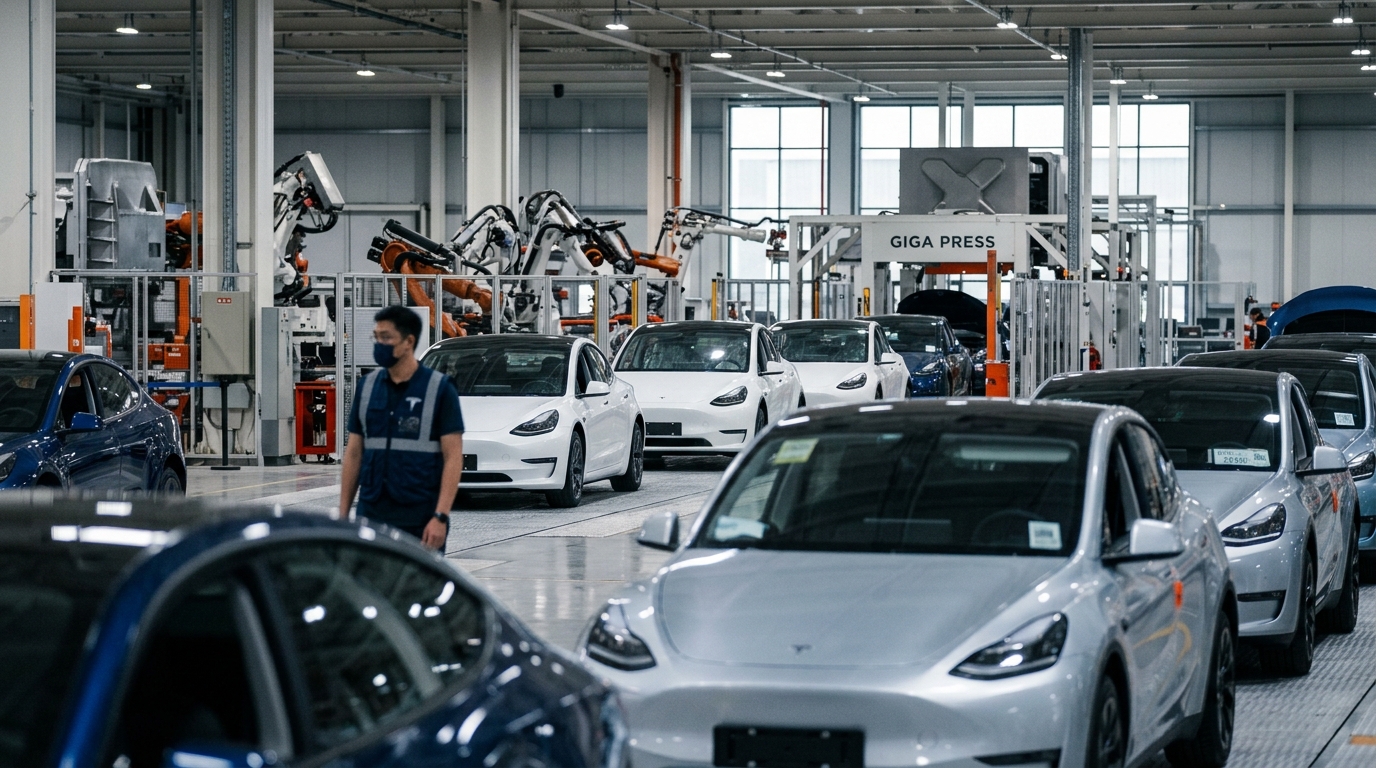
Tesla delivered 480,126 vehicles in Q2. The Street was expecting roughly 406,000. That’s a big number. So why did the stock sell off on the news?
Because deliveries, at this point, are almost beside the point.
The question that actually matters going into July 22 is whether Tesla made money on those cars. Specifically: did automotive gross margins hold up, or did the volume surge come at the cost of profitability? Tesla reported automotive gross margin ex-regulatory credits of 19.2% in Q1 2026 — a sharp improvement from 12.5% a year earlier. But Q1 had a tailwind from one-time warranty adjustments and tariff refunds. Strip those out and the Q2 margin reading becomes the single most important number in the report.
The consensus for Q2 revenue sits around $25.4-$25.64 billion. Non-GAAP EPS is pegged at $0.47-$0.49 by most models, though UBS analyst Joseph Spak is notably higher at $0.67 — his argument being that the Street hasn’t fully updated for the delivery surge. That gap is interesting. An EPS beat might already be baked in. A margin miss, on the other hand, would not be.
Forward P/E around 204x. No margin for error.
Three Things That Actually Move the Stock
The financials are almost a formality at this point. What investors are really tuning in for on the earnings call is progress — or the lack of it — on three fronts.
First, Cybercab. Tesla is running steering-wheel-free, pedal-free Cybercab engineering units on public roads in Austin right now. That’s a real development. The vehicle is built from scratch for full autonomy — no human controls at all — and is expected to enter the live robotaxi fleet once production volume scales later this year. Musk has targeted a sub-$30,000 price point and a pre-2027 commercial launch. A lot of observers think that timeline slips. What matters on the call is whether management gives anything concrete: a production number, a city target, a revenue projection. Vague language about “ramping toward end of year” moves nothing. A hard commitment changes the calculus.
Second, robotaxi geography. The unsupervised service is currently live in Austin, Dallas, Houston, and Miami, which launched July 3 — making Florida the third state with active Tesla robotaxi operations. The Bay Area is running under a separate permit structure with safety drivers. Tesla had originally targeted seven new cities for the first half of 2026. Only Dallas and Houston made it before July. Miami opened a few days into Q3. Orlando, Tampa, Phoenix, and Las Vegas are still listed as “preparations underway.” Management has signaled that meaningful robotaxi revenue is unlikely before 2027, which is worth keeping in mind when evaluating the bull case on autonomy.
Elon Musk’s Insane Projection: 7,692,207%
Where should you invest $100 right now?
Elon Musk just invented and patented this new AI technology…
And he’s predicting it will launch a NEW industry that will grow more than 7 million percent in the coming years.
Even if he’s only 10% right, that would still be enough to grow $100 into more than $700,000.
Click here to see the details on what Elon Musk called “an infinite money glitch.”
Worth noting: Tesla’s current active robotaxi fleet is estimated around 59 vehicles nationally. Waymo is running roughly 4,000 vehicles across ten cities and completing over 500,000 paid rides per week. The gap is not small. Tesla’s long-term advantage is supposed to be software-driven cost efficiency at scale. The key phrase there is “at scale” — which hasn’t happened yet.
Third, the capex story. Tesla guided to more than $25 billion in capital expenditures for 2026 — nearly triple what it spent in 2025. The money is going into AI chips (AI5 and AI6), Optimus humanoid robots, Terafab chip fabrication in Texas, and energy and battery infrastructure. Q1 free cash flow came in at $1.44 billion, but management has guided toward negative free cash flow for most of the year as spending accelerates. Investors want a clearer picture of when this spending starts generating returns — not just that it will, eventually, but when.
How to Think About the Trade
Bull case: Q2 automotive gross margins come in at or above Q1’s 19.2% ex-credits on a clean basis. Management delivers a credible Cybercab commercialization timeline with specific numbers attached. Energy storage — 13.5 GWh deployed in Q2, up more than 40% year over year — keeps accelerating, and energy gross margins hold near Q1’s 39.5%. For this view, a defined-risk structure: August call spread, long the $420, short the $450.
Bear case: Margins compress in Q2 as Q1’s one-time benefits fade, Cybercab commentary is vague, and the $25B+ capex trajectory spooks investors watching free cash flow. For this view: a put spread, long the $380 put, short the $360 put, expiring August 8.
Neutral case: The delivery beat was already public before the report. A mixed result — revenue beat, margin wobble — produces a muted move. Implied volatility heading into July 22 is elevated, which means post-event compression is the opportunity regardless of direction. A short iron condor with wings set at 10-12% lets that work without requiring a directional call.
Where Analysts Stand
42 analysts cover TSLA. The consensus sits at Moderate Buy. Average price target is in the $407-$419 range. The spread of views, though, is unusually wide for a mega-cap — from $600 to $24.86. That gap alone says something about how differently people are valuing the autonomy optionality.
- Wedbush (Dan Ives) — Outperform, $600: Street-high target. Sees Tesla reaching a $2T market cap in 2026, driven by robotaxi rollout across 30+ cities. Most vocal bull on Wall Street.
- RBC Capital (Tom Narayan) — Outperform, $500: Raised from $475. Views Tesla as AI infrastructure, not just an automaker. Robotaxi is the primary long-term opportunity in his model.
- JPMorgan — Neutral, $475: Upgraded from prior Underweight on June 5, 2026. Raised target alongside. Still neutral — wants to see margin recovery and robotaxi traction before going further.
- UBS (Joseph Spak) — Neutral, $442: Raised from $364 on July 9. Expects Q2 EPS to beat consensus by roughly 37%. Projects auto gross margin near 19%. Neutral rating despite the bullish near-term read.
- Morgan Stanley — Equal Weight, $415: Projects roughly 1,000 active robotaxis by year-end 2026. Cautious overall. Watching energy storage margin closely alongside automotive.
- Goldman Sachs — Neutral, $375: Stock seen as fairly valued even if Tesla beats. Wants sustained margin recovery and concrete robotaxi progress before updating the view.
- Jefferies — Hold, $375: Raised from $350 on June 22. Neutral heading into Q2 results. No major conviction shift.
- Barclays — Hold, $360: Argues delivery volume is no longer the relevant metric. Investor focus has fully shifted to AI, autonomy, and robotaxi execution.
- Piper Sandler — Overweight: Reaffirmed in June 2026. No updated price target publicly disclosed.
- GLJ Research — Sell, $24.86: Most bearish on the Street. Reaffirmed sell in June 2026. Views current valuation as fundamentally disconnected from the underlying business.
The Part Worth Watching Closely
FSD subscribers hit 1.28 million as of Q1, up 51% year over year. That’s real recurring software revenue starting to show up in the model, and it tends to get overlooked in the margin debate. If that number accelerates further in Q2, it adds a layer of support to the gross margin line that doesn’t require selling more cars.
What I’m actually watching on July 22 isn’t the headline EPS. UBS is probably right that the Street is behind on its models and an EPS beat is likely. That’s already partially anticipated.
“A Dangerous Financial Plan Unfolding in D.C. Could Cost You 40% of Your Wealth”
Former Goldman Sachs executive who traded through Black Monday warns this plan is all written down in black and white, spearheaded by a financial insider who infiltrated the Federal Reserve… It’s gone “viral” in the hedge fund circles… and yet practically nobody on Main Street understands this financial shock playing out across America. He lays out all the evidence… plus a detailed roadmap for exactly what to do. (And it doesn’t require shorting… options… or perfectly “timing the market.”)
The real signal is whether Musk puts a hard number on Cybercab. Not a direction. Not a general timeline. A number — fleet size, city count, revenue projection, something specific enough to hold him to. If that happens, the stock re-rates on the call regardless of what the margin line says. If it doesn’t, then July 22 becomes entirely about whether the Q2 gross margin held up after the one-time Q1 benefits fell away.
Either way, the easy part of this trade — the delivery beat — is already behind us.