
June 20, 2026
Elon Musk’s ‘Dark Energy’ Could Replace Foreign Oil
Featured: Nobody talks about water. That is the first thing worth noticing.
Editor’s Note: Please see the following from Professor Joel Litman, a former consultant to the Pentagon and FBI, who just flew a small helicopter near one of the most secure sites in America to uncover what he says could soon become the biggest stock market story of 2026.
Elon Musk’s ‘Dark Energy’ Could Replace Foreign Oil
Confirmed by satellites 300 miles above the Earth’s surface…
Elon Musk is rolling out a breakthrough technology that could replace our need for foreign oil and ignite a $10 trillion boom for the stocks involved.
It’s a new way to power our world that could completely solve the big power bottleneck being reported by outlets like Bloomberg and The Wall Street Journal.
It may sound like science fiction when you first hear about it.
In fact, one of its first uses was for the U.S. military.
It’s a breakthrough I call “Dark Energy.”
Tanks powered by this “Dark Energy” source move almost silently and produce no smoke.
In NATO battlefield exercises, it was described this way by soldiers who witnessed it in action:
One of the [Dark Energy tank] companies charged into a Canadian mechanized infantry company, which was riding into action… The Canadians were ‘wiped out’ before they could react.
Unlike traditional power sources that take five years or more to connect to the grid… “Dark Energy” can be deployed anywhere.
Once installed, it goes online in about 5 minutes.
“Dark Energy” is 326 times more powerful than emergency generators used by hospitals…
And it could soon radically lower power bills across the country.
But it’s not wind, solar, geothermal, nuclear, coal, or anything you’ve probably heard about before. It never uses a single drop of oil.
The catch is…
Elon Musk can’t make this technology by himself.
He has to go through a small group of little-known suppliers to get it.
And these suppliers’ stocks are poised to soar hundreds of percent or more in the days ahead, as this news spreads across the country.
All the wealthiest and most powerful people in tech are piling into this… including names like:
- Nvidia’s CEO Jensen Huang…
- OpenAI’s CEO Sam Altman…
- And even President Trump has stepped in to greenlight this underlying technology on an emergency basis.
Right now, you have the chance to invest in the key stocks that own the rights to this tech before their names show up in major headlines.
And if you act now, I believe this could be one of the most profitable moves you make all year – perhaps all decade.
I’m sharing all the details in a boots-on-the-ground briefing, straight from one of the most secure sites in America – right next to the place where the military builds nuclear weapons.
If you tried to approach this site without clearance, you’d be arrested.
But I got in with permission… to show you the full story about this “Dark Energy” technology and the stocks that could soar as it rolls out nationwide.
For all the details…
Regards,
Joel Litman
Chief Investment Officer, Altimetry
P.S. As reported by Financial Times, OpenAI CEO Sam Altman was heard on an open phone line begging a small company in Colorado to build this tech for him.
Today, I’m sharing this company’s name for free on camera.
Click here to see the supplier that OpenAI’s founder begged them to build “Dark Energy” – for free.
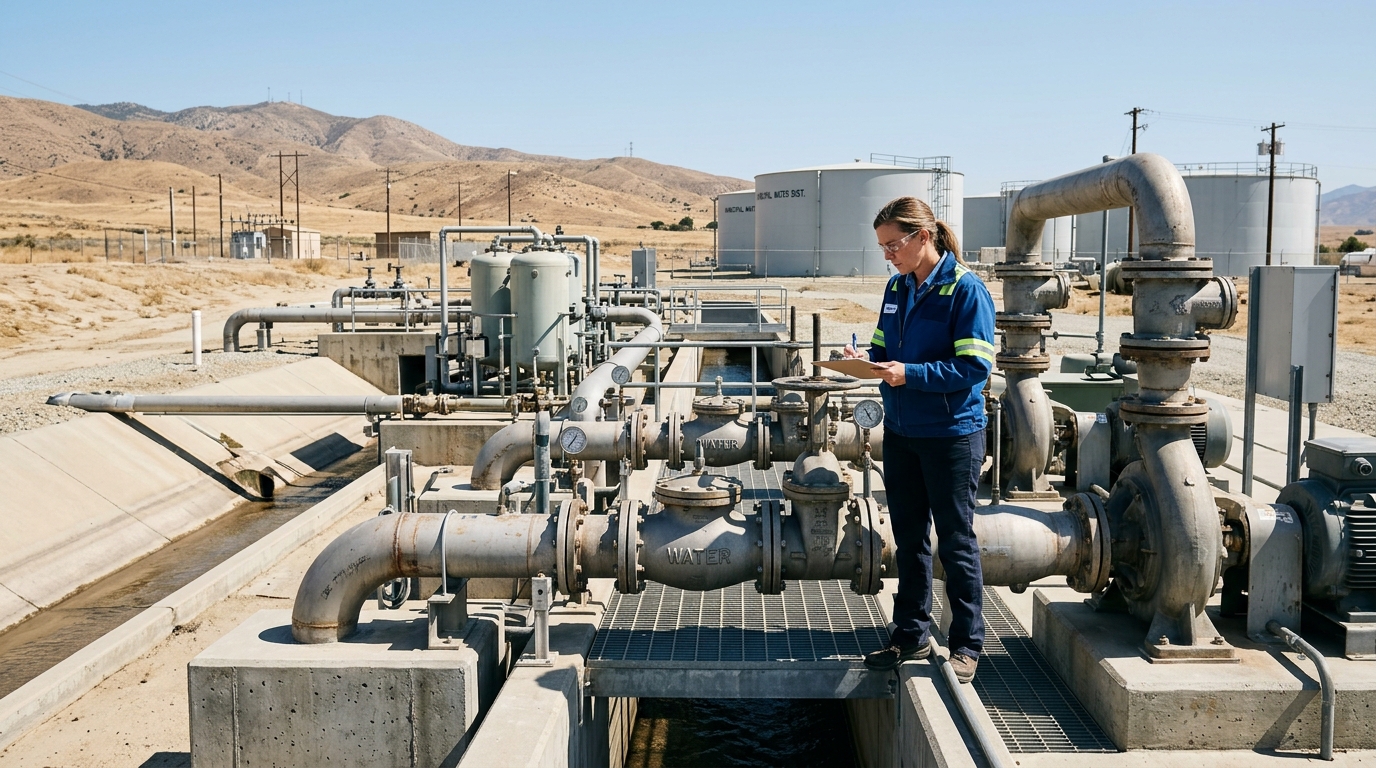
Nobody talks about water. That is the first thing worth noticing.
Right now, as of the latest U.S. Drought Monitor data, 55% of the Lower 48 states are in active drought. Forty-five U.S. states are experiencing moderate drought or worse. Eight western states set new record-low April 1 snowpack levels this year. Lake Okeechobee is still losing more water than it receives. Significant water supply concerns are persisting across southern Georgia and throughout Florida. This is mid-June, and the summer demand peak has not arrived yet.
Meanwhile, in a market locked onto AI chips, GLP-1 drugs, and the next Fed move, the water infrastructure sector is sitting in the background running a completely different playbook. One that most investors have not opened in years.
Three things are converging right now in the water sector, and none of them are cyclical.
The first is infrastructure age. Most of the U.S. water network was built decades ago. The sector is staring at a $1 trillion national funding gap covering pipe replacement, treatment upgrades, and lead-line removal. Federal dollars help at the margins. They do not come close to closing the gap. State utility commissions are approving rate increases with increasing frequency as the political urgency becomes impossible to ignore. The business model here is essentially pre-approved capex monetization: you deploy capital, regulators sign off on cost recovery, revenues grow. That is the whole thing.
The second is PFAS. EPA regulations require more than $10 billion in remediation costs by 2030, targeting so-called forever chemicals in drinking water systems. These costs flow through rate mechanisms, which means future revenue is effectively approved before the capital is even spent. American Water Works has already secured roughly $185 million in net payments from PFAS manufacturers to offset remediation costs for its customers. That is a structural tailwind that barely shows up in the quarterly discussion.
The third one almost nobody is modeling: data centers. The AI infrastructure buildout everyone is tracking for chip demand and power consumption also has a water demand side. Large-scale data centers consume enormous quantities of water for cooling. As hyperscalers keep expanding across the Sun Belt and mid-continent, they are materially increasing local water demand in regions already running dry.
Drought. Structural underfunding. Regulatory mandates. Industrial demand. All four, simultaneously, in June 2026.
This Is What Modern Warfare Looks Like Now
One operator controlling multiple drones… AI identifying targets in seconds… Technology is rapidly changing the battlefield and creating new opportunities in defense.
This exclusive research highlights five companies at the forefront of this shift and explains why they are gaining attention.
Three Names Worth Understanding
American Water Works (AWK) is the largest publicly traded water and wastewater utility in the U.S., serving approximately 14 million people across 14 states. It is also in the middle of a major structural shift. A pending all-stock merger with Essential Utilities, announced October 2025, has already cleared shareholder votes and received its first state regulatory approval in Kentucky. Decisions in Virginia and Illinois are expected before year-end, with closing targeted by end of Q1 2027. The combined company would serve more than 4.7 million water and wastewater connections across 17 states.
Q1 2026 was a miss on the surface. Revenue came in at $1.21 billion against a $1.28 billion consensus, and adjusted EPS of $1.01 fell short of the $1.13 estimate. The stock rose 3% in premarket trading anyway. The reason was simple: management reaffirmed full-year 2026 adjusted EPS guidance of $6.02 to $6.12, representing 8% growth versus 2025, and the board raised the quarterly dividend 8.2% to $0.895 per share, extending over a decade of consecutive dividend growth. Management also flagged roughly $100 million in annual cash flow benefit from recent corporate tax law changes, plus a pending $84 million refund. The Q1 shortfall was already baked in. Most of the expected EPS growth is back-weighted to the second half, when rate decisions in Pennsylvania and New Jersey take effect. Long-term EPS and dividend growth targets remain 7% to 9% annually through 2030, supported by 6% to 8% rate base growth per year.
Not exciting. That is kind of the point.
Xylem (XYL) is the technology and equipment side of this story. Pumps, treatment systems, smart metering, advanced water analytics. Q1 2026 revenue came in at $2.13 billion, up 2.7% year-over-year. Adjusted EPS of $1.12 beat the $1.09 consensus by 3.3%, and management raised full-year revenue guidance to $9.2 to $9.3 billion while holding adjusted EPS guidance at $5.35 to $5.60. The company also landed a record $850 million outsourced water contract in its Water Solutions and Services segment during the quarter. U.S. utility demand showed double-digit order growth. The stock was trading near its 52-week low of $114.48 heading into the report, at a P/E of roughly 31x.
The honest bear case on XYL: organic revenue was flat in Q1. Not up slightly. Flat. Sell-side forward revenue growth estimates are in the 2% to 3% range for the next twelve months. Management is managing through macro uncertainty and trimming low-margin business in China and Western Europe. None of that is invisible. But the longer view is a different conversation. Two-year annual EPS growth of roughly 16%, a $4.7 billion backlog at quarter-end, and a management team that sees enough value in its own stock to guide conservatively while executing at the high end. Worth knowing the difference between near-term noise and the underlying cycle.
Veralto (VLTO) was spun off from Danaher in 2023. It focuses on water analytics and product quality, with the Water Quality segment, which includes Hach and Trojan Technologies, supplying instruments, treatment systems, and ultraviolet disinfection technology globally. Q1 2026 results: total sales of $1.42 billion, up 6.7% year-over-year. Water Quality segment sales up 10.1%. Adjusted EPS of $1.07, up 13% year-over-year, beating the $0.88 consensus by over 21%. Management raised full-year 2026 adjusted EPS guidance to $4.20 to $4.28, up from the prior $4.10 to $4.20 range, and deployed roughly $1 billion in the quarter across two acquisitions and opportunistic share repurchases.
One number worth flagging: core organic sales growth for VLTO was only 1.9% in Q1. The headline revenue growth looks better than the underlying demand momentum. Management expects acceleration through the year. The stock is down roughly 10% year-to-date and off about 8% over the past twelve months, despite the consistent execution and raised guidance. That gap between fundamentals and price action is the part that deserves attention.
The Rate Picture, Honestly
On June 17, 2026, the Fed held rates steady at 3.50% to 3.75% in a unanimous 12-0 vote. Chair Kevin Warsh, presiding over his first FOMC meeting, kept communication deliberately minimal. The statement came in at 130 words, roughly two-thirds shorter than April’s release.
What actually moved markets was the dot plot. The median year-end 2026 rate projection shifted to 3.8%, up sharply from 3.4% in March. Nine of eighteen participants are now backing at least one rate hike before December. The Fed also revised its 2026 PCE inflation forecast to 3.6%, a dramatic jump from 2.7% just three months ago. Seventeen of eighteen participants see inflation risks tilted to the upside. The central bank went from signaling a cut this year to signaling a hike. That is a meaningful shift.
For AWK and regulated utilities, this matters. Higher rates pressure valuations through borrowing costs and relative yield competition. That dynamic has already weighed on the sector for two years. With the June dot plot now leaning hawkish and inflation stickier than expected, this headwind has not cleared. Investors in AWK need to own that risk with open eyes.
XYL and VLTO are a different exposure. More growth-sensitive, less rate-sensitive, more tied to municipal budget cycles than Fed policy. They are not rate proxies the way AWK is. That distinction matters when you are trying to figure out what you are actually buying.
Michael Burry flagged water scarcity as a defining investment theme of this century years ago. He was not wrong about the thesis. Timing is always the variable. What is interesting right now is that the timing argument is getting harder to dismiss.
AWK raised its dividend quietly. VLTO deployed a billion dollars in capital and barely moved. XYL landed an $850 million contract and is still trading near a 52-week low. None of this is getting attention in a market focused on AI hardware and drug approvals. And in mid-2026, with more than half the Lower 48 in active drought, PFAS mandates accelerating capital deployment, data center water demand growing in already-stressed regions, and a $1 trillion infrastructure gap that is not going anywhere, the water sector is quietly building a case that most investors are not positioned for.
That may be exactly why it is worth paying attention.
For informational purposes only.