
May 14, 2026
No TSMC, No AI Boom
One company manufactures the chips powering every major AI system on earth. The Q1 numbers just confirmed it’s not slowing down.
Most people still reach for the word “chipmaker” when they describe Taiwan Semiconductor Manufacturing (NYSE: TSM). It’s not wrong, exactly. It just misses the point by about an order of magnitude.
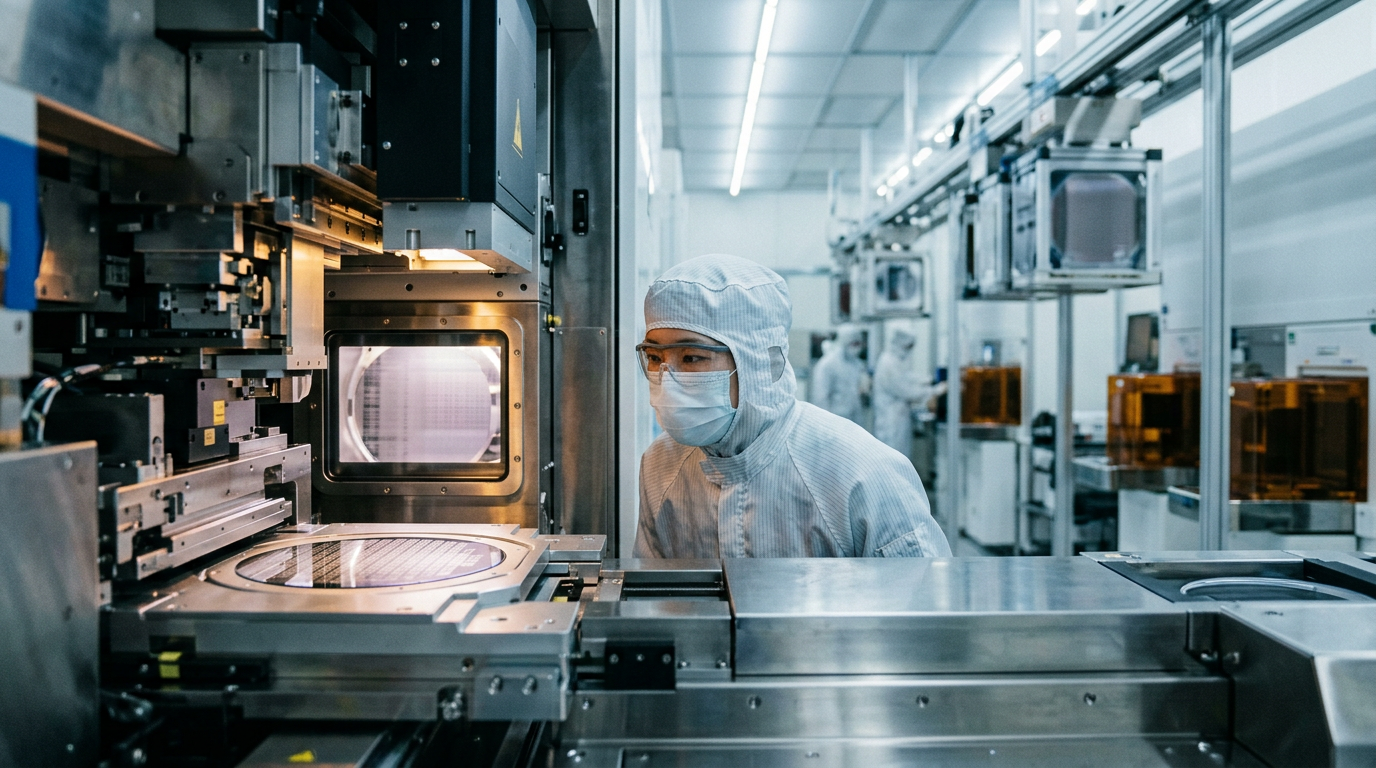
TSMC doesn’t design chips. It builds them — physically, at atomic scale — for Nvidia, Apple, AMD, Broadcom, and essentially every company whose silicon ends up inside the world’s AI systems. The designers get the credit. TSMC gets the orders. In 2026, those two things are increasingly inseparable.
Q1 2026 results landed in April and the numbers were, to put it plainly, difficult to dismiss.
Revenue came in at $35.9 billion — up 40.6% year-over-year, ahead of the $35.5 billion consensus. Net income surged 58.3% to NT$572.48 billion. Gross margin hit a record 66.2%, well above management’s own guided range of 63–65%, with advanced nodes at 7nm and below accounting for 74% of wafer revenue. That’s the eighth consecutive quarter of double-digit earnings growth. The company then guided Q2 revenue at $39.0–$40.2 billion — roughly 10% sequential growth — and raised full-year 2026 guidance to above 30% revenue growth in USD terms, up from the “close to 30%” range it had issued back in January.
Full-year 2026 revenue is now expected to approach $158 billion.
Trump’s Iran Smokescreen
The headlines scream about oil and regime change in the Middle East. But behind the scenes, President Trump is about to unleash something far more shocking in the homeland.
You won’t hear about it on Fox Business or CNBC.
But it’s about to have a seismic impact on the wealth of every American patriot.
It’s the boldest initiative of President Trump’s second term by far – and it’s not even close.
To find out why, and how it could affect your financial future – click here immediately.
Why the Demand Isn’t Letting Up
Here’s the thing about the AI infrastructure cycle — it’s being funded by companies that have essentially bottomless balance sheets and a genuine competitive fear of falling behind. Alphabet, Amazon, Microsoft, and Meta have collectively committed to roughly $725 billion in capital expenditure for 2026, up 77% year-over-year. Each one of them reported Q1 earnings and raised their spending guidance further. A Counterpoint Research analyst told CNBC that AI chip demand has pushed TSMC’s manufacturing capacity to its limits — and that this sold-out environment could define the semiconductor industry throughout 2026.
TSMC’s HPC segment — which is where AI accelerators live — accounted for 61% of total Q1 2026 revenue. Two years ago in Q1 2024, that figure was 46%. That 15-point shift in revenue mix inside 24 months is the structural story. It’s not a rotation into AI. It’s a company that has already rotated — and is now scaling the position.
CEO C.C. Wei spent a meaningful portion of the Q1 earnings call discussing the shift from generative AI to agentic AI — systems that don’t just generate responses but take actions, run multi-step processes, operate autonomously. His point: agentic workloads consume significantly more compute per task than anything that came before. He raised TSMC’s long-term AI accelerator revenue forecast to a compound annual growth rate in the mid-to-high-50% range from 2024 through 2029 — up from a prior estimate of around 45%.
Brief tangent worth sitting with: TSMC is currently building 3-nanometer fabs in Taiwan, Arizona, and Japan at the same time, while simultaneously ramping 2-nanometer capacity that entered high-volume manufacturing in Q4 2025. The 2026 capex plan sits at the high end of a $52–$56 billion range — up from $40.9 billion spent in 2025. That’s a potential 37% increase in capital spending in a single year, for a company already operating at capacity. C.C. Wei himself said on the earnings call that he remains “very nervous” about that commitment, and that he verifies customer demand personally before signing off on it.
The Part Worth Being Honest About
TSM has returned over 103% in the past twelve months. The stock trades at roughly 34x trailing earnings — about 60% above its 10-year historical average of 21x. On a forward basis, the multiple drops to approximately 26x, which actually sits below the semiconductor sector median of around 37x forward — so the valuation isn’t irrational, but it isn’t cheap either.
The concentration risk is real. A meaningful portion of TSMC’s revenue flows from a small number of U.S. hyperscalers. If their AI spending decelerates — due to pressure on returns, a macro shift, or something less predictable — utilization rates and pricing power could compress faster than the current growth trajectory suggests.
And then there’s Taiwan. Geopolitical exposure remains an institutional concern that doesn’t go away, regardless of how many hedge funds hold the stock — and 224 now do, one of the largest quarter-on-quarter increases in institutional ownership among mega-cap technology names heading into 2026.
Giving “2022 pre-ChatGPT” vibes (but 10x bigger)
Do you remember when ChatGPT launched, Nvidia soared 1,800% in 3 years, and 500,000 regular Americans became millionaires?
According to Nvidia’s CEO, July 22nd could trigger an even BIGGER explosion of wealth…
Because Tesla is set to unveil a revolutionary technology that could shock the markets…
And be “10x bigger than the largest product in history” according to Elon Musk.
What Analysts Are Saying Now
Consensus 12-month price targets on TSM currently sit in the $463–$477 range, implying roughly 15–19% upside from levels near $400. The longer-range case rests on the mid-to-high-50s AI accelerator revenue CAGR through 2029, a semiconductor market IDC projects will exceed $1.29 trillion annually by 2026, and TSMC’s 72%+ share of leading-edge foundry capacity — a position that no competitor has credibly threatened at scale.
At some point the spending cycle will moderate. C.C. Wei seems to know that. The $52–$56 billion capex commitment was made carefully, with demand verification built into the process. Whether TSMC lands at the top or bottom of that range may tell you more about 2027 than any analyst model will.
What’s interesting is that most of the debate around AI investment centers on software, models, and platforms — while the company physically enabling all of it keeps compounding in relative quiet.
Full breakdown here — and it’s worth reading before Q2 results drop.
This editorial is for informational purposes only and does not constitute financial advice or a recommendation to buy or sell any security. All investments carry risk. Past performance is not indicative of future results. Always consult a qualified financial advisor before making investment decisions.