
May 4, 2026
Robots Are Shipping. Now What?
The headline names are priced for perfection. Here’s where the value might actually be hiding.
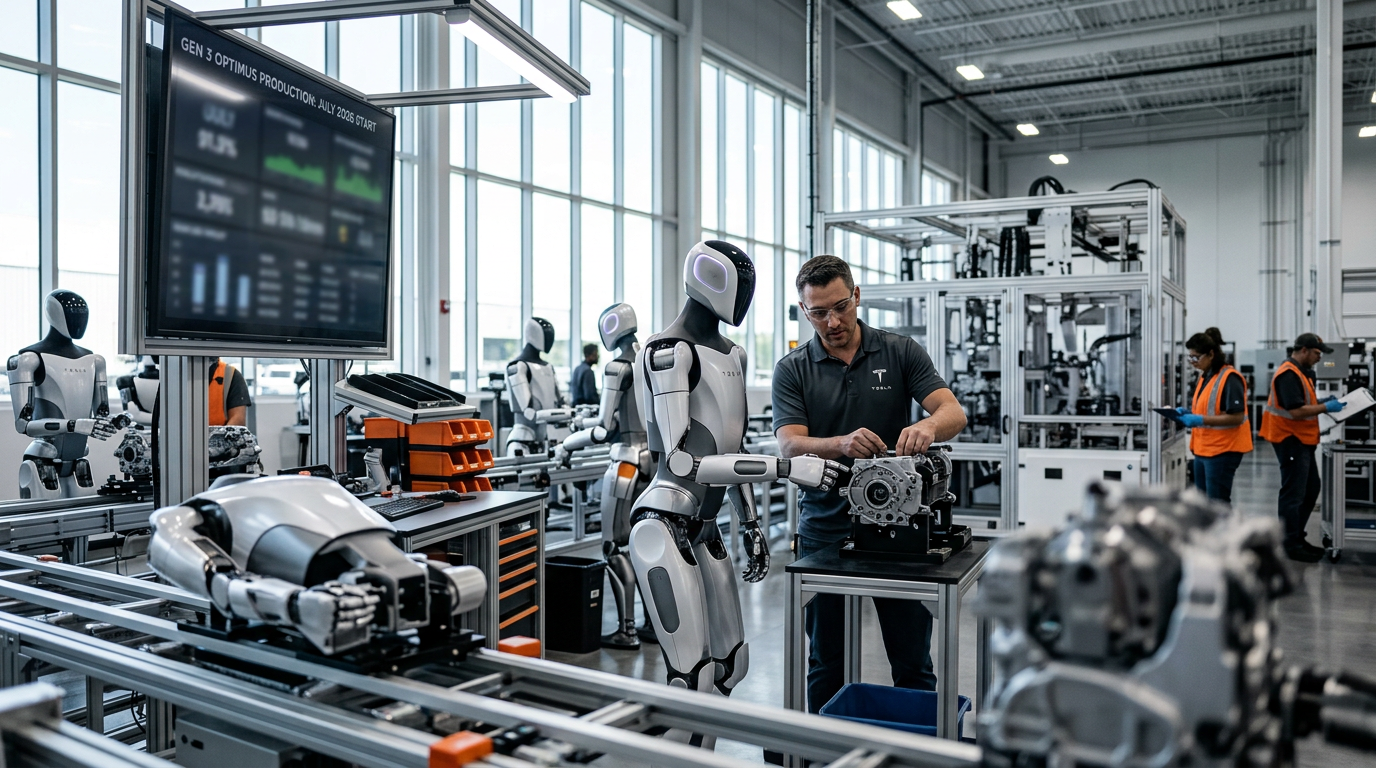
Something crossed a line recently — and I don’t think the market has fully processed it yet.
At CES 2026, Boston Dynamics didn’t show a demo. They showed a product. The production-ready Atlas humanoid — majority-owned by Hyundai — won Best Robot at the show, and units started shipping immediately out of their Massachusetts headquarters. Every 2026 Atlas is already spoken for: Hyundai’s Robotics Metaplant Application Center and Google DeepMind have locked up the entire first run. New customers get in line starting 2027. Hyundai’s full factory deployment — 30,000 robots per year — is targeted for 2028, starting with parts sequencing and material handling.
That’s not a roadmap slide. That’s a shipping schedule.
Meanwhile, Tesla is physically tearing down its Model S and Model X lines at Fremont — ending 14 years of passenger vehicle production — to make room for Optimus V3 manufacturing. On the Q1 2026 earnings call, Musk confirmed production starts in late July or August. He also declined to give volume targets, calling initial output “quite slow” and any rate prediction “literally impossible.” Worth noting: in January 2025 he said Tesla would build 10,000 Optimus units that year. By January 2026, he admitted not one was doing useful work in a Tesla factory. The ramp that matters is probably 2027, when Giga Texas spins up a second dedicated Optimus facility — eventually targeting 10 million units annually. But the floor is being cleared right now, and that part is real.
TrendForce projects global humanoid shipments exceed 50,000 units in 2026. That’s a 700% jump over the year prior — not a range, an order of magnitude. China is moving fast too: Unitree and AgiBot alone could account for nearly 80% of Chinese shipments, with Chinese suppliers already making up an estimated 60–70% of Optimus’s core component value. That price competition will hit margins across the board eventually. It’s coming.
Slight tangent, but it matters: Nvidia’s entire CES keynote from Jensen Huang was about physical AI. Not data centers, not inference chips — robots. The Isaac GR00T model is now on version N1.7 with commercial licensing added for production deployments, and Nvidia’s Physical AI Dataset has been pulled 4.8 million times on Hugging Face. Every serious robot in production today — Atlas, Optimus, Agility’s Digit — trained in Nvidia’s Isaac Sim before taking a single real step. That detail doesn’t get enough attention.
2026: The Year of the Robot
A revolutionary new robot is beginning to emerge.
Elon Musk says it will “change civilization as we know it.”
Microsoft’s Bill Gates said, “it will be as revolutionary as the PC.”
Nvidia’s Jensen Huang says it could be “the largest technology industry the world has ever seen.”
Creating a $24 trillion opportunity for investors.
And one $7 stock could be the biggest winner of all.
One layer back from the obvious trade
Tesla is at 180–193x forward earnings depending on the source. Trailing P/E is north of 300x. That’s not a valuation for a company navigating a genuinely uncertain production ramp — it’s a valuation for a company that executes the entire vision without a single timeline slip. Given the Optimus track record, that’s a lot of faith to price in.
What’s interesting is how much less crowded the component layer looks by comparison. A few names worth understanding:
- Nvidia (NVDA) – Platform-agnostic by design. Sells chips, simulation tools, and training infrastructure to Tesla, Boston Dynamics, Agility, Franka, LG, and dozens more. Doesn’t need a winner — it supplies everyone. GR00T N1.7’s new commercial licensing just opened the production deployment market.
- Qualcomm (QCOM) – Dragonwing chips built for 5G connectivity plus on-device AI inference. The fleet communication layer that almost nobody talks about in robotics coverage.
- Ambarella (AMBA) – Low-power edge AI for machine vision. A robot catching something mid-motion can’t afford a cloud round-trip. That latency gap is Ambarella’s entire pitch.
- MP Materials (MP) – Rare earth magnets live inside every electric actuator in every humanoid. Supply is genuinely constrained. MP runs the only operational rare earth mine of scale in the Western hemisphere — and that’s not changing quickly.
- Roundhill Humanoid Robotics ETF (HUMN) – Holds Tesla, Nvidia, Harmonic Drive Systems, and the broader supply chain in one ticker. A reasonable diversified entry if you don’t want to pick a single winner.
On Harmonic Drive Systems specifically: each high-spec two-armed humanoid uses up to 44 harmonic drives — the precision gear systems controlling joint movement. There’s no real substitute at this quality level. Japan owns this component moat, and TrendForce’s reporting from iREX 2025 shows Harmonic Drive is already retooling reducer designs for humanoid joints specifically — flat, high-torque builds for necks and arms, ultra-compact for fingers. The moat isn’t theoretical. It’s being reinforced right now.
Public Law 63-43: Trump’s Secret Weapon to Win the Midterms?
Most pundits are predicting the coming midterm elections will be a disaster for Republicans.
But the 112-year-old little-known law you see below could save Trump from this disaster.
Because Public Law 63-43 could also have a huge impact on your wealth in 2026 – starting on May 15th.
What could go wrong
The risks aren’t subtle. Optimus needs 10,000+ unique components from a supply chain that barely exists at scale — Tesla is building it vertically from near scratch. Labor-displacement pressure is already showing up in Washington. And Chinese competitors with government backing and structurally lower costs are coming for the same market. That price pressure will be real, and it’ll arrive faster than most Western projections account for.
There’s also just the basic Musk problem. The man sets timelines that consistently slip. Optimus is behind where he said it would be. That pattern is documented, not speculative.
Here’s where I’m at though: the structural case in 2026 is different from 2024. Back then, humanoid robotics was roadmaps and keynote demos. Now Atlas is physically shipping. Fremont is being reconfigured. Tesla’s June shareholder meeting — likely including a full Optimus V3 reveal — is the next real data point. That event will either validate the timeline or expose another slip, and the stock will move accordingly.
The question isn’t whether this is happening anymore. It is. The question is whether the front-page names have already priced in the upside — and whether the value for a patient investor is one layer down, in the components and infrastructure that every robot needs regardless of who wins the race. That’s the part that still looks uncrowded. Worth a closer look.
Futurist Eric Fry says it will be a “Season of Surge” for these three stocks
One company to replace Amazon… another to rival Tesla… and a third to upset Nvidia. These little-known stocks are poised to overtake the three reigning tech darlings in a move that could completely reorder the top dogs of the stock market. Eric Fry gives away names, tickers and full analysis in this first-ever free broadcast.