
October 1, 2026
Bonus Content: OpenAI Shelved Its IPO. The $1.4 Trillion Price Tag Is Now Wall Street’s Problem.
A Gold-Silver Story Built to Finance Itself.
The weirdest part of this story is not gold. It is not silver either.
It is the fact that the market may still be looking at this like a normal junior explorer.
Normal junior explorers usually ask investors to wait. Wait for drilling. Wait for permits. Wait for financing. Wait for the long, expensive march toward possible production.
This one has a much more intriguing setup.
The company is working with above-ground material from a historic gold-silver property, with 2026 production timing and potential cash flow starting to come into view.
However, once a junior name starts moving toward cash flow, it no longer fits neatly in the “just another exploration stock” old chapter..
And this new chapter revolves around surface metals, production timing, and a self-funding exploration story in a gold and silver market that is already moving.
That is a much different conversation.
See why this under $1 gold-silver story may writing its new chapter >
OpenAI Shelved Its IPO. The $1.4 Trillion Price Tag Is Now Wall Street’s Problem.
Two companies. Two answers to the same question: how do you price an AI lab that is losing money at scale while growing revenue at 70% per quarter?
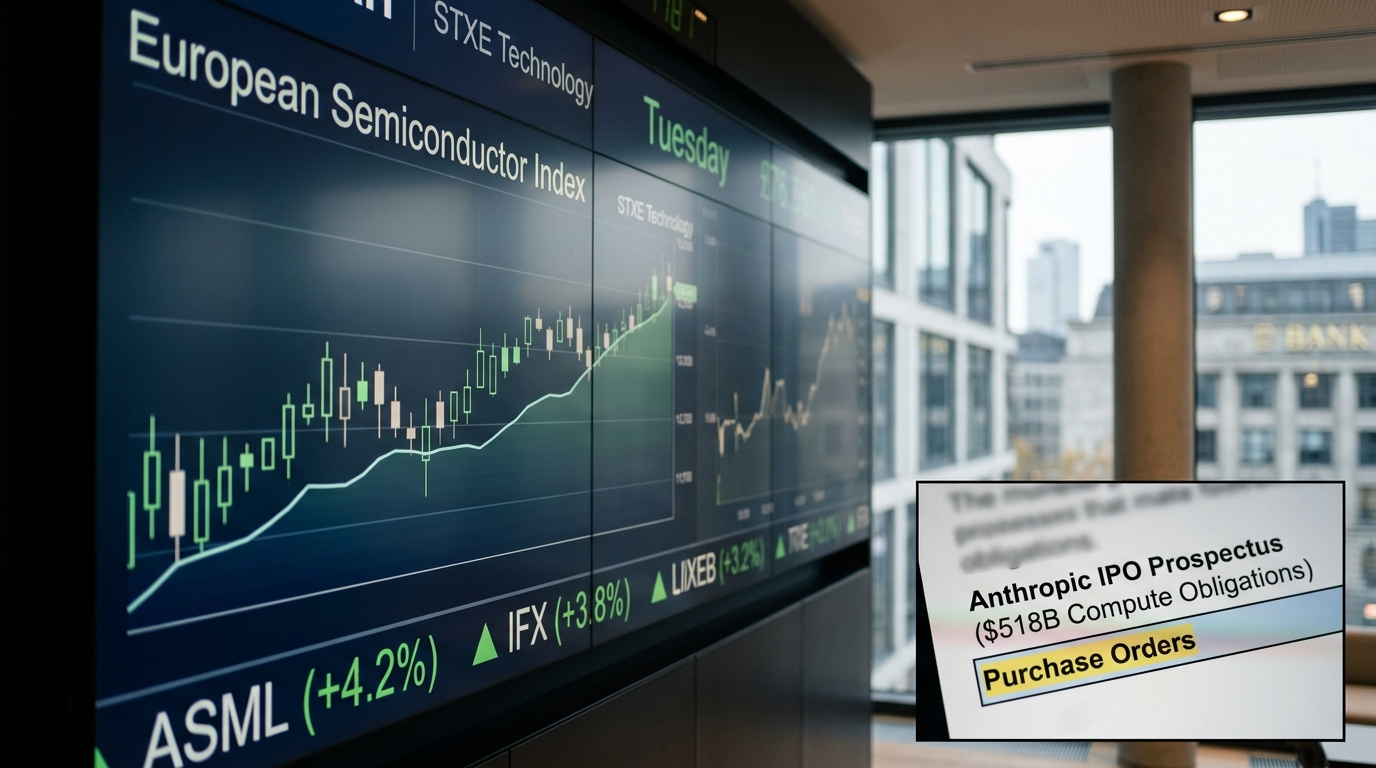
OpenAI is in talks with investors to raise at least $30 billion in a pre-IPO funding round at a valuation of roughly $1.4 trillion, Bloomberg reported Tuesday. The proposed valuation excludes the new capital being raised and would represent a significant increase from the ChatGPT maker’s previous valuation. OpenAI previously raised $122 billion on March 31, 2026 at a post-money valuation of $852 billion. Anthropic, meanwhile, is doing the opposite: on June 1, 2026, Anthropic said it filed a confidential draft S-1 with the SEC and has been reported as targeting a November 2026 IPO at around a $2 trillion valuation.
The divergence is the cleanest signal the market has produced this cycle. One company is betting that private money is cheaper and more patient than public scrutiny. The other is betting that public markets will reward the competitor who shows up first.
Why Institutions Are Paying Attention
CEO Sam Altman has said OpenAI has ruled out a public debut in 2026, citing AI safety concerns. That framing is convenient. The harder truth is structural: OpenAI needs fresh money to expand its data centers, and the Financial Times reported, citing a company presentation, that the company expects cumulative negative free cash flow of $278 billion from 2026 through the end of 2030. An IPO would have put those numbers on a public filing and invited short sellers. A private round at a $1.4 trillion mark does not.
The company’s annualized revenue run rate is approaching $70 billion, a rise of more than 70% since the beginning of the third quarter, Axios reported. That is a real number. But a company growing at that pace while projecting $278 billion in negative cash flow over five years is, in effect, asking investors to finance a war on credit. The question is not whether demand is real. The question is who absorbs the risk when the capital gets harder to find.
SoftBank Is the Load-Bearing Wall
The most concentrated risk sits at SoftBank. SoftBank has said that upon completion of its $30.0 billion follow-on investment, its cumulative investment in OpenAI is expected to represent an ownership interest of approximately 13%, and S&P Global Ratings has estimated that OpenAI could account for roughly 20% to 30% of SoftBank’s investment assets upon completion of that additional investment. Reuters reported that SoftBank launched about $11 billion of bonds to fund the $10 billion third tranche payment, and Fitch assigned the proposed notes a BB+ rating, in speculative territory. That is junk-rated paper financing a 13% stake in a company with no public market exit and $278 billion of projected cash burn ahead of it. If OpenAI’s valuation drops, the hit lands directly on SoftBank’s balance sheet rather than staying confined to unrealized paper losses.
What Investors Are Missing: The Oracle and CoreWeave Problem
Most of the discussion around OpenAI’s delayed IPO focuses on what it means for tech listings broadly. The more consequential second-order question is what it means for the infrastructure providers that have bet their backlogs on OpenAI’s ability to keep spending.
Oracle ended fiscal 2026 with remaining performance obligations of $638 billion, and Oracle said it expects to recognize approximately 12% of that as revenue over the next 12 months. With OpenAI at the center of many of those commitments, any slowdown in its spending or funding could quickly ripple through Oracle, CoreWeave, and their suppliers. CoreWeave’s exposure is direct: CoreWeave said its total contract value with OpenAI stands at approximately $22.4 billion across multiple agreements.
Neither Oracle nor CoreWeave is priced for a scenario where OpenAI’s private funding stalls. That is the bet both stocks are currently making, implicitly, every day the market stays open.
Stocks to Watch
OpenAI (private) / Microsoft (MSFT): The most direct proxy for retail investors remains Microsoft, OpenAI’s largest strategic partner. If the $1.4 trillion round closes on schedule, it validates the AI spending outlook embedded in Azure’s growth guidance.
Oracle (ORCL): Oracle reported remaining performance obligations of $523 billion as of its fiscal 2026 second quarter and $638 billion as of fiscal year-end 2026. A prolonged reliance on private capital instead of IPO proceeds shifts the risk of delayed drawdowns squarely onto Oracle’s revenue recognition timeline.
CoreWeave (CRWV): CoreWeave has reported a $66.8 billion revenue backlog. Concentration remains the structural risk. OpenAI is still its anchor customer, and anchor customers that fund themselves through junk-rated bond sales are worth monitoring.
Anthropic (pre-IPO): Anthropic’s annualized revenue run rate reportedly surpassed $65 billion by the end of July 2026. If the Nasdaq listing prices near $2 trillion this fall, it sets a public-market benchmark that will either validate or expose OpenAI’s $1.4 trillion private mark. That verdict may arrive before the year is out.