September 8, 2026
Bonus Content: UBS Flipped to Two Fed Hikes. Its Equity Call Deserves Scrutiny.
Chasing America’s Metals Gap
Washington is spending billions rebuilding America’s weapons stockpiles.
But the rebuild still needs to secure FRIENDLIER sources of one of the critical metals behind them.
This little-known metal makes ammunition harder, strengthens military alloys and plays important roles in missiles, drones, infrared sensors and night-vision technology.
That metal is antimony.
Defense-industry estimates suggest antimony components are found in roughly 72% of ALL U.S. military equipment.
Yet America produces virtually no newly mined antimony today. Meaning, the race is on to bring that critical supply closer to home. Luckily, one overlooked company is already moving.
They have quietly built a position around a historic antimony mine in North America – an area with a remarkable history of producing high-grade material.
Now it is bringing modern technology to determine how much past efforts may have missed. This emerging company may play an early role in bringing critical supply closer to home.
Most investors have never heard of it – and that might be exactly why it is worth discovering now.
Meet the company moving early in America’s critical minerals race >>
UBS Flipped to Two Fed Hikes. Its Equity Call Deserves Scrutiny.
The debate dominating institutional strategy desks this week is not whether the Federal Reserve hikes on September 15. It is whether UBS’s full playbook, flip to two hikes and stay overweight equities simultaneously, holds together under pressure.
Why Wall Street Cares
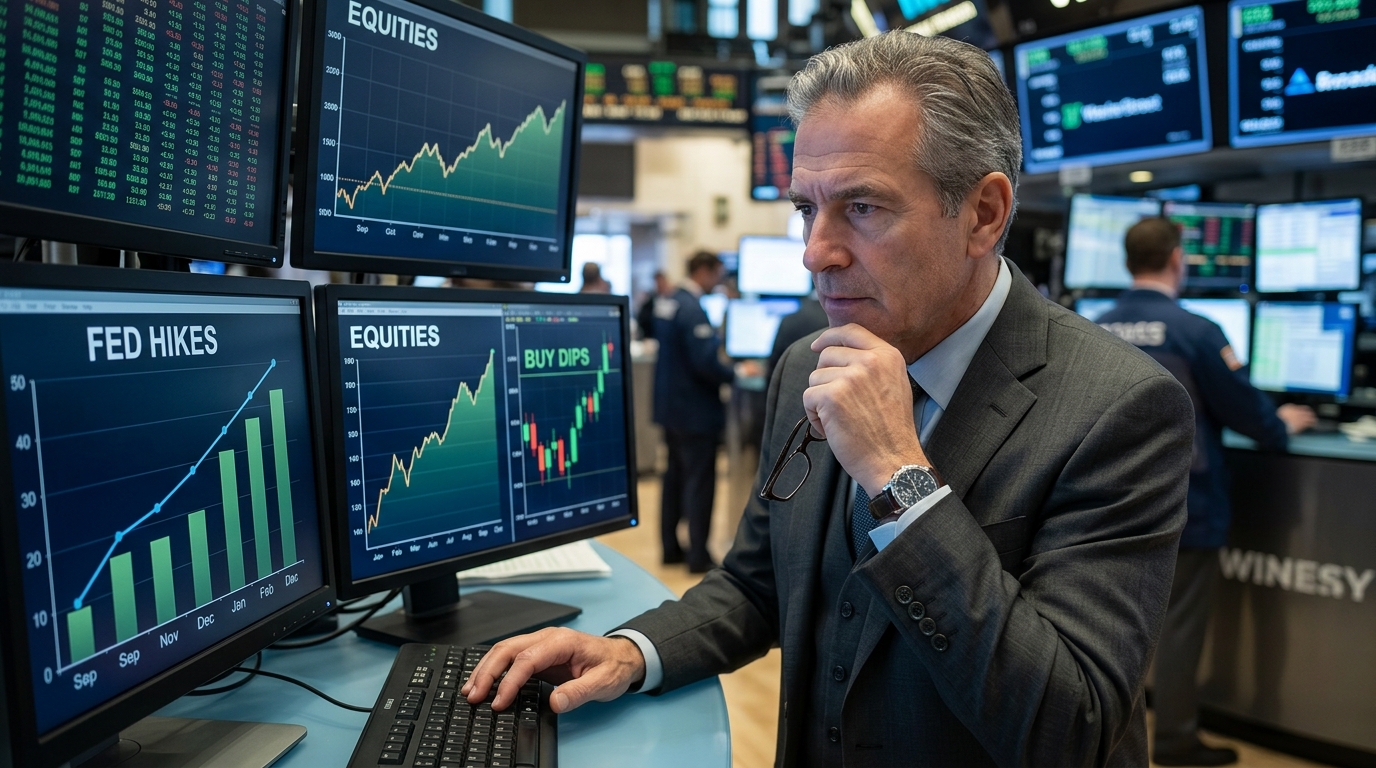
UBS has reversed its previous expectation that the Federal Reserve would leave interest rates unchanged for the remainder of 2026, now forecasting two 25-basis-point hikes in September and December. That alone would be routine. The part that demands scrutiny is what UBS is telling clients to do about it. Strategists led by Mark Haefele recommended “buying potential dips in equities (provided earnings prospects remain strong), taking advantage of elevated medium-to-long duration quality bond yields, reducing excess dollar holdings on strength, or using dips in gold to build a longer-term portfolio hedge.” A house that just upgraded its rate path by 50 basis points is simultaneously telling clients not to de-risk. That tension is the real investment question this week.
The Bull Case
UBS is drawing a sharp line between a Fed hiking because the economy is strong and a Fed hiking because inflation is getting away from it, and it is the former reading that keeps the bank’s equity outlook intact. The economic growth effects of two rate hikes should be fairly modest, and UBS still expects growth to stay near trend, as tailwinds from AI capital spending should continue. On bonds, UBS no longer recommends that investors lock in yields in short- to medium-duration bonds as an alternative to cash. Instead, opportunities are opening up in the medium-to-longer part of the yield curve, where recent moves higher in yields offer income and diversification benefits.
The Bear Case
UBS acknowledges that the investment implications depend on the reason behind any Fed tightening. A rate hike driven by stronger economic growth would have different consequences from one prompted by persistent inflation and weaker growth. That caveat is doing a lot of work. Inflation remains materially above the central bank’s 2% target, with headline CPI running 3.4% year-on-year in July, only slightly lower than June’s 3.5%. The July PCE price index increased 3.7% from a year earlier, while core PCE inflation stood at 3.3%. Those are not numbers that give a Fed chair room to declare victory.
The Evidence
Nonfarm payrolls jumped by 162,000 in August, well ahead of the consensus for roughly 50,000 to 60,000, while the unemployment rate held steady at 4.1%. Revisions added 55,000 combined for June and July, erasing much of the prior softness in the summer run-rate. Add Warsh’s Jackson Hole tone, and UBS had enough to move. Federal Reserve Chairman Kevin Warsh used his Jackson Hole speech to deliver a more hawkish reading of inflation, recommitting to the Fed’s 2% PCE target and saying elevated prices should be the central bank’s main focus. “And while this summer’s PCE and CPI readings were better than expected, they do not tell me that underlying trends have meaningfully improved,” Warsh said. The Fed is in blackout. Market-implied odds of a September hike have risen back above 60% as the blackout period before next week’s meeting began.
The Mavens’ View
The honest read of the UBS note is that it is a conditional call dressed as a conviction call. Monthly core inflation prints closer to 0.3% in the second half of 2026, with a growing share of items rising over 3%, would support a three-hike path. But if inflation readings through October average below 2% annualized, it is possible the second hike is postponed. That is not a forecast. That is a range of outcomes with a preferred scenario attached. Federal Reserve Bank of Cleveland President Beth Hammack, one of three FOMC members who dissented in favor of a July hike, said in late July that “now is the time” for the FOMC to act. The committee is not unified, and Warsh’s deliberate ambiguity gives him cover to move either direction depending on Thursday’s PPI and Friday’s CPI.
What Investors Are Missing
The overlooked risk in UBS’s playbook is what happens if Friday’s CPI resolves the call, but in the wrong direction. Fed Governor Chris Waller said last week that the coming CPI report will largely determine whether he supports a September hike. Core CPI is expected to rise 0.2% month-on-month, with the year-over-year rate around 2.5%. A soft number there collapses the September probability and likely forces UBS to walk back its two-hike forecast within days of publishing it. Clients who repositioned into long-duration TLT or added GLD hedges on the back of the call would be sitting on whipsaw risk. Buying dips is sound advice in a hiking-into-strength environment. It is considerably harder to defend if the hiking rationale evaporates before the first move lands.
Stocks to Watch
- SPY: The broad equity index is where UBS’s buy-the-dip logic gets tested first. The S&P 500 fell 0.4% on the day of the payroll release, suggesting the market is not pricing a hard landing. That is consistent with UBS’s view, but leaves little cushion if CPI surprises hot.
- TLT: UBS has argued that opportunities are opening up in medium-to-long duration quality bond yields, after backing away from treating short- to medium-duration bonds as the clean alternative to cash. The thesis works only if the Fed hikes and then stops.
- GLD: UBS frames gold as a portfolio hedge rather than a directional trade, and hawkish signals from Warsh, including his Jackson Hole remarks on restoring confidence in the 2% inflation target, have already lifted broader rate-hike probability to above 60%, giving gold a macro tailwind regardless of this week’s CPI outcome.
- DXY: UBS’s explicit instruction to reduce excess dollar exposure on strength is the most quietly aggressive piece of the playbook. A dollar that weakens after two hikes would confirm the bank’s view that the tightening is growth-driven, not crisis-driven. A dollar that rallies would challenge it.