
Here is the contradiction sitting at the center of Tuesday’s AMD report: the company that sold off hardest among AI chipmakers on Friday is also the one whose revenue is least exposed to the problem that triggered the selling.
AMD stock fell 11.78% to $499.67 during Friday’s regular trading session, extending losses after Intel’s weaker-than-expected fourth-quarter guidance raised concerns about the semiconductor industry’s exposure to a prolonged PC slowdown. MarketWatch noted that PCs account for more than half of Intel’s revenue exposure, compared with less than a quarter for AMD. The market, at least on Friday, did not make that distinction.
Intel’s Warning, AMD’s Problem
At the center of Intel’s warning is a global shortage of memory chips that has driven up PC prices and squeezed corporate technology budgets. Intel now expects 2026 PC unit demand to decline about 12% and 2027 to decline about 10%, with weakness lasting at least through the first half of 2027. Intel shares plunged nearly 30% on Friday after a weak fourth-quarter forecast and a grim warning about the personal computer market.
The implications extend to AMD’s business because both companies sell processors for PCs and data center servers. Intel also expects weakness in the PC market to persist into the first half of 2027, raising questions about demand conditions across the industry. Those questions are real, but they hit AMD’s smaller segment. AMD’s data center revenue more than doubled to $6.7 billion in the second quarter, while client revenue rose 23% to $3.1 billion.
What Tuesday Actually Needs to Answer
AMD is set to report another record quarter, with Wall Street expecting roughly $13 billion in Q3 2026 revenue and gross margin around the mid-50% range. That bar was set before Friday’s selloff carved roughly $90 billion off AMD’s market value. Investors now need two things from Tuesday’s call, not one.
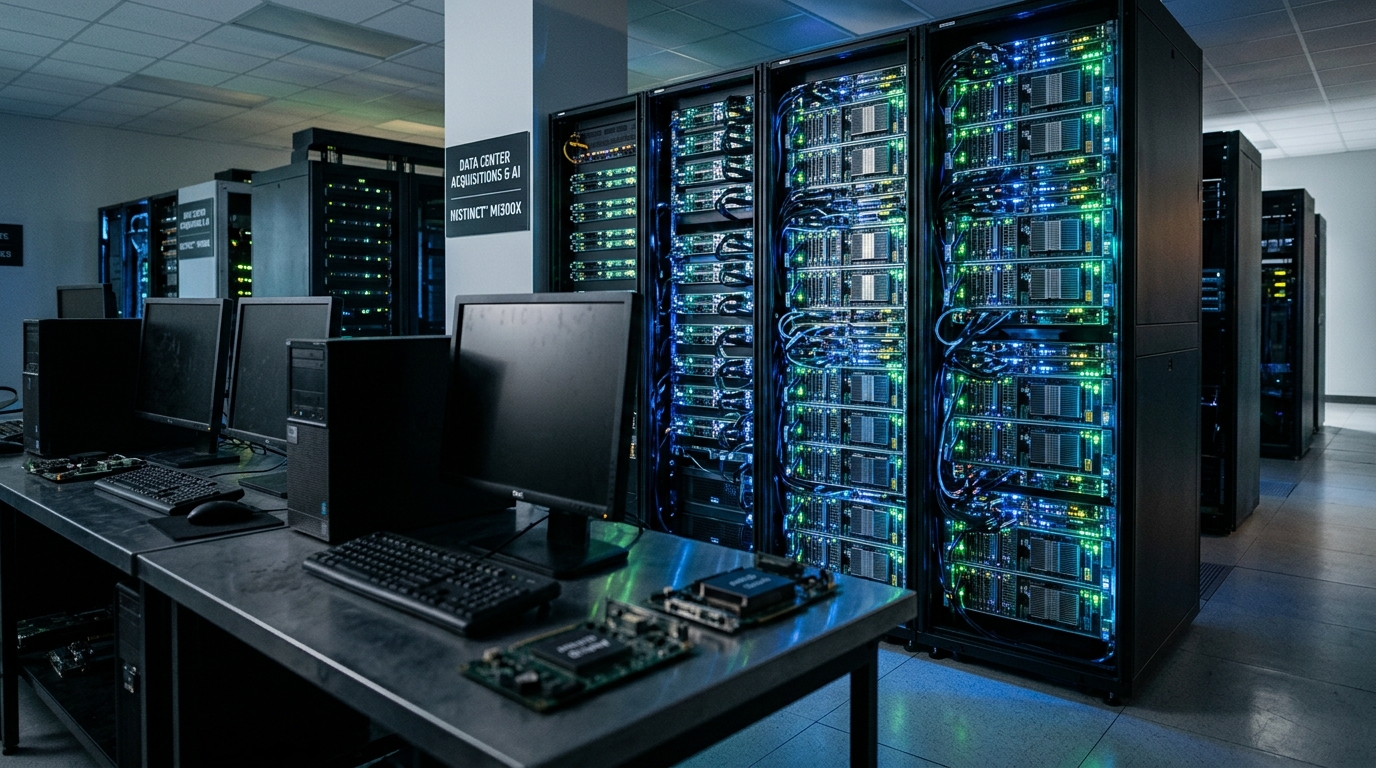
First, the Instinct line. The Instinct GPU business deserves particular scrutiny. It represents AMD’s most direct bet on AI accelerators, a market where buyers have plenty of incentive to diversify suppliers. AMD’s Instinct AI accelerators are gaining traction among cloud computing companies seeking alternatives to Nvidia’s chips. The company has introduced its MI400-series accelerators, including the MI455X, designed to handle increasingly demanding AI training and inference workloads. Whether accelerator revenue accelerated in Q3 or stalled is the single most important number in the report.
Second, the client segment. The PC slump still costs AMD something. It guided third-quarter revenue to approximately $13.0 billion, plus or minus $300 million, and a memory-driven PC slowdown into 2027 would still weigh on the part of the business tied to PCs. A figure near Q2’s $3.1 billion would tell investors that Friday’s read-through overstated the damage. A miss there validates it.
The Bull and Bear Cases
The bull case rests on a separation that Intel’s own report actually supports. Lost in the selloff, Intel’s Data Center and AI revenue grew 78% to $7.3 billion, which CFO David Zinsner called Intel’s strongest data center revenue growth in 15 years. If enterprise demand for compute is accelerating at Intel’s data center division, AMD’s EPYC and Instinct lines should be feeling the same tailwind. Despite the share-price decline, two investment firms retained positive views. Jefferies kept its $650 target and Buy recommendation, while Susquehanna lifted its target from $620 to $650 and maintained a Positive rating. Both firms pointed to AMD’s growth prospects in data center computing.
The bear case is simpler: a memory-driven PC slowdown into 2027 would still weigh on the part of AMD tied to PCs, and if Instinct GPU shipments disappoint even modestly, a stock that was up about 164% in 2026 before Friday has plenty of room to reprice further. Guidance for Q4 will matter as much as Q3 results.
What to Watch Tuesday
Three numbers will settle the debate. Data center segment revenue versus the $7-plus billion implied by consensus. Instinct GPU revenue specifically, to measure the AI acceleration claim. And Q4 guidance, which will tell investors whether CEO Lisa Su sees the same PC weakness Intel does, or whether AMD’s mix insulates it enough to hold the growth line.
AMD stock was up about 164% in 2026 through late October, outpacing both the S&P 500 and Nasdaq Composite. Tuesday is the moment the company has to justify that run on its own numbers, not Intel’s.