
Editor’s Note: Rob Spivey spent 25 years in the upper echelons of finance. His analysis is followed by BlackRock, JP Morgan, Goldman Sachs, and over 300 money management firms from coast to coast. He spotted Meta’s potential in 2013…Moderna, before it shot up 2,200%…and even AMD before it exploded 4,200%. But according to Rob, his latest discovery could make every single prior call pale in comparison.
Dear Reader,
If you are waiting for Tesla or SpaceX to save your retirement…
Wall Street insider Rob Spivey says you’re late.

Look, he called Tesla profitable in 2018 while the press was writing obituaries.
But THIS TIME, he’s NOT telling you to buy Tesla…
Not SpaceX…
Or any “AI darling” tied to Elon.
Instead, he’s focused on the layer BENEATH Musk’s empire.
He calls it Elon’s “Shadow Trust”.
It’s not a family office…
Not a government slush fund…
But a special group of stocks helping solve the AI bottleneck facing Elon’s (and America’s) growing empire.
And unlike the flashy names EVERYONE’S talking about…
This “shadow trust” does something special…
Long-term, our backtest shows it pays you.
In fact, it would’ve generated an average of $12,000 a month over the past two decades.
Just imagine…
Every time a Tesla rolls off the assembly line…
Every time a Starlink goes up…
Every time another gigawatt of compute gets eaten…
YOU’RE in position to see results.
In the last 12 months alone, it has paid out $4 billion.
And more than $1 billion since the SpaceX IPO.
The next payout window?
Which means we have a lot of urgency here.
The White House has already thrown its full weight behind this initiative…
And Rob Spivey reveals how YOU could tap into Elon’s “Shadow Trust” today.
It’s easy.
It takes as little as 3 simple steps.
Click here to see the full story in his latest presentation.
Best,
Dan Ferris
Chief Analyst, Stansberry Research
Caterpillar’s Mining Robots Already Work. The Business Model Is the Real Bet.
Caterpillar reports Q3 2026 earnings on Thursday, October 29. Analysts are expecting about $7.03 to $7.04 in earnings per share on roughly $20.7 billion in revenue. Those are reasonable numbers to track. They are not the number that matters most for anyone trying to understand what this company is actually becoming.
The real question is how much of Caterpillar’s autonomy push is converting from capital expenditure into recurring software and services revenue, and whether that conversion rate justifies the multiple the stock currently carries.
What the Fleet Has Already Proven
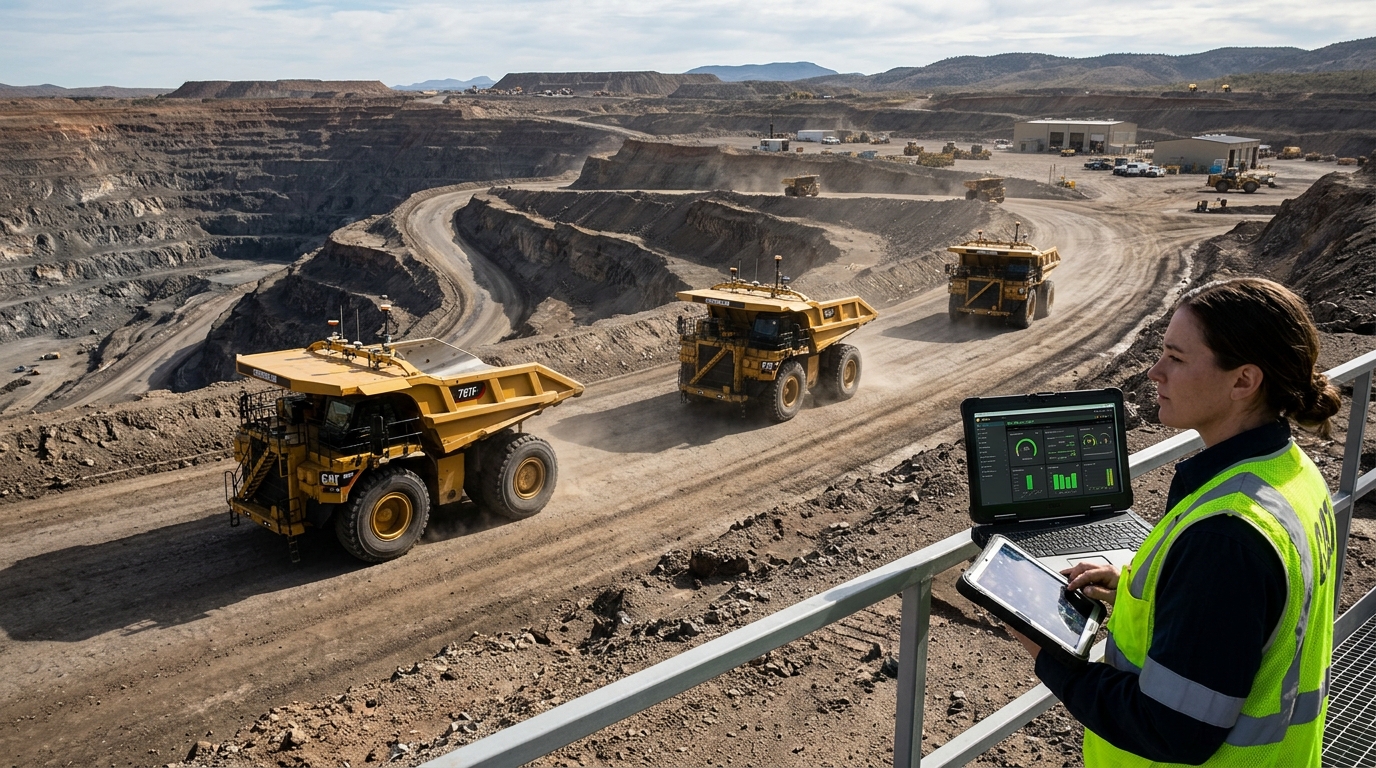
Speaking at CES 2026, Caterpillar CTO Jaime Mineart said the autonomous mining fleet has moved over 11 billion tonnes of material and traveled more than 385 million kilometers autonomously, which Caterpillar and CES coverage have characterized as more than twice the autonomous mileage of the automotive industry, without a single reported injury. That is not a pilot program. Caterpillar says nearly 700 autonomous mining trucks are in operation around the world, and group president Bob De Lange has said the company’s next target is to triple the size of its autonomous fleet.
Caterpillar is integrating the NVIDIA Jetson Thor platform into its next generation of autonomous machines to enable real-time processing capabilities essential for autonomous operations in extraction environments. These hardware upgrades could provide the foundation for self-operating mining fleets that process sensor data locally, functioning as a digital nervous system across mine sites. The Cat MineStar Command system ties it together: the company today offers autonomous drilling, autonomous underground loaders, autonomous dozers and remote-controlled equipment, all coordinated through a software command center with fleet management and what the company calls remote terrain intelligence.
Why Underground Changes the Calculus
Underground mines are growing faster at a 10.59% CAGR because automation solves acute safety problems linked to ground-falls and poor ventilation. Surface autonomy is largely solved. Underground is where the engineering difficulty lives, and where the competitive moat deepens. Autonomous underground loaders let mines recover deeper orebodies without exposing crews to heat, ground-fall, or diesel-particulate hazards, aligning with regulators’ zero-harm mandates.
When paired with Helios, Caterpillar’s platform that integrates and manages more than 16 petabytes of data generated by millions of machines, dealers, and customers worldwide, Nvidia’s edge AI technology is enabling real-time decision-making without compromising safety or reliability. That data flywheel is what competitors cannot replicate quickly. Komatsu, Epiroc, and Sandvik all have autonomy programs. None of them have 30 years of operational data from machines running across iron ore, copper, gold, coal, and lithium sites on three continents.
The Bear Case Is in the Services Line
Here is what the bulls are missing. Caterpillar’s backlog grew to a record $51 billion in 2025, an increase of 71% compared to 2024, and full-year services revenues totaled $24 billion. Impressive. But services revenue is still heavily weighted toward aftermarket parts, not software subscriptions. The autonomy stack commands premium economics only if MineStar Command and Helios migrate to per-fleet licensing rather than bundled hardware sales.
The valuation question is not new to this earnings cycle. CAT’s trailing and forward multiples have run well above their long-term averages, a gap that services-revenue growth must justify.
Training programs, operational integration processes, and data platform dependencies create barriers to equipment vendor changes that fundamentally alter competitive positioning within the heavy machinery sector, as one industry analysis noted. That stickiness is real. Whether Caterpillar charges for it appropriately is a separate question.
Stocks to Watch
Caterpillar (CAT) is the obvious center of gravity. The company is supported by a record roughly $72 billion backlog and a raised 2026 sales-growth outlook. Thursday’s Q3 report is an opportunity to ask how much autonomy is contributing to services margin rather than simply pulling forward equipment sales.
Nvidia (NVDA) benefits as Caterpillar’s edge compute partner. The NVIDIA Jetson Thor platform enables real-time AI inference on Cat construction, mining and power equipment, laying the foundation for next-generation autonomy and intelligent in-cab experiences. Every autonomous Cat machine deployed is Nvidia hardware in a harsh environment with no upgrade cycle pressure.
Epiroc (EPI.ST) is the most direct competitor in underground automation and the clearest read on whether Caterpillar’s underground push is gaining ground or ceding it. If Epiroc’s Open Autonomy platform wins mixed-fleet contracts at large copper and lithium operations, Cat’s data moat narrows faster than the backlog suggests.