
Starting Wednesday morning in Wellington and ending Friday at noon in Tokyo, five G10 central banks will announce policy decisions inside 60 hours. The sequencing is almost theatrical: the RBNZ opens, the Bank of Canada and the Federal Reserve follow on Wednesday afternoon, the European Central Bank steps up Thursday, and the Bank of Japan closes the week in Asian hours Friday. Each meeting carries its own weight. Together they amount to the clearest snapshot of global monetary divergence in years.
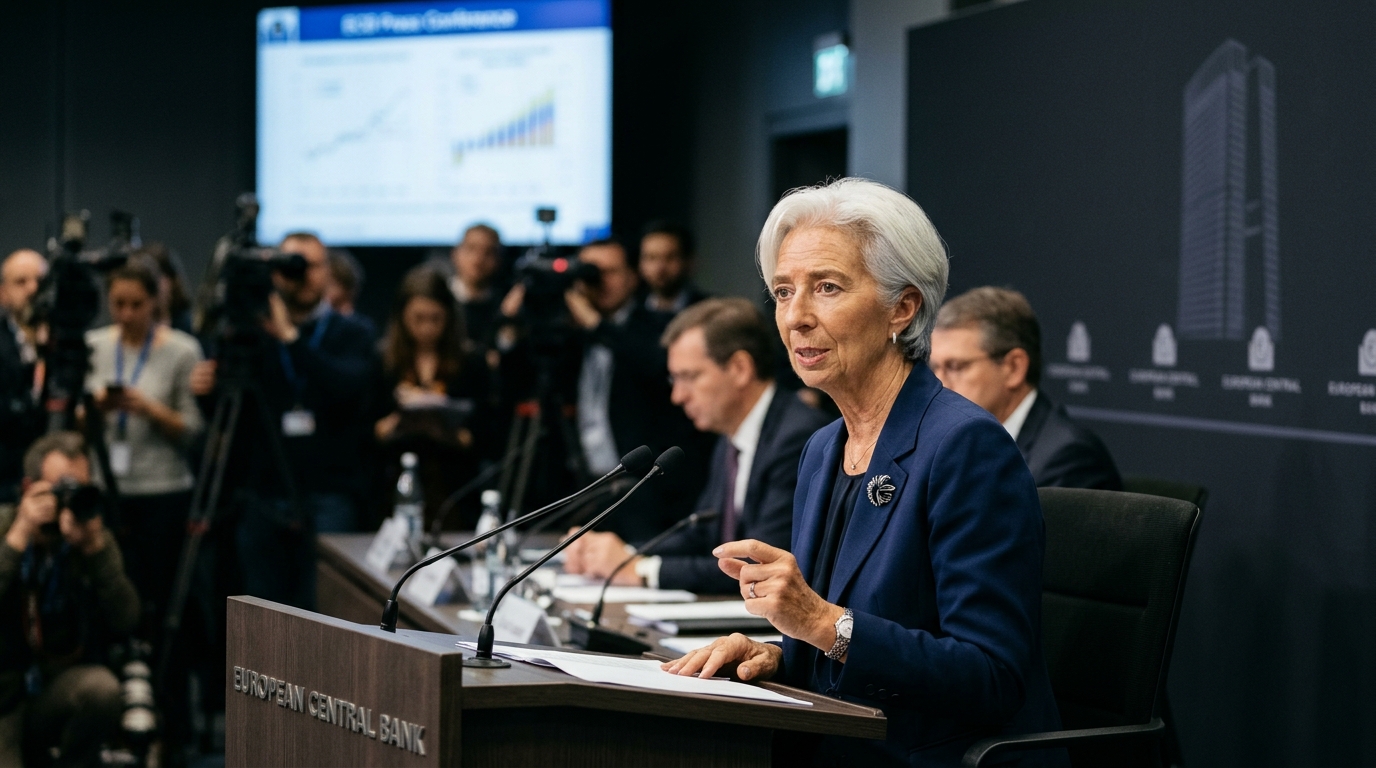
The one press conference investors should clear their calendars for is Christine Lagarde’s on Thursday.
What the Scoreboard Says
The RBNZ enters with its OCR at 2.75%, and markets are pricing an 80 to 85 percent probability of a 25-basis-point hike to 3.00%. That call has grown more uncertain after New Zealand’s Q3 CPI came in softer than expected at 3.7% year-on-year against a consensus of 3.8%, and 0.7% quarter-on-quarter against 0.8%. A hike is still the base case, but the RBNZ will not be reading from a clean script.
The Bank of Canada is more contested. Nineteen of 34 economists in a Reuters poll conducted October 21-23, 2026, 56%, expect a quarter-point hike to 2.50%, which would be the Bank’s first move in a year. The case for action rests squarely on Governor Tiff Macklem. The sharpest swing in the options market came on October 19, when the probability of a hike jumped 68 percentage points in a single session, driven by hawkish weekend comments from Macklem reinforced by a 3.1% year-on-year inflation reading. The counterweight is equally stark: Canada shed 68,000 jobs in September, and the unemployment rate climbed back to 6.5%. The updated inflation forecast in the accompanying Monetary Policy Report may matter more than the rate decision itself, listen for how much weight the Bank places on oil-driven inflation versus the softening labor market.
The Bank of Japan is expected to hold its policy rate at 1.25%, with attention focused on the Bank’s inflation assessment and its updated Outlook Report. Swaps price just 2% odds of a hike on October 30, and 80% probability of a move at the December 18 meeting. Some 83% of economists forecast the BoJ will raise borrowing costs in December, and more than 80% of BoJ watchers anticipate that as the next move. The real question at Friday’s meeting is whether the Bank finally declares that underlying inflation has sustainably reached its 2% target, a statement that would shift the December hike from likely to near-certain.
Why Lagarde’s Conference Is the One to Watch
The ECB holds its deposit rate at 2.50%. That part is not in dispute, 70 of 73 economists surveyed expect no change, and the ECB has already hiked twice this year, in June and September. A pause is widely anticipated after both moves were made to counter rising inflation as the Iran war pushed up energy prices. Eurozone inflation jumped to 3.8% in September, driven by energy prices. The ECB’s own communication has been deliberately cautious: caught between high inflation and concerns that rising bond yields could hurt growth, policymakers have recently argued for what Lagarde called a “measured response.”
That is the polite version. The harder version involves France.
Bond yields have surged globally in recent weeks, with debt-laden France among the hardest hit, on the back of worries about debt and inflation. At the IMF-World Bank meetings in Bangkok, Reuters reported that Lagarde addressed France’s debt strains directly, saying the solution must first and foremost be found domestically, as a matter of fiscal policy. She also argued that the bond selloff itself is doing some of the ECB’s work, making borrowing more expensive in the eurozone and curbing growth and ultimately inflation.
That argument is not risk-free. Tighter financial conditions from rising French spreads compress growth across the bloc, giving the ECB cover to pause. But if energy-driven inflation feeds into wages and services, the second-round effect the ECB says it is not yet seeing, a December hike becomes harder to avoid. A further hike in December is expected by many forecasters, which would take the deposit rate to 2.75%, a level the ECB has described as restrictive.
What to Watch Next
In clustered central bank weeks, markets often trade less on the individual decisions than on the sequencing. The Fed sets the dollar baseline on Wednesday afternoon, which conditions how much the RBNZ, BoC, ECB, and BoJ moves actually move their currencies. If Chair Kevin Warsh signals continued patience, the dollar softens and Lagarde’s problem with French spreads becomes marginally less acute. If the Fed tilts hawkish, the euro faces pressure before the ECB even speaks.
Watch Lagarde’s opening statement for any language shift on France, specifically whether she moves from “fiscal responsibility” to something closer to concern. Watch the BoC’s MPR for its oil price assumption. And watch the BoJ’s inflation language: with an October 30 move ruled out by every economist surveyed, the yen’s direction will hinge entirely on the tone of the statement, and a declaration that underlying inflation has reached 2% would mark a historic shift.
Five decisions. Three days. The scoreboard looks orderly. The press conferences will not.