Here is the question Boeing investors should be sitting with today: how much is a type certificate worth when 1,555 airplanes are waiting behind it? The FAA answered that question Tuesday afternoon in Everett, Washington, when it signed the amended type certificate for the 737-10, the largest member of the MAX family. The certification clears Boeing to begin delivering the airplane in the coming months. After six years of slipping schedules, a worldwide fleet grounding, and a last-minute navigation software scare in September, the door is open.
Boeing has booked 1,555 orders for the MAX 10 from more than 30 customers, accounting for more than 30% of its unfilled MAX order book. That is not a marginal product. It is the single largest tranche of undelivered Boeing commercial aircraft, and until Tuesday it was generating zero revenue. Major carriers holding large-volume orders include American Airlines, Delta Air Lines, Ryanair, and United Airlines, and Boeing has said it expects to begin deliveries in 2027.
Why This Certification Is Different
The MAX 10 is the first commercial aircraft certified under the full requirements of the 2020 Aircraft Certification, Safety, and Accountability Act, which established additional requirements for safety assessments and human factors evaluations. That distinction matters for Boeing beyond this single airplane. Boeing senior vice president Mike Sinnett has said the company is taking lessons from the MAX certification process that it expects to carry into future certification efforts, including the 777-9 program. Transportation Secretary Sean Duffy used the Everett event to argue publicly that the process should move faster, a signal that regulatory friction could ease for Boeing’s next programs.
The certification program included more than 2,000 flight hours, approximately 1,000 hours of ground testing, and nearly 1,000 test flights. A navigation software issue disclosed in late September threatened to delay the approval further; FAA Administrator Bryan Bedford held certification until the agency assessed a flight-management computer software issue affecting automated vertical guidance during a go-around. On October 2, the FAA’s Corrective Action Review Board concluded the fault did not pose a safety concern because pilots retained control and cockpit indications remained clear. Approval followed eighteen days later.
What Changes at Boeing
The milestone represents a major win for Boeing Commercial Airplanes and CEO Kelly Ortberg, who had identified the MAX 10’s certification as a mission-critical goal when he took the job in August 2024. The company has been delivering only the MAX 8 and MAX 9. Adding the MAX 10, which seats up to 230 passengers, puts Boeing directly into the segment where Airbus has been collecting orders with the A321neo.
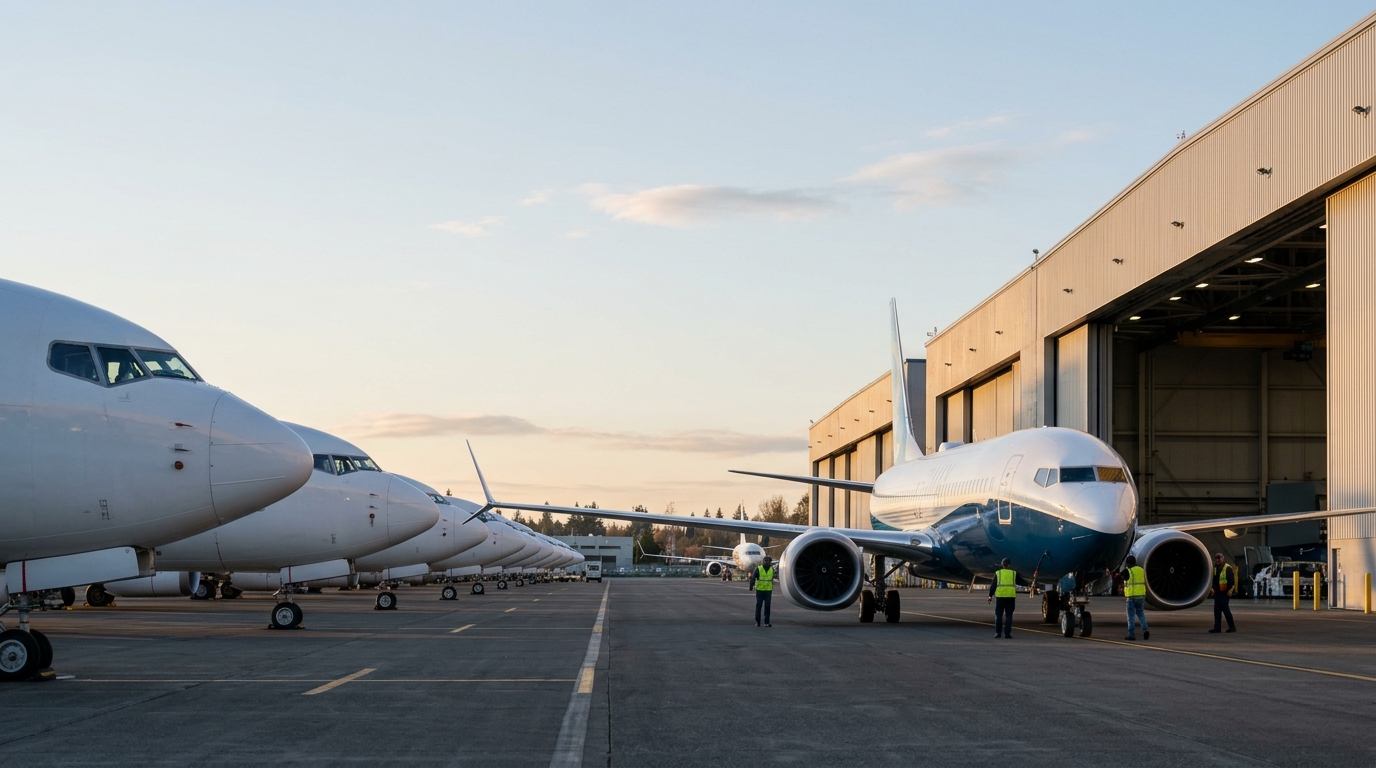
The cash timing matters. About 35 737-7 and 737-10 aircraft already in inventory are waiting in Renton, and they require continued maintenance while parked, adding costs that erode margins. Getting those airframes into customer hands stops the bleed. Boeing reports Q3 results on October 27; last quarter it posted a loss of $0.28 per share against a consensus expectation of a $0.76 loss. The certification arrives one week before the release, giving management a significant data point to anchor the call.
Bull and Bear
The bull case is straightforward: with 1,555 firm orders spread across more than 30 customers, the variant represents a significant portion of Boeing’s near-term revenue pipeline, and its per-seat economics make it a strong answer to the Airbus A321neo in the high-capacity single-aisle market. Certification also completes the LEAP-1B supply picture. The FAA and EASA have certified durability upgrades for the CFM LEAP-1B, and CFM has said the industrial cutover for new and shop-visit engines is expected in 2027, aiming to roughly double time on wing in hot, harsh environments. That means the MAX 10 can enter the market as the improved engine standardizes.
The bear case: Boeing must work through a low-margin portion of its delivery backlog, as aircraft promised to airlines years ago carry compensation penalties, with program cash margins running only slightly above break-even on the 737. Certification is not the same as manufacturing at scale. The FAA has determined that the MAX 10’s design meets safety standards, but Boeing must continue to show it can consistently build the aircraft to the approved design. Ramp speed, not regulatory approval, will determine how quickly those 1,555 orders convert to cash.
What to Watch
Three things will tell investors whether the thesis is tracking: delivery cadence out of Renton in the first half of 2027, the Q3 earnings call on October 27 for any guidance on MAX 10 margin structure, and whether United Airlines, the largest MAX 10 customer in the world with 165 unfulfilled orders, accelerates its intake schedule now that the certificate exists. United expects its first MAX 10s in 2027 and plans to retire at least 80 older, less fuel-efficient aircraft that same year. Confirmation of that timeline would be the clearest early signal that Boeing’s revenue bridge is holding.