October 13, 2026
Bonus Content: Dairy Farms Are Sitting on a Gas Mine. The Developer Is Keeping Most of It.
Dear Reader,
While most Americans are watching candidates battle for Congress, one private AI company is putting serious money behind the rules that could govern the next technology boom.
I’m Alexander Green, Chief Investment Strategist of The Oxford Club. I’ve spent 40 years on Wall Street. I recommended Nvidia in 2004 and bought Apple, Amazon and Netflix years before they became household names.
That’s why I believe you should hear what I’ve uncovered about Anthropic, creator of Claude.
Anthropic says it has committed $40 million to Public First Action, a nonpartisan organization advocating AI safeguards, American leadership and transparency.
To me, that signals something important:
Anthropic understands that the next Congress could help shape the future of artificial intelligence.
This is exactly the kind of overlooked transition I look for: a company moving from a technical story to a political and financial force.
Most people will treat this as another midterm political story.
I see a private company protecting its position while reports of a potential IPO bring it closer to Wall Street’s spotlight.
And regular investors may not have to wait for an opening bell.
I’ve identified a publicly accessible vehicle that lists Anthropic as its largest holding. It can be purchased through an ordinary brokerage account, does not require accredited-investor status and provides indirect exposure rather than direct Anthropic shares.
That does not mean an Anthropic IPO is guaranteed. Nor does it guarantee a profit.
But the advantage today is time.
While the crowd is staring at polls, debates and election maps, you can investigate this setup without the pressure that could arrive once the midterms end and Wall Street turns its full attention back to AI.
See why I believe the quiet window matters before the midterms end. Free to watch.
Good investing,
Alexander Green
Chief Investment Strategist, The Oxford Club
P.S. The vehicle also holds two other major private companies: Databricks and Anduril. The political spotlight will not stay elsewhere forever. Watch before the post-election crowd catches on – no credit card or email required to view.
Dairy Farms Are Sitting on a Gas Mine. The Developer Is Keeping Most of It.
There is a quiet transfer of wealth happening on American dairy farms, and most of the money is flowing away from the barn.
Agricultural biogas has moved from a farm sustainability project to a financed energy asset class, with oil majors, infrastructure funds, and utilities underwriting the build-out. The economic engine is stacked environmental credits: dairy renewable natural gas can score a negative carbon intensity, letting a single project earn federal Renewable Fuel Standard RINs and California LCFS credits on top of the value of the gas itself. That combination is what makes the trade so attractive to capital allocators, and so lopsided for the farmer supplying the raw material.
The numbers illustrate the gap. A million BTUs of methane might sell for roughly $3 at the city gate, but in 2025 D3 cellulosic RINs tied to dairy RNG traded at levels that kept their value in the low single digits per RIN, based on EPA transaction data. California’s LCFS credit price averaged $57.77 per metric ton CO2e in 2025, and the program’s Credit Clearance Market maximum price was $275.39 per credit in 2026. The commodity gas is almost irrelevant. The credits are the business.
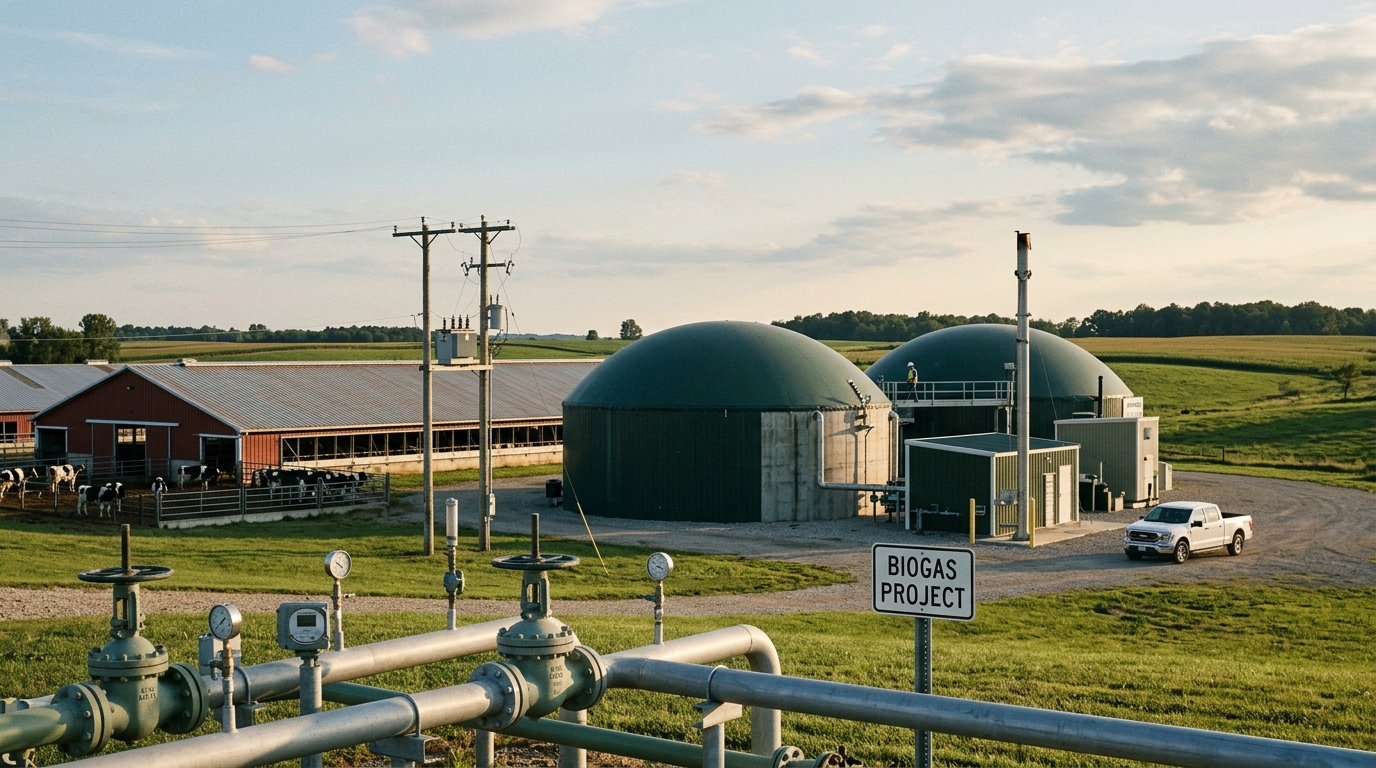
The Curtis Creek Dairy case in Newton County, Indiana, makes the split concrete: an $80 million Sedron Varcor facility now sits on the farm’s ground, and in the deal as described in industry reporting, the developer, not the farm, owns the environmental credit stack tied to gas production. The farm’s payoff is modeled at roughly $250,000 per year in avoided costs, locked in against a 15-to-25-year manure supply contract. The developer keeps the credit stack. In most deals structured this way, the developer’s profits come primarily from the credit stack, not the base gas price.
Vanguard Renewables, a portfolio company of funds managed by BlackRock, builds with TotalEnergies, while Clean Energy Fuels develops dairy RNG through CE Renewco, its joint venture with bp. These are not small bets. Nearly $4 billion has been invested in dairy biogas projects since 2020, including approximately $800 million tied to facilities that opened in 2025 alone, with Texas, Idaho, and Wisconsin accounting for more than half of that activity.
The opportunity that remains is enormous. The American Biogas Council estimates substantial untapped potential, noting that approximately 2,955 additional farms with at least 500 cows could support methane-capturing biogas systems. Only about 14% of potential U.S. dairy biogas projects have been developed. That gap is exactly what institutional capital is racing to close, on terms that favor the capital provider.
The debate institutional investors should be having is not whether dairy RNG works. It clearly does. The real question is what happens when farmers, increasingly sophisticated after a decade of deals, start demanding a share of the credit stack rather than accepting a manure contract and avoided-cost payments. One in five producers is currently participating in carbon credit programs, and compensation has surpassed low awareness as the primary reason for nonparticipation. Producers know exactly what the programs are. They just don’t think the check is big enough. When the largest herds begin negotiating from that position, the margin arithmetic changes for everyone who has been pricing these projects on the assumption that farmers stay on the outside of the credit economy.
Stocks to Watch
- Clean Energy Fuels (CLNE): The most direct publicly traded exposure to dairy RNG at scale, with projects across six states expected to produce approximately three million gallons of RNG annually once fully operational.
- Aemetis (AMTX): Received funds from the sales of $18 million of Section 45Z Clean Fuel Production Tax Credits in 2026, including tax credits generated by year-to-date 2026 ethanol and renewable natural gas production, signaling the federal credit layer is now cash-flowing.
- Gevo (GEVO): Building dairy digester partnerships with a focus on negative carbon intensity scores, which anchor the LCFS credit premium the entire trade depends on.