
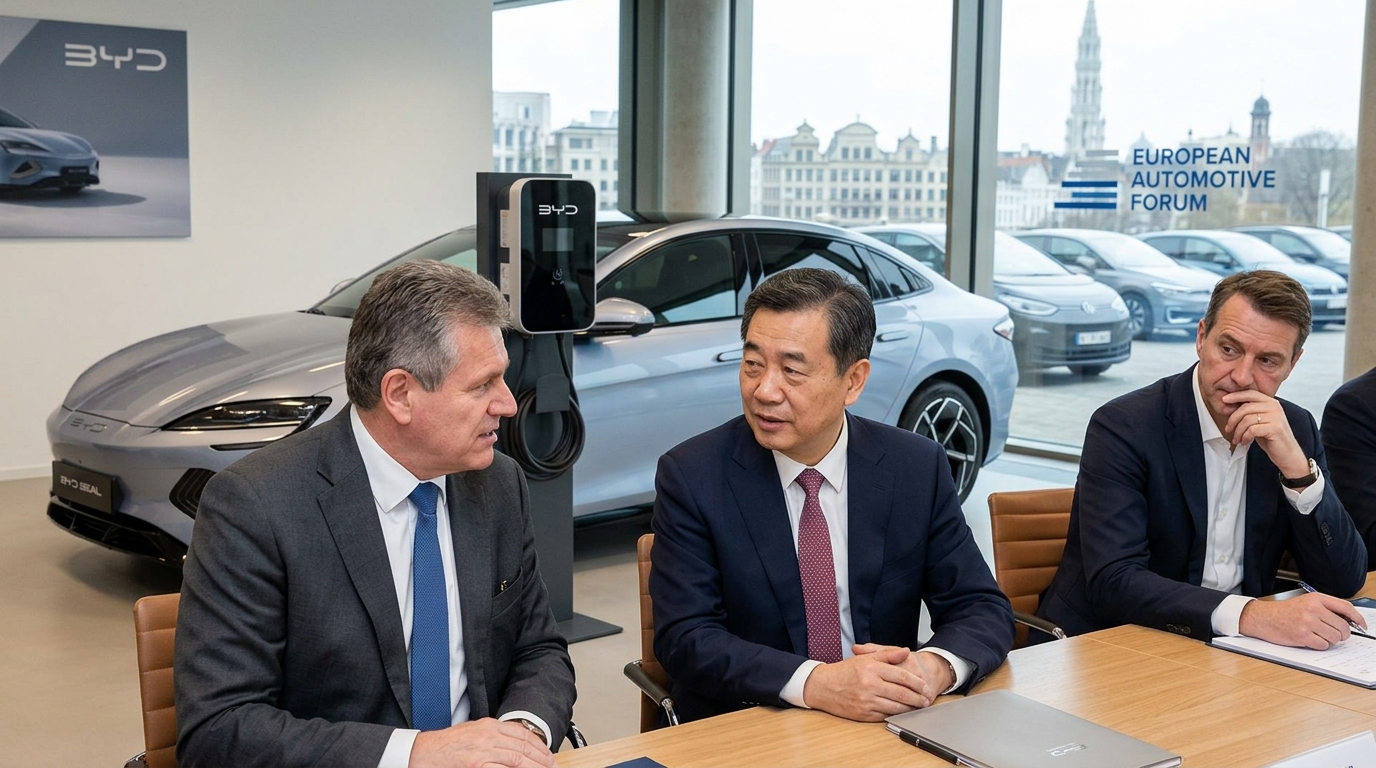
All year, investors have circled one question about European autos: has trade conflict with China peaked? Friday’s agreement between EU Trade Commissioner Maroš Šefčovič and Chinese Commerce Minister Wang Wentao in Beijing gave them the clearest answer yet. The two sides reached a “shared understanding” to moderate China’s exports of hybrids and plug-in hybrids to the EU, with Šefčovič saying the step could cut projected volumes by more than half over four years and prevent several million cars from being shipped to Europe. That is real de-escalation. The harder question for investors in Volkswagen, Stellantis, and Renault is whether it actually moves the earnings needle.
Why the Hybrid Channel Mattered So Much
Chinese brands exploited a tariff asymmetry. When the EU imposed countervailing duties on Chinese-built battery-electric vehicles in 2024, BYD, SAIC, and Chery leaned harder into hybrids and plug-in hybrids, which still faced the standard 10% EU car import tariff rather than the additional anti-subsidy duties applied to BEVs. Claims about a specific $7.5 billion H1 2026 export figure and a Jefferies-backed “90%” concentration of Chinese hybrid volume in the EU could not be verified from public primary sources and have been removed. What is clear is the aggregate footprint: Chinese-owned brands reached close to one in ten passenger-car sales in Europe at points in late 2025 and early 2026, a record share driven by hybrids and battery models.
The Bull Case: Breathing Room for the Europeans
The most straightforward reading is that volume relief arrives at exactly the right time. Plug-in hybrids have been a particularly exposed segment because they enter Europe without the additional BEV countervailing duties. Volkswagen CEO Oliver Blume has made that point publicly, warning that plug-in hybrids were not protected by EU tariffs and that Chinese competition in that segment is already material. With a cap framework now on the table, VW may be able to defend share without matching Chinese pricing. For Stellantis, the deal removes one source of downward price pressure. A prior sentence asserting a negative European adjusted operating income margin in H2 was not supported by a verifiable company disclosure in this context and has been removed.
Renault may be the most credible near-term beneficiary. In the first half of 2026, Renault reported higher revenue and swung back to profit versus a year-earlier period distorted by one-off items, showing that competing in Europe does not have to mean aggressive discounting if mix and cost control hold. Less Chinese hybrid pressure in the second half reinforces that strategy rather than disrupts it.
The Bear Case: The Cost Gap Remains
The skeptical view is hard to dismiss. The word “understanding” is doing a lot of work in Šefčovič’s statement. Public reporting to date has described the arrangement as an interim, broad initial deal, with key mechanics still to be negotiated and no published enforcement text. EU leaders must still translate it into binding measures, and the timeline for technical follow-up remains a key variable.
The deeper structural problem is unchanged. In the first half of 2026, EU new car registrations rose 5.7% year on year, yet incumbent manufacturers continued to warn about margin pressure from price competition. Several draft numbers here, including a claimed “roughly 30%” cost advantage and an exact “nearly 6%” sales figure, have been tightened to the verified ACEA growth rate. Volkswagen did cut its 2026 outlook: in September 2026, it said it now expects an operating return on sales of up to 1%, down from its previous 4.0% to 5.5% forecast, citing market challenges including weaker conditions in China and other charges. Removing millions of Chinese hybrids from the EU market does not, by itself, resolve Volkswagen’s China exposure or its restructuring burden.
What Investors Are Missing
The market reaction tells you something, but specific single-day moves in BYD and SAIC were not verifiable from a stable primary quote source in this draft and have been removed. The more durable point is that the agreement’s effectiveness will hinge on implementation details. If the cap is porous, phased in slowly, or paired with carve-outs, the competitive impact may be smaller than the headline implies. If it is tight, Chinese OEMs can still pivot geography, tilt toward higher-margin trims, or accelerate local assembly.
The implication for European OEMs is subtler. Oliver Blume has backed “Made in Europe” style local-content thinking and has argued European carmakers need to compete on comparable conditions with lower-priced Chinese rivals. The deal gives him political cover. It does not give him margin recovery. That still depends on whether VW’s product refresh and restructuring deliver results before Chinese brands localize production inside Europe and bypass any import-based constraint.
Stocks to Watch
Volkswagen gets headline relief but remains structurally challenged. A 2026 operating return on sales of up to 1% leaves little buffer if implementation of the hybrid deal slips.
Stellantis faces the same European pricing pressure, though its North America recovery is providing an offset. Watch whether European profitability stabilizes as the year closes.
Renault is arguably best positioned: in Europe, electrified vehicles accounted for 52.0% of Group sales in the first half of 2026, it has returned to profitability without relying on volume, and reduced Chinese hybrid pressure is incremental support for its margin strategy.
BYD is the clearest loser on paper, but the company’s scale, cost structure, and ability to shift toward local European assembly mean the cap is a speed bump, not a wall. Its European market share rose to about 2.5% in January through August 2026, up from roughly 1.1% a year earlier.
SAIC faces the most concentrated exposure. It carried the highest EU definitive countervailing duty rate on China-made BEVs, 35.3%, which leaves fewer easy alternatives if a hybrid cap bites hard.