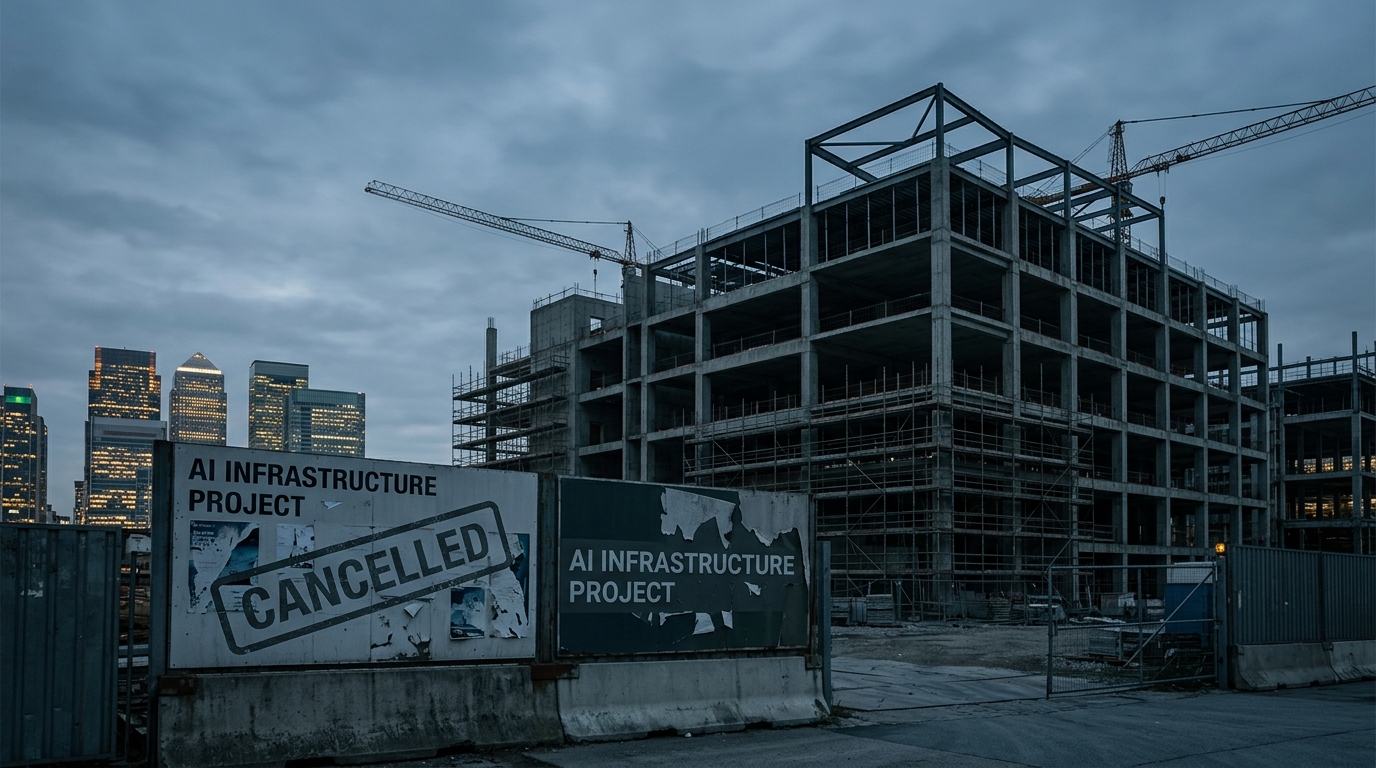
The week’s clearest market signal had nothing to do with an index close or a Fed comment. It was the sound of a door shutting. Australian AI data centre operator Firmus, backed by Nvidia, withdrew its planned mega initial public offering, citing market volatility and conditions. The deal is dead. Firmus will raise privately instead.
The company had initially planned to sell shares at A$11 each, giving Firmus an equity valuation of $30.6 billion, nearly triple the $10.5 billion valuation it achieved following a fundraising round in August. That trajectory, from a $1.85 billion valuation in September 2025 to a $30.6 billion IPO target in October 2026, roughly 17x in thirteen months, was the pitch. The public market said no.
The speed of the compression matters. The IPO was set to be one of Australia’s largest new share sales and met lukewarm demand, a warning sign that investors remain selective about AI issuers even as the artificial intelligence boom drives global markets. Firmus said its board determined that the terms of the proposed offering did not adequately reflect the strength of its business and long-term growth outlook. The board’s language is standard. The reality is simpler: the price didn’t clear.
What the Debt Math Said
Sophisticated investors could read the structure. The Nvidia-backed operator has two sites operational, and five more under development across Asia-Pacific. Estimates put Firmus’s debt at roughly US$30 billion. At A$11 a share, buyers were being asked to carry that leverage at a valuation that had tripled in two months. They declined.
Backers include Coatue, Nvidia, Jane Street, Blackstone funds, and others, with a US$10 billion debt facility led by Blackstone. Blackstone’s dual role as equity holder and lead lender made the capital structure unusually complex for a company with two sites online. That complexity did not help the book.
The Collateral Damage in Maas Group
The clearest second-order casualty was Maas Group (ASX: MGH). On October 8, Maas shares opened at A$5.00 and closed at A$4.96, a fall of 22.38%, touching a low of A$4.47 on volume of more than 16 million shares. The ASX issued a formal price query the same day.
The exposure is direct. The Dubbo-based construction business invested $410 million for a 3.2% stake in Firmus, and its subsidiary JLE Group has secured over $1.2 billion worth of electrical infrastructure work tied to Firmus’s network of Australian AI factories. That contract backlog is now contingent on a private company with uncertain public-market access completing a multi-site expansion plan on borrowed time and borrowed money.
What the Market May Be Missing
The Firmus withdrawal is being read as a valuation story. That is partially correct, but the more durable signal is structural. Public market investors, unlike the private backers who funded Firmus at every prior round, cannot exit at will. They are being asked to hold the liquidity risk of a capital-intensive, pre-revenue-scale business at a multiple that assumes flawless execution across five countries.
That is a different ask than buying Nvidia itself, which at least has current earnings. Market conditions have turned increasingly selective for tech listings, with investors growing more cautious about which AI companies deserve premium valuations, particularly as companies grapple with massive capital requirements and uncertain returns on AI data centre buildouts. The Firmus collapse makes that caution visible in one clean data point.
Risks and Counterpoints
The bear case wrote itself this week. But there is a genuine counterpoint: private markets have consistently pushed AI infrastructure higher, and Firmus has secured commitments from Meta for GPU computing capacity. Firmus will now pursue capital from the private markets and consider alternative public and private market options. A private round at a lower valuation is possible. A renewed IPO attempt in a calmer window cannot be ruled out.
For Maas Group, the question is whether JLE’s contracted work survives a Firmus funding gap. The contracts exist regardless of Firmus’s listing status, but the scale of the buildout depends on capital Firmus has not yet secured.
What to Watch Next
Watch whether Firmus surfaces a private round in the next 30 to 60 days and at what valuation. A meaningful haircut from $30.6 billion would confirm that public-market pricing, not just volatility, was the real obstacle. For Maas Group, the next catalyst is any update on the JLE contract delivery schedule. And more broadly, watch the pipeline of AI infrastructure listings globally: if other issuers quietly delay, the Firmus withdrawal was a leading indicator, not an isolated event.