

August 27, 2026
Bonus Content: Klarna’s Loss Curves Are the Credit Data the Market Needed
Dear Reader,
This is urgent.
A new type of AI called “Accelerated AI” is about to take the world by storm…
And stocks connected to it are already breaking out.
Check this out…
One “Accelerated AI” stock just moved 133%…
A second ripped 320% in less than three months…
And a third company jumped over 210% in under four months…
All the while Tesla, Microsoft, Meta… even the king of AI – Nvidia… kept going sideways.
And it’s just getting started.
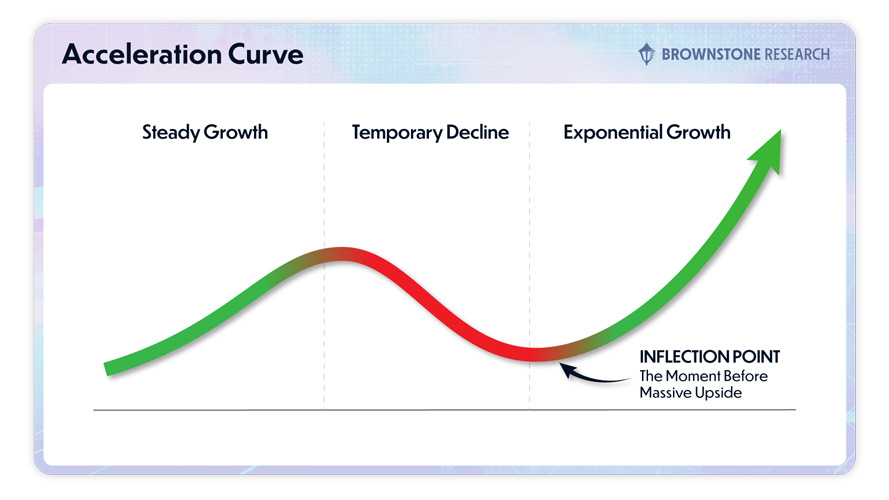
At the inflection point right before “Accelerated AI” explodes into the mainstream…
And unlocks an entire new dimension of exponential growth.
If history is any guide, we could be looking at potential gains of up to 10,000% from here.
If you want to find out more about “Accelerated AI”…
The “light-speed” device powering it…
Why it’s about to crack open the next wave of AI fortunes…
And the #1 “Accelerated AI” play everyone should buy right now – for free…
Let the money flow to you,
Jason Bodner
Founder, Inflection Point
Klarna’s Loss Curves Are the Credit Data the Market Needed

Klarna reported a profit. Shares fell nearly 20%. That divergence is worth sitting with, because what the market priced on August 18, 2026 was not Q2 earnings. It was the embedded assumption that BNPL credit losses would stay contained as consumer conditions softened.
The Numbers Behind the Move
Klarna’s Q2 2026 earnings delivered a $0.01 EPS beat against a -$0.05 estimate and turned net income positive at $9 million, yet shares fell about 20% to roughly $15.57, trading well below the $40 IPO price. The driver was a full-year 2026 revenue guidance cut to $4.08–$4.16 billion from above $4.34 billion that overshadowed the profitability milestone.
In the company’s earnings release, Klarna attributed the softer outlook to a more measured view of primarily German volumes, its largest market by volume, alongside roughly $600 million in currency-translation headwinds since its previous guidance.
Germany Is a Credit Story, Not a Currency Story
The FX framing is defensible on a spreadsheet. It is incomplete as investment analysis. Germany’s consumer weakness is not a translation artifact. It reflects actual volume deceleration in Klarna’s deepest market, and volume deceleration in a BNPL model means fewer new originations to offset the loss curves embedded in the existing book.
Management attributed the softer GMV and revenue outlook partly to a more measured view of primarily German volumes, its largest market by volume. That cautious view is a credit signal. When the origination engine slows in a market where collections are still cycling through, the ratio of performing new assets to seasoning old ones deteriorates. That is the dynamic the market priced, not the headline profit.
Morgan Stanley’s new $17 target rests on a 16x multiple applied to revised 2028 IFRS earnings of $1.09 per share, after cutting that estimate by roughly 15%. The firm reduced medium-term estimates on a softer European volume outlook and what it called a slower compounding path from the new base, warning that continued execution and forecasting difficulties could justify a more punitive discount over time. JPMorgan went further, downgrading Klarna from Overweight to Neutral and cutting its target to $18 from $22 on concerns about the guidance reduction.
What Institutions Are Underweighting
The broader consumer debate has centered on whether U.S. spending holds. Klarna’s German data is the first clean read suggesting that in a market where BNPL penetration is mature and consumer confidence is genuinely soft, volume compression arrives faster than the equity models assumed. Affirm carries similar exposure to U.S. consumer credit quality; Synchrony has it across a broader installment and revolving book. Neither has shown Germany-style volume stress, but neither has been stress-tested against a sustained consumer pullback in their primary market.
The announced departure of CFO Niclas Neglén, and Chief Marketing Officer David Sandström adds timing risk to an already uncertain volume recovery. Both are expected to exit in early 2027. Leadership transitions during a credit normalization cycle concentrate execution risk precisely when it should be dispersed.
Stocks to Watch
- KLAR: Shares are down roughly 48% year-to-date. The Q3 GMV trajectory in Germany is the number to watch, not EPS.
- AFRM: Morgan Stanley’s Klarna target carries a 20% implied discount to its Affirm target. If the BNPL discount widens on European credit evidence, Affirm’s U.S.-only premium gets tested.
- SYF: Synchrony’s installment book and private-label credit exposure make it the most direct read-across for subprime-adjacent consumer credit stress spreading beyond BNPL.
- PYPL: PayPal’s Pay Later volumes are growing into the same consumer cohort. If Klarna’s loss curve thesis proves structural rather than geographic, PYPL’s BNPL provisioning assumptions deserve another look.