July 24, 2026
Ford Takes the Fight to Tesla
An Apple deal and a $30K EV truck shift the debate.
First a note from Banyan Hill Reasearch
Dear Reader,
I hesitated to even send you this.
After what I heard…
After who told me…
On January 7th… just outside Washington, D.C… I sat across from a man whose family has been tied to global power for decades.
Oil deals. Intelligence circles. Government insiders.
He leaned in and told me something that changed everything I thought I knew about the Iran war.
What you’re seeing on the news?
It’s not the real story.
Not even close.
The strikes… the chaos… the escalation…
It’s all part of something much bigger.
A global deal worth trillions.
And the only reason I know this is because of him – an anonymous contact who risked everything to pass this information along.
I verified it. Cross-checked it. Dug deeper.
And what I uncovered is something every American investor needs to see immediately.
Click here to see the full breakdown before it’s too late.
It’s a coordinated move that could reshape the global economy for decades.
But you need to see it for yourself.
Go here now and uncover the real reason behind the Iran war.
Regards,

Addison Wiggin
Founder, Grey Swan Investment Fraternity
Ford Takes the Fight to Tesla
The Big Question
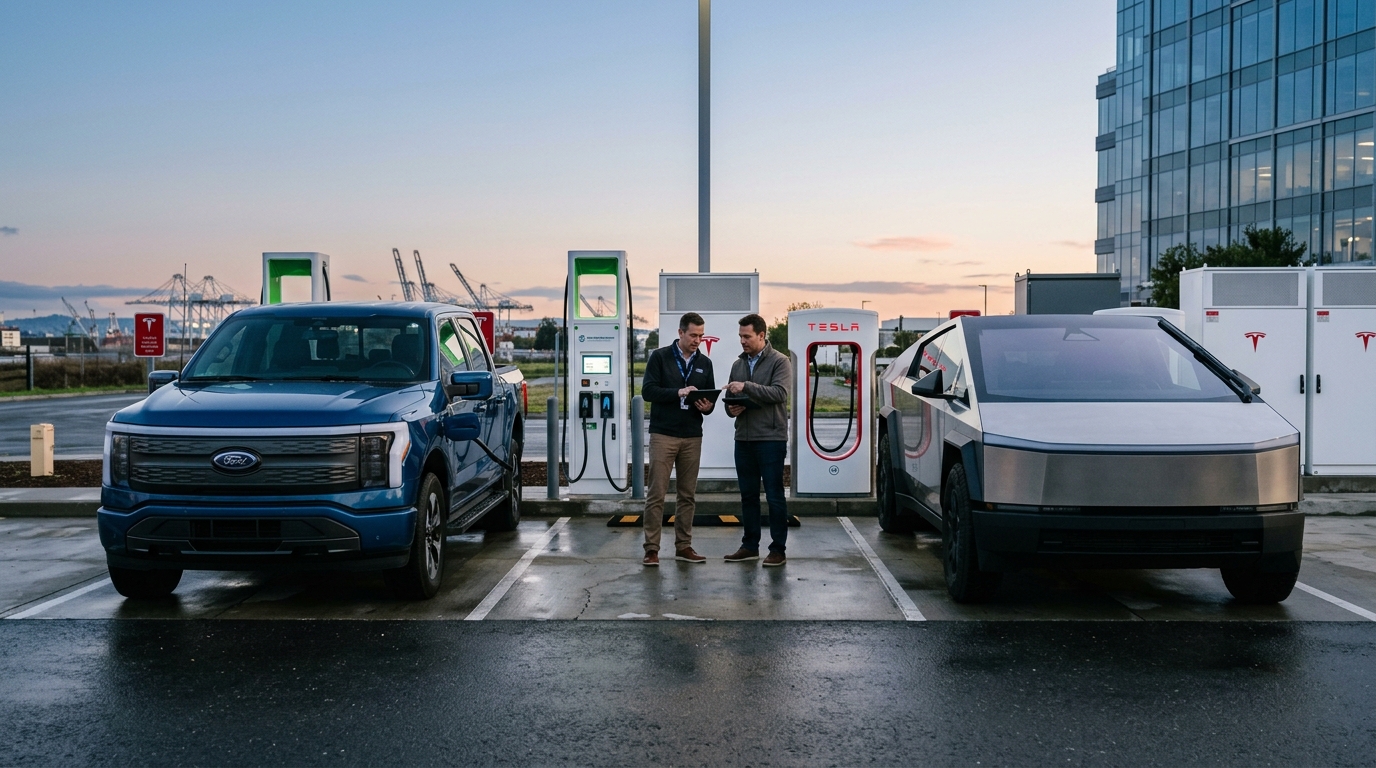
Can a legacy automaker with a century of combustion engine DNA actually close the technology gap with Tesla? That is the question sitting at the center of every institutional conversation about Ford right now. And for the first time in a while, the bull case has some real substance behind it.
On July 23, Ford and Apple announced a partnership that goes well beyond a software feature. Ford announced it had partnered with Apple to embed Apple Maps directly into its next generation of electric vehicles, becoming the first automaker in the world to use Apple’s new MapKit for Automotive software development kit. That last part matters. First mover in a category Apple is just now opening up is not a trivial position to hold.
Why Institutional Investors Are Paying Attention
The reason this lands differently than a typical tech partnership is what sits underneath it. MapKit for Automotive lets Ford build Apple Maps natively into the vehicle itself, separate from CarPlay and separate from any iPhone. The maps are there whether or not a phone is connected. That is a fundamentally different user experience than mirroring a phone screen.
But navigation is almost beside the point. The real play is driver assistance. The integration will feed road-level information from Apple Maps into Ford’s next-generation BlueCruise hands-free driver-assistance system. The upgraded version of BlueCruise, expected to roll out next year, will handle an entire highway journey including on- and off-ramps. The company has said the new system will ultimately handle point-to-point autonomy, similar to Tesla’s Full Self-Driving software, before progressing to eyes-off driving in 2028.
The person most responsible for this deal has a very specific resume. Doug Field spent years at Apple working on a car the company never built. When Apple shut down Project Titan in early 2024, Field moved to Ford, where he has been leading the automaker’s technology strategy since. The Ford-Apple partnership is, in some ways, the ghost of Project Titan finally finding a vehicle to live in.
The Bull Case
Start with the product. Apple’s MapKit for Automotive SDK will debut with Ford and its new line of electric vehicles, starting with a $30,000 midsize truck in 2027. Ford is placing a serious bet on this next generation of EVs, which it has promised will be affordable and efficient while offering the latest technology. To build them, Ford ditched its traditional approach and started fresh with a Universal EV Platform, or UEV, that will underpin the midsize truck and eventually other vehicles including a sedan, a crossover, a three-row SUV, and small commercial vans.
The engineering substance here is real. Ford has revealed a new 48-volt architecture, structural LFP battery, and aerodynamic gains the company says surpass any pickup currently on the market. The newest EV will use 25% fewer fasteners than previous, more conventionally built EVs, and there will be 20% fewer parts overall. Ford’s own projections: the pickup’s five-year ownership cost will be lower than that of a three-year-old used Tesla Model Y.
Then there is the software angle that most people are sleeping on. Development of Ford’s next-generation self-driving tech is led by Latitude AI, a team of 600 experts in machine learning, robotics, and software, advancing Ford’s in-house hands-free, eyes-off automated driving system. Apple’s road-level mapping data fed directly into that team is a meaningful acceleration.
The Bear Case
Here is where experienced investors pump the brakes. Tesla’s grip on the U.S. EV market is not loosening on anyone else’s schedule. Tesla held a commanding 59% share of the U.S. EV market in early 2026, up from 41% in the previous quarter, as it reclaimed share following the end of the federal EV incentives, which had a greater impact on rivals’ sales.
Meanwhile, Tesla’s FSD user base keeps growing. Tesla said active FSD subscriptions rose 56% in Q2 2026, and the company now has 1.48 million subscribers total to that product. Ford is promising FSD-level capability by 2027 and eyes-off driving by 2028. Tesla is already selling subscriptions at scale today.
Ford’s EV losses have also been painful. The Model E division was restructured and integrated into a newly formed department. The automaker recently reorganized its Model E division, which is now integrated into the newly formed Product Creation and Industrialization department, led by Ford’s Chief Operating Officer Kumar Galhotra. Ford’s EV chief Doug Field also departed following that announcement. Leadership changes mid-execution of a technology-intensive platform launch are never a green flag.
And the macro headwinds are real. U.S. EV sales face significant headwinds amid changes to federal support by the Trump administration, as well as less-than-expected consumer adoption. EV sales peaked in September at 10.3% of the new vehicle market ahead of federal incentives ending, and demand fell sharply to preliminary estimates of 5.8% during the fourth quarter.
What Professionals Are Debating
The investment committee debate on Ford right now is not really about whether the Apple deal is good. Everyone agrees it is. The real debate is whether Ford can execute the UEV launch on time and on price, in a market where consumer EV enthusiasm has cooled and Tesla’s brand advantage is structural.
What makes sophisticated investors cautious is the gap between Ford’s product roadmap and its current financials. According to 21 analysts polled by S&P Global, Ford stock carries a consensus rating of Hold with an average price target of $15.05, against a current price of $14.42. That is not a market pricing in a transformation story. That is a market waiting to see proof.
Jim Farley has been direct about what he is attempting. “At Ford, we took on the challenge many others have stopped doing. We’re taking the fight to our competition, including the Chinese,” Farley said during an event at the Louisville plant. That is not a CEO hedging. That is a CEO who knows exactly what he is up against.
What Investors Are Missing
Most of the coverage on this deal focuses on the navigation features. That is the wrong frame entirely.
The real story is what the Apple partnership signals about the broader software-defined vehicle race. Tesla built its competitive moat not from having the best car but from having the best data flywheel. More miles driven equals better AI training equals a better product. Ford’s move to embed Apple’s road-level data directly into BlueCruise is an attempt to compress that data advantage gap without having to spend years accumulating it organically.
There is also a second-order story almost nobody is discussing. Unlike General Motors, which chose to phase out Android Auto and Apple CarPlay, Ford still plans to support those technologies on the Universal Electric Vehicle Platform. That is a strategic choice that keeps the broadest possible consumer base comfortable. GM is betting on a closed software ecosystem. Ford is betting on openness. One of those bets will look smarter in 2028.
The other underappreciated angle is Europe. Ford and Geely Auto announced plans to jointly manufacture low- and zero-emission vehicles at Ford’s Valencia, Spain factory, a deal Edmunds’ head of insights Jessica Caldwell called a road map for how traditional automakers can survive in Europe, noting that Ford gets scale and cost efficiencies while Geely gets a shortcut around EU tariffs. That plant had been running well below capacity, and this joint venture changes the economics meaningfully.
Stocks to Watch
- Ford (F) — The obvious name. The UEV platform, Apple partnership, and Geely joint venture represent the most concentrated period of strategic repositioning in Ford’s recent history. The stock is priced for skepticism, which is exactly when transformation stories can surprise. The 2027 product launch is the binary event investors should be tracking.
- Apple (AAPL) — Less obvious but important. MapKit for Automotive is a new revenue and ecosystem vector that barely registers in current analyst models. If Ford is first and others follow, this could become a meaningful services contributor over the next three to five years.
- Tesla (TSLA) — The company to watch for signs of competitive pressure. Since the introduction of the Cybertruck in late 2023, Tesla has not launched a completely new passenger vehicle. This lack of fresh offerings may be affecting consumer interest, especially as competitors introduce updated models. Tesla’s moat is real, but it is not invincible.
- Rivian (RIVN) — Rivian sits in the same midsize truck segment Ford is about to enter at $30,000. Rivian’s R2 launch and the upcoming R3 will pressure the segment in 2026 and 2027. The arrival of a $30,000 Ford electric truck complicates Rivian’s value proposition considerably.
- Aptiv (APTV) — The overlooked beneficiary. As zonal electrical architecture becomes the industry standard across Ford’s UEV platform and beyond, Aptiv’s high-voltage systems and software business grows regardless of which brand wins the consumer battle.
The investment case for Ford is not about this quarter or even this year. It is about whether a $30,000 EV truck with Apple navigation baked in, a hands-free driving system targeting Tesla-level capability, and a profitable manufacturing model finally shows up on time in 2027. If it does, the conversation in every investment committee changes fast.
If it does not, the bears will have been right all along: legacy automakers can announce transformations, but delivering them is a different matter entirely.
— Wall St. Mavens