
July 5, 2026
ISRG Reports July 16
The stock is down 30% from its high. The business hasn’t skipped a beat.
First a note from Resource Stock Digest
Gold is on fire – racing toward US$5,000 an ounce as governments continue piling on debt, central banks continue accumulating bullion, and investors increasingly seek hard assets in uncertain times.
One ultra low-priced explorer is launching a major drill campaign on its ALREADY huge gold discovery in one of the safest and most mining-friendly gold districts on Earth.
This exceptionally well-run small-cap currently controls a multi-million-ounce gold system in a top Canadian gold belt – all while remaining largely undiscovered by Wall Street.
Backed by a newly strengthened treasury and multiple high-priority targets, the company is now set to unlock the next phase of growth via the drill bit.
It all starts with a large, fully funded drill campaign designed to expand its already impressive gold resource.
And if the drills continue to hit paydirt as the team expects, we could be talking about an even larger gold haul at a time when large-scale gold assets in ultra-safe mining jurisdictions are becoming increasingly difficult to find and increasingly valuable to the market.
And here’s where it gets even more interesting…
In addition to its flagship gold asset, this soon-to-be-known small-cap also offers:
✔ A multi-million-ounce gold inventory with meaningful expansion potential
✔ A strong treasury capable of supporting aggressive exploration and project advancement
✔ A strategic land position in one of North America’s premier mining jurisdictions – with key infrastructure already in place
✔ Exposure to one of the strongest gold markets in history as prices race toward US$5K per ounce
In short: This is an exceptionally well-run, fully funded explorer in a top-tier Canadian jurisdiction with drilling on-deck and multiple catalysts stacked for 2H 2026 and beyond.
The market cap? Still remarkably small.
The share price? Still below US$0.25 per share.
The opportunity? A chance to get positioned before the next phase of growth begins.
This is one of those rare setups where early-stage speculators can position early and low… and then ride the momentum as the drill bit spins.
We’ve prepared a FREE online report detailing the opportunity, including:
✔ A full breakdown of the flagship gold asset
✔ An exclusive interview with the CEO bringing you directly onsite
✔ Why gold projects in safe jurisdictions are attracting increased attention
✔ The details behind the upcoming fully funded drill campaign
✔ And how to get positioned before this sub–$0.25 story goes mainstream
Funding is secured. Targets are defined. Drills are set to turn. Catalysts are stacked.
The market hasn’t noticed yet – but soon will!
Click here to get instant access and see why this ultra low-priced gold story could be one of the breakout resource opportunities of 2026-27.
FEATURED
ISRG Reports July 16
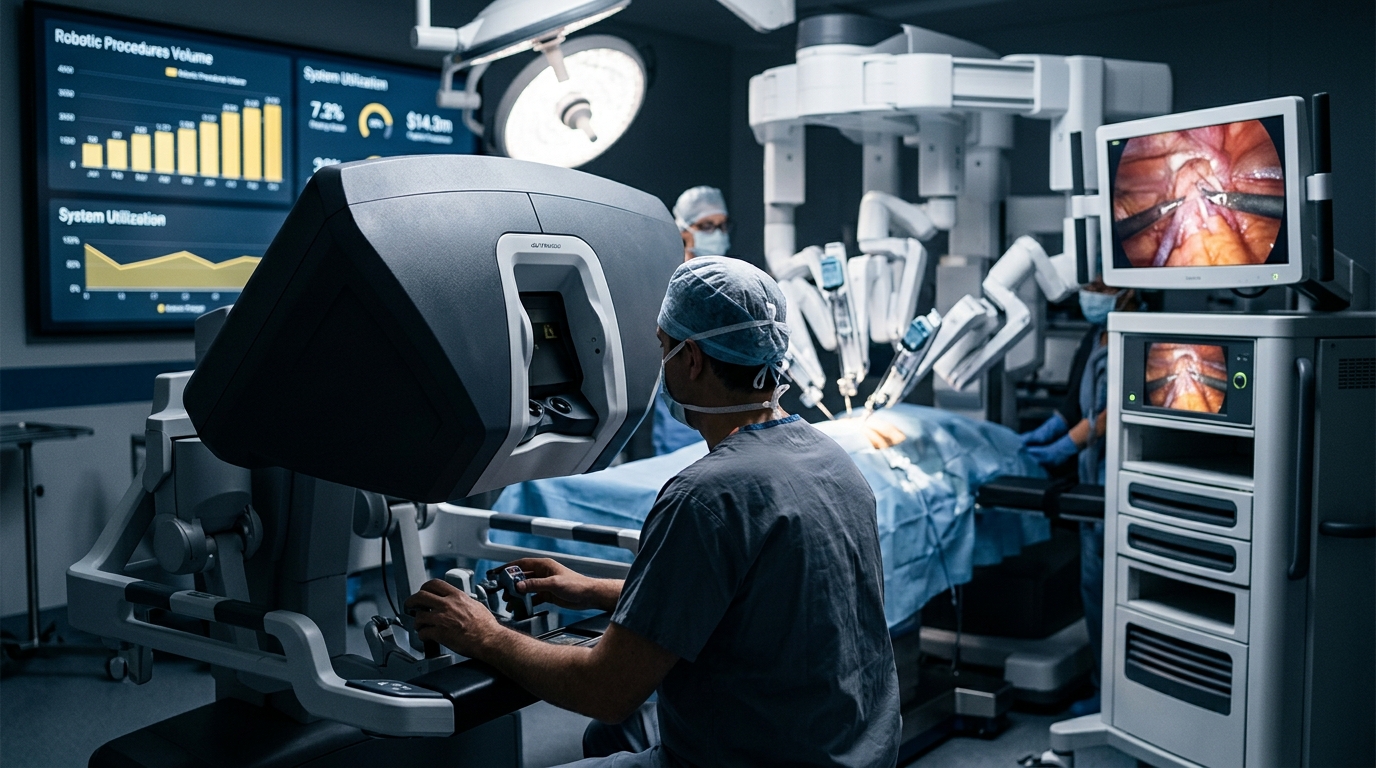
There is a category of company Wall Street occasionally misprices not because the business is broken but because the growth is so consistent that investors stop asking interesting questions. Intuitive Surgical is that company right now.
Q2 2026 earnings are confirmed for July 16, after the close. The stock is sitting roughly 15% off its post-Q1 high and about 30% off its 52-week high of $603.88, despite zero deterioration in the fundamental story. That gap is worth examining carefully.
What Q1 2026 Said
Intuitive delivered a strong Q1 2026, with revenue accelerating 23% year over year to $2.77 billion and non-GAAP EPS of $2.50.
- Q1 2026 EPS: $2.53 (GAAP) vs. $2.27 estimate; Revenue: $2.866B vs. $2.763B estimate
- Total procedures: +17% year over year; Da Vinci +16%, Ion +39%
- Da Vinci 5 placements: 232 systems, up from 147 a year ago
- Total da Vinci installed base: 11,395 units (+12% year over year); Ion installed base: 1,041 units (+22%)
- Full-year procedure growth guidance: Raised to 13.5% to 15.5%
Recurring revenue was up 23% and accounted for 86% of total revenue. That is the razor-and-blades model working exactly as intended.
Da Vinci 5 utilization is already running ahead of the older Xi platform, driving U.S. utilization growth of 4% with after-hours procedures up 31%. Hospitals are getting more throughput from the same capital investment. That is a stickiness argument that is very hard to argue against.
The Part People Skip: Ion
Ion procedures grew 39% in Q1. The platform, focused on lung biopsies, is doing something strategically important: it diversifies Intuitive away from pure reliance on surgical procedure volumes.
This is portfolio diversification at the procedure level. For context, bariatric volumes have been pressured for several quarters by GLP-1 adoption. Ion’s growth offsets that drift. The full-year guidance raise happened while those offsets were actively working, and that is not an accident.
The Competitive Question Nobody Has Fully Answered
The da Vinci 5 made up 85% of U.S. system placements in Q1 2026. That pace of adoption is locking hospital capital budgets in before competitors can establish a meaningful U.S. foothold.
Johnson and Johnson submitted Ottava to the FDA for De Novo classification in January 2026. As of now, the system is not commercially available in any market. The FDA review is pending. So while the competitive threat is real and worth tracking, an imminent U.S. launch is not the base case for 2026.
There is also antitrust aftermarket litigation running in the background over EndoWrist instrument servicing. The court ruled with plaintiffs that the da Vinci robot and EndoWrist instruments occupy separate product markets for antitrust purposes, and that Intuitive holds monopoly power in the aftermarket for repair and replacement. Not a thesis-killer, but a risk that resurfaces periodically.
They Consulted Him to Help End “The Pelosi Paradox”
How is Nancy Pelosi worth $413 million on a $174,000 salary?
For decades, the revolving door between Washington and Wall Street kept regular folks like you locked out.
(One Jeff Brown was consulted by Congressional offices on…)
The “Pelosi Paradox” is coming to a swift end.
And it’s lighting a fuse under an over $2 quadrillion corner of the tech market.
Click here to discover how you could profit from this landmark moment.
In what’s set to be the biggest wealth transfer in America in 53 years.
The AI Layer Nobody Is Fully Valuing
Intuitive is investing in data and digital infrastructure to build out AI-enabled capabilities. The company’s approach: layer capabilities starting with high-quality procedural data from surgeries, robotic data streams, and electronic medical records, then use AI to provide insights, reduce outcome variation, and assist in surgical learning.
Here is what makes this interesting. Intuitive has approximately 11,395 da Vinci systems globally, each generating structured procedural data no competitor can replicate without decades of comparable installations. That data moat is arguably the most underappreciated part of the long-term case. Slight tangent, but worth sitting with: this is less a medical device company and more a data platform that happens to operate inside operating rooms.
Forward Scenarios
- Bull: Q2 procedure volumes hit the high end of guidance, dV5 placements accelerate, Ion enters new indications, and the AI product roadmap gets fresh analyst attention. Stock reclaims its post-Q1 high and pushes back toward the $480 to $500 range.
- Base: Steady execution in line with guidance, dV5 upgrade cycle continues at current pace, no major competitive developments. Stock consolidates in the $420 to $450 range through and after earnings.
- Bear: Management baked in roughly 100 basis points of gross margin pressure from tariffs into FY26 guidance. If that worsens, or China and Japan hospital spending stays subdued, or J&J Ottava receives FDA clearance faster than expected, multiple compression follows any guidance miss.
Q2 2026 will tell you whether the procedure volume guidance was conservative or fair. Given Q1’s 17% growth against a 13.5% to 15.5% full-year range, there is meaningful room for the business to outperform its own forecast again. July 16 is when the market decides whether this pullback was noise or something more. That answer is about 10 days away.