July 1, 2026
Kroger Just Bought Giant Eagle
A $1.65B deal closed this morning. The grocery war is accelerating.
KR: Bearish Signal Before the News Hit
Before we get into the deal itself, here’s where Kroger’s stock stood technically as of Tuesday’s close — because this context shapes how the market is likely to digest today’s announcement.
- Price vs. 50-day SMA: KR closed at $55.53 on June 30, well below its 50-day simple moving average of approximately $68.74. That’s a significant gap — not a minor drift.
- Price vs. 200-day SMA: The 200-day SMA sits near $62.18. KR is trading roughly 11% below that level. Both moving averages are pointing lower, which is a textbook bearish posture.
- RSI: The 14-day RSI was sitting near 42 heading into today — below the neutral 50 line, not yet oversold, but softening. There’s room to fall further before technicals flash a reversal signal.
- 52-week range: KR has traded between $54.97 and $76.58 over the past year. It closed just 56 cents above its 52-week low on Tuesday. That’s a stock under pressure.
- Moving average signals: Across MA5 through MA200, technicals were showing 11 Sell signals versus 1 Buy signal heading into this morning. Broadly, the chart is not telling a recovery story yet.
- Key levels to watch: The $54.97 low is the immediate floor. Reclaiming $62 (the 200-day SMA) would be the first meaningful technical signal that sentiment is shifting. Until then, the path of least resistance is sideways to lower on price action alone.
That’s the technical backdrop. Now here’s what changed this morning.
Do NOT buy SpaceX until you read this
History shows…
Investing into the biggest IPO of our era is NEVER where the biggest money gets made.
Instead, as the man whose research has been sought out by over 500 institutions says…
The real fortunes are made in “The Aftershock.”
Kroger announced this morning that it’s acquiring Giant Eagle for $1.65 billion. The market moved on, mostly fixated on chip stocks. That’s probably the wrong call.
This deal is the opening move in something bigger.
What Happened
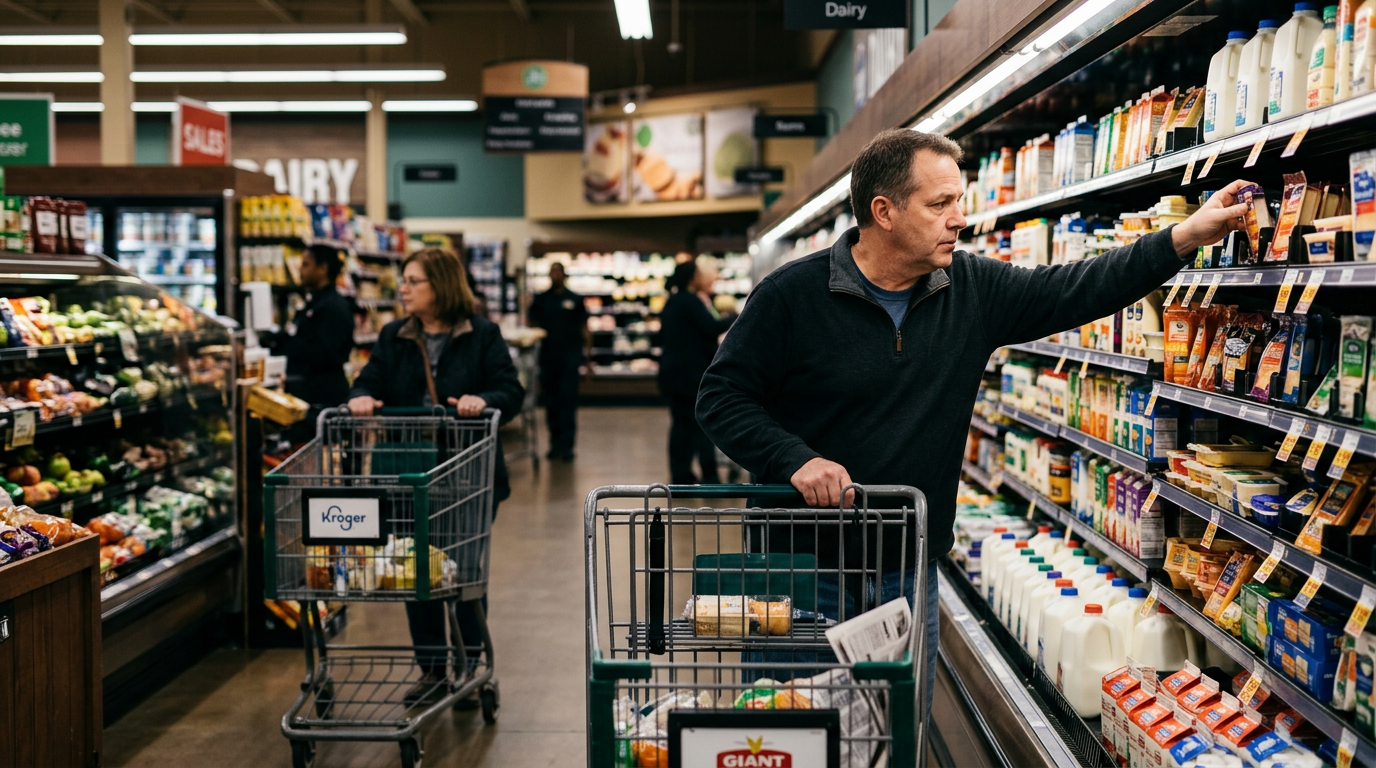
Kroger will acquire Giant Eagle, a leading family-owned food and pharmacy retailer with approximately $9 billion in annual sales and 197 supermarkets and 11 standalone pharmacies across northern Ohio, western Pennsylvania, West Virginia, Maryland, and Indiana. The purchase price is $1.65 billion, comprised of $1.25 billion in cash and the assumption of approximately $400 million in outstanding liabilities.
The deal is the first major acquisition under CEO Greg Foran, who took the top job in February 2026 after a roughly year-long search following the ouster of former CEO Rodney McMullen. Foran came straight from running Air New Zealand and, before that, spent five years leading Walmart’s U.S. operations. That last part matters more than people are giving it credit for.
The context makes the move feel even more pointed: this is Kroger’s first major acquisition following its failed mega-merger with rival Albertsons. That deal, worth nearly $25 billion, fell apart in 2024 after the two largest U.S. supermarket chains failed to convince multiple courts that they should be allowed to merge.
So Kroger is back. Smaller deal, cleaner regulatory path, regional focus. Smarter approach.
Why This Matters Beyond the Headline
The U.S. grocery industry is in the middle of a consolidation wave that the Albertsons collapse temporarily paused. Giant Eagle generated about $9 billion in sales, representing roughly 6% of Kroger’s $147.6 billion in annual revenue. That’s a meaningful bolt-on. Not transformative on its own, but it establishes a pattern.
What’s interesting is the geography. Ohio, Pennsylvania, West Virginia, Maryland, Indiana. This is exactly the Midwest and mid-Atlantic corridor where Walmart has been aggressively expanding its grocery footprint through its supercenter model and digital delivery buildout. Kroger is planting a flag in contested territory. And the man leading Kroger used to run Walmart’s U.S. business. He knows exactly where the pressure points are.
The pharmacy angle deserves attention too. Grocery-pharmacy integration is one of the few defensive moats left in traditional retail. It drives loyalty, visit frequency, and data — all things Kroger needs to compete against Amazon Fresh and Walmart+. Adding 11 standalone pharmacies on top of 197 supermarkets is not a small thing.
Your Complimentary Dividend Package
Today, you can claim the Ultimate Dividend Package… For FREE. (No credit card required!)
Inside, Marc Lichtenfeld – bestselling author of Get Rich with Dividends and world-renowned income expert – is giving away his top dividend picks for 2026.
You’ll get details on…
• Marc’s No. 1 dividend stock for 2026
• The safest 9% dividend in the world
• The top three “Extreme Dividend” stocks
• And much, much more!
Sector Angles Worth Watching
A few threads worth tracking as this deal moves toward a close expected in 2027.
First, the divestiture angle. Kroger and Giant Eagle have already flagged that a limited number of Giant Eagle stores will be divested as part of the regulatory approval process. Those stores will go somewhere. Regional chains and private equity-backed grocery operators in the mid-Atlantic are the most likely buyers. SpartanNash (SPTN) and Grocery Outlet (GO) are worth watching as potential beneficiaries of whatever gets shed.
Second, the private label angle. Giant Eagle has a strong private label program. Kroger’s private label margins run structurally higher than branded products. Folding Giant Eagle’s SKU base into Kroger’s Our Brands umbrella could add meaningful margin lift across a 24-month integration window. This is Kroger’s real long-term play here — not just store count.
Third, the loyalty data angle. Kroger plans to maintain Giant Eagle’s myPerks loyalty program while exploring opportunities to expand its reach. Loyalty programs in grocery are effectively data infrastructure at this point. The scale of Kroger’s combined customer database post-close becomes one of the largest consumer datasets in U.S. retail.
Three Scenarios
Bull Case: Regulatory approval comes with minimal conditions. Integration costs track below guidance. Private label margin expansion arrives earlier than expected. Kroger demonstrates that Foran is executing a disciplined, targeted acquisition strategy. Analyst targets range from $71 (Guggenheim Buy) to $78 (Telsey Outperform), with the median across 33 analysts sitting at $74. KR starts closing the gap.
Base Case: Regulatory review runs through late 2026 into early 2027. Limited divestitures reduce dilution. Kroger shows integration discipline. The deal proves accretive in the second full year after completion, consistent with company guidance. KR trades sideways to modestly higher as the deal works through the approval process.
Bear Case: Regulators demand broader divestitures than flagged, reducing the strategic value of the deal. Integration costs surprise to the upside. Meanwhile, Walmart accelerates its grocery delivery buildout and takes share in the exact markets Kroger just paid a premium to enter. KR underperforms the consumer staples sector through 2027, with Wells Fargo’s $58 target as the floor to watch.
Elon Musk Deploys Next Big Project (Not Space or AI)
Elon Musk is rolling out a breakthrough technology that could replace our need for foreign oil and ignite a $10 trillion boom a small group of stocks.
Trading Notes
KR closed at $55.53 on June 30, just 56 cents above its 52-week low of $54.97. The stock was indicated down roughly 2% in premarket trading on the announcement. The current level puts it well below where most analysts have their targets — the median sits around $74 across 33 analysts, with Telsey Advisory at $78 (Outperform) and Guggenheim at $71 (Buy). Not everyone is optimistic: Citi cut its target to $61, and Wells Fargo lowered to $58, both with neutral ratings.
Slight tangent, but it matters: Kroger also raised its quarterly dividend by 11% to 39 cents per share just last week — boosting the annual dividend from $1.40 to $1.56. That’s not a company hunkering down. That’s a company signaling confidence in its cash generation even as the stock sits near annual lows.
For options traders, implied volatility on KR is relatively low given the event risk now embedded in the stock. A longer-dated call spread targeting a recovery toward the $62 to $67 range — the 200-day SMA and above — with a January 2027 expiry gives exposure to the potential upside window without requiring precise timing. Sizing matters. This is a patient trade.
The broader point: grocery is not a sleepy sector right now. Specialty banners like Trader Joe’s are outperforming, discounters like Aldi are pulling in cost-conscious shoppers, and Amazon isn’t standing still. The defensive, high-frequency nature of grocery is attracting capital in this environment. Kroger just bought 197 more doors. What Walmart does next is the real question.
For informational and educational purposes only. Not investment advice. Trading involves risk, including loss of principal.