June 9, 2026
Alibaba just got flagged by the Pentagon
Not a sanctions headline. A procurement headache that spreads quietly.
First a message from Stansberry Research
Editor’s Note: Marc Chaikin, the 60-year Wall Street legend who called Nvidia before it soared 45,000%, just came forward with another huge opportunity he’s spotted in the AI space. It’s a way to get backdoor pre-IPO exposure to SpaceX – and I haven’t heard anyone else talking about it. With the IPO date looming, this note from Marc is extremely time-sensitive, so take a moment now to read it.
Dear Reader,
One simple trade you can make in your brokerage account today can unlock a backdoor to pre-IPO exposure to SpaceX before it goes public.
Get in position now, and you could look forward to benefiting from as high as a $122 billion windfall on IPO day.
That’s a payout worth more than the market cap of most publicly traded companies.
WARNING: You only have days left to make this play before SpaceX goes public.
Get all the details of this trade right here…
Sincerely,
Marc Chaikin
Founder, Chaikin Analytics
P.S. I highly suggest you do NOT buy into the SpaceX IPO on day one, because share prices could become extremely unstable. This backdoor way in before the company goes public is a much better way to get your piece of the SpaceX pie. Click here to see how…
Alibaba just got flagged by the Pentagon
June 8, 2026 is the date to circle.
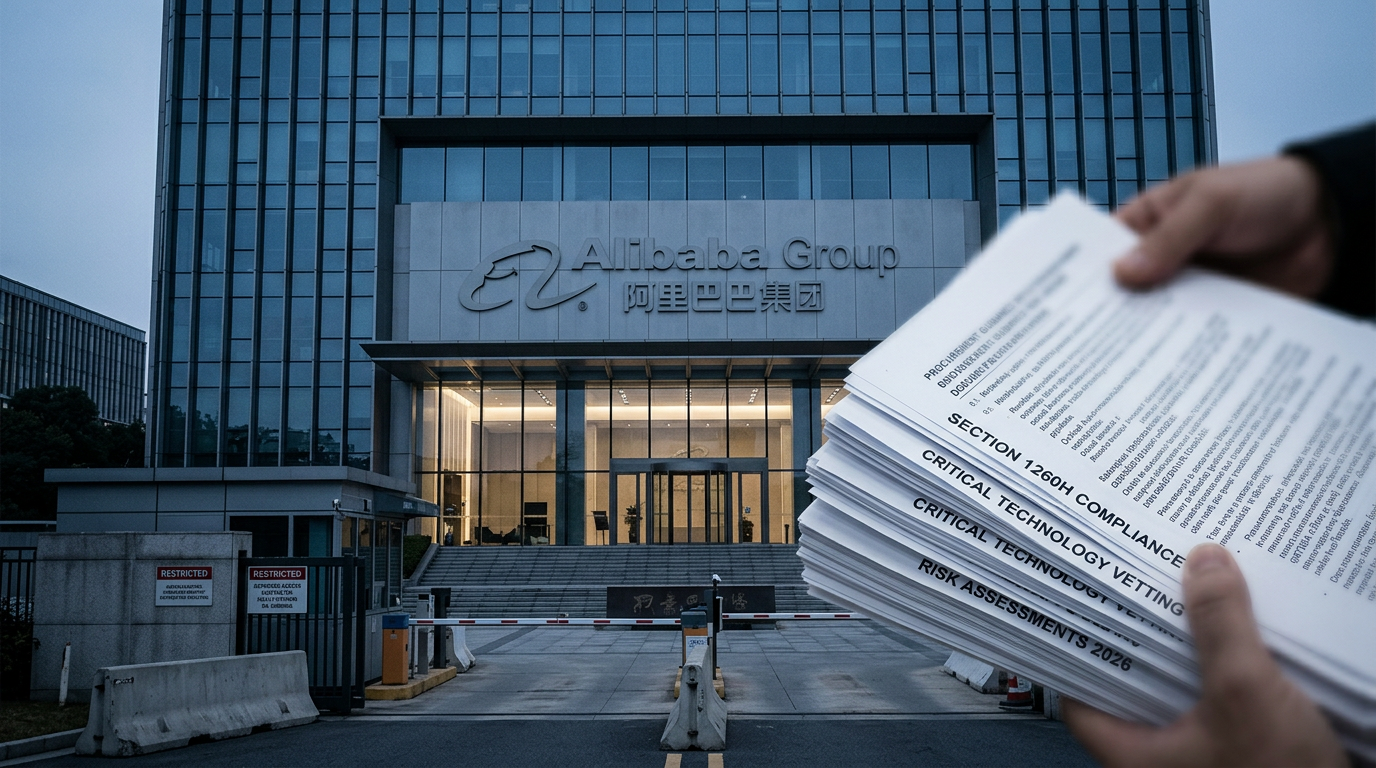
The U.S. Defense Department added Alibaba Group Holding Limited (BABA) to its Section 1260H list of “Chinese military companies.” It also named other household-name firms in the same update. This is not a rumor, and it is not an “internet said so” situation.
What’s interesting is how fast a label like this travels through procurement, even when the average investor reads it as just another Washington headline.
Here’s the thing: procurement people do not wait for the big hammer. They work off risk signals. A list entry becomes a compliance question, which becomes a vendor review, which becomes a quiet “let’s avoid this if we can.” It’s boring. It’s administrative. And it can be very real.
Also, the 1260H designation has a specific downstream effect: it can restrict Defense Department contracting with listed entities, which is why the list matters even if you never expect Alibaba to sell directly to the Pentagon.
Slight tangent, but it matters. Modern “consumer tech” is often the same infrastructure stack that small businesses and public sector vendors rely on. Cloud services, identity tools, content delivery, data tooling, security layers. The lines blur. Dual use is the default now.
This is where it gets interesting: the biggest impact often shows up one step away from the named company. Systems integrators, MSPs, and software vendors start auditing dependencies. Big enterprise customers start asking for clean attestations. Procurement teams start preferring the vendor that creates fewer meetings.
We can’t keep this report public much longer.
We printed 1,000 copies of this report. 688 are gone.
When the last one goes out, we’re pulling it offline – the information inside is too sensitive to leave up indefinitely.
Here’s what’s inside the remaining copies:
This isn’t a newsletter. It’s not evergreen content.
It’s a window. And 688 people already jumped through it.
Alibaba is not one simple business line you can isolate. It’s commerce, logistics, media, and a cloud unit that touches data and compute. So the risk is not a single lost contract you can model cleanly. The risk is friction that spreads across partnerships and customer decisions, especially where government-adjacent rules and vendor screening already exist.
What I’m watching next is not a dramatic announcement. It’s the slow part: whether more contractors adopt internal “no touch” policies for anything on the 1260H list, and whether other rulebooks follow the same direction over the next few quarters. You’ll see it first in procurement language, not press releases.
Worth a look: pull up your list of companies that sell infrastructure to everyone and then ask a simple question. If procurement teams get jumpy, which names get avoided even if the product is fine?