
May 20, 2026
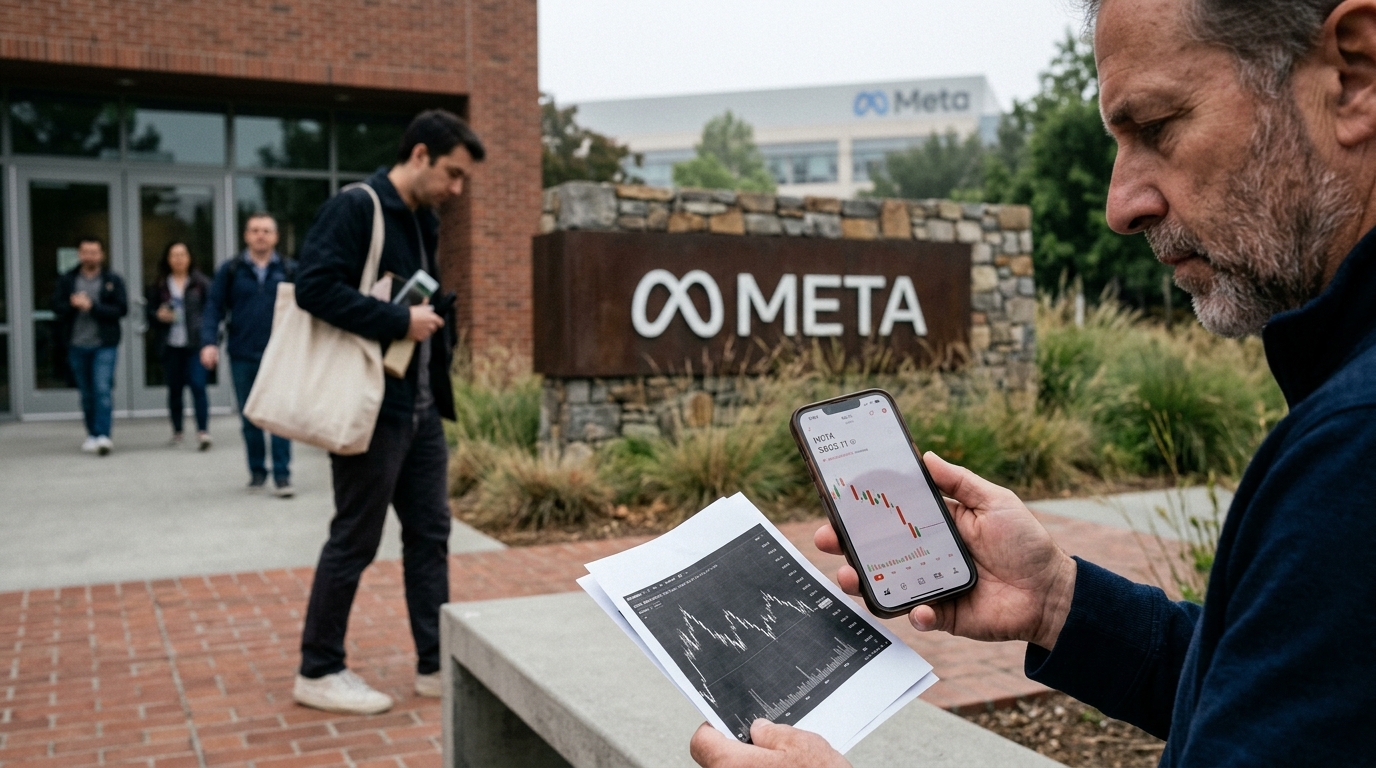
Meta cut 8,000 jobs this morning
The stock is 24% off its high. IV is compressed. July 29 is the next real event.
$590 is the number I’m watching today.
Not because of the layoffs — the market knew those were coming. Not because Q1 was weak — it wasn’t. I’m watching $590 because that’s the post-earnings low from April 30, it’s been tested twice since, and META is currently sitting at $603 on a day when 8,000 employees are being walked out. That’s a thin cushion. Whether it holds through today’s close tells you a lot about where this thing goes over the next 10 weeks.
Here’s the full picture.
The Defense Choke Point Nobody Is Talking About
When defense budgets grow, most attention goes to big programs – aircraft, hypersonic missiles, and satellites. But history shows the real limits often appear elsewhere.
Testing, scheduling, and access determine how fast new systems actually reach the field. And right now, those systems are under strain.
As hypersonics and space technology move from research into deployment, infrastructure – not funding – is becoming the choke point.
That’s where a small, operational aerospace company is gaining relevance. Not by competing with defense giants, but by helping them move faster.
In every major build-out, the companies that remove bottlenecks often matter long before they become widely known.
Q1 was legitimately strong. Revenue of $56.31 billion, up 33% year over year — fastest pace since Q3 2021 — beat consensus by $860 million. Adjusted EPS came in at $7.31 against a $6.79 estimate. Ad impressions grew 19%, average price per ad up 12%, operating margin held at 41%. On every line item that matters for the ad business, Meta delivered. And then the stock dropped 8.5% the following session anyway, erasing roughly $175 billion in market cap in a single day. That kind of reaction on a beat isn’t a fundamentals story. It’s a valuation story. Specifically, it’s a spending story — Meta revised 2026 CapEx from $115–$135 billion up to $125–$145 billion, citing higher memory chip costs and data center overruns, while Reality Labs posted $402 million in revenue against a $4.03 billion operating loss. Those two disclosures hitting simultaneously on top of already-stretched capital expenditure expectations is what gapped the stock down at the April 30 open. The business compounded. The forward cost structure scared people.
Q2 guidance is $58–$61 billion, implying 23–25% growth at the midpoint. That’s not a slowdown. The question isn’t whether Meta is growing — it clearly is. The question is whether the market is willing to hold a $145 billion CapEx year with minimal near-term AI revenue visibility. That’s a patience trade, and patience trades are hard when the 200-day is overhead resistance.
Which brings me back to the levels.
$590–$595 is near-term support. Clean break below $590 on volume — not a wick, a close — changes the short-term posture and opens the door to $560–$580, which is the next real demand zone based on the 2025 price structure. $640–$650 is the first resistance worth respecting on the upside. That’s where the pre-earnings consolidation zone sits and where the 50-day moving average is hovering after META broke it on the April 30 gap. Reclaiming $650 with conviction is the first sign the selling has actually exhausted. Above that, $680–$690 is the 200-day — intermediate-term resistance until proven otherwise. $700 is round-number overhead. $720 is where JPMorgan just set their revised target after cutting from $825, and it roughly marks the pre-CapEx-revision baseline.
Those are the lines. Everything else is commentary.
On options: before the April 29 earnings release, weekly IV was pricing in a 5.8% one-day move — widest expected range on a META earnings event since November 2022. The 25-delta put-call skew on May expirations hit 6.4 volatility points on April 24. Institutions were clearly hedging into the report. Post-event IV crush has brought things down sharply. IV rank has compressed from the upper quartile pre-earnings to a much more neutral zone, which is actually useful for traders right now — long premium structures are materially cheaper than they were three weeks ago. That window won’t last. IV starts expanding again 2–3 weeks before July 29, which means the next 6–7 weeks are the entry window for anyone building a defined-risk position around Q2 earnings.
China Thought They Had This Locked Up
China controls 98% of the world’s gallium supply – critical for modern technology.
But a small American firm may have just changed the game with a breakthrough called GaN.
Watch this presentation to learn how it could reshape tech – and why investors are watching
Three ways to play it, honestly framed:
- Long bias: If Q2 revenue lands at or above $61 billion on July 29 and CapEx commentary doesn’t get worse, $720 is the first target, $800+ is the Q3/Q4 scenario. A bull call spread — long August $640 call, short August $720 call — works here while IV is still compressed. Invalidated on a close below $590.
- Short bias: If CapEx guidance moves higher again or AI monetization timelines slip, $590 breaks and $560–$580 gets tested. A bear put spread in August expiry captures that move with defined risk. Invalidated on a volume-confirmed reclaim of $650.
- Neutral: Most probable scenario between now and mid-July is that nothing dramatic happens — the stock grinds in a $590–$650 range while the market waits. An iron condor with short strikes at $570 and $660 collects time decay in that environment. The risk is a macro shock or surprise mid-quarter management update, both of which would require fast adjustment.
Now, the layoffs themselves — because the framing matters for how you read the Q2 margin line.
This isn’t a distressed cut. Meta ended Q1 with $81.2 billion in cash and marketable securities against $58.7 billion in long-term debt. Free cash flow stayed strongly positive even while running $19.8 billion in Q1 capital expenditures alone — an annualized pace that already exceeds the guidance midpoint. The 8,000 departures are being partially replaced by 7,000+ new hires into AI-specific roles. Bank of America estimates $7–$8 billion in annualized savings. What traders are actually watching for is whether any of that shows up in the Q2 operating margin line. If margins hold at 40%+ while revenue grows 23–25%, the 18.4x forward earnings multiple — against a five-year average of 24–25x — starts looking like a real discount, not just a paper one.
Worth noting: JPMorgan’s downgrade to Neutral — cutting target from $825 to $725 — flagged intensifying full-stack AI competition, not deteriorating fundamentals. Goldman Sachs stayed constructive. The Street is 96% Buy-rated with a consensus target around $834–$836. The split isn’t about whether the business works. It’s about whether you get paid for waiting. That’s an honest disagreement and I don’t think either side is obviously wrong right now.
Slight tangent, but it’s been nagging at me: the $19.8 billion Q1 CapEx figure is running hotter than the full-year guidance midpoint would imply if you just annualize it. Management called out higher component pricing and additional data center costs as the driver. That could be front-loaded spending that normalizes by Q3 — or it could be a preview of another guidance revision in July. I don’t have a strong view on which. But if you’re long into July 29, that’s the question I’d be sitting with.
July 29 is 10 weeks out. Between now and then, $590 is the line I’m not willing to see close below without reassessing.
Why Wall Street is Dumping ETFs – May 29th
What does the “smart money” know that you don’t? On May 29, a 90-year-old law could shake the global gold market. While retail investors sit in ETFs, institutions are quietly buying a little-known “shadow miner.” It can move 10x faster than gold.
For informational and educational purposes only. Not investment advice. Trading involves risk, including loss of principal.