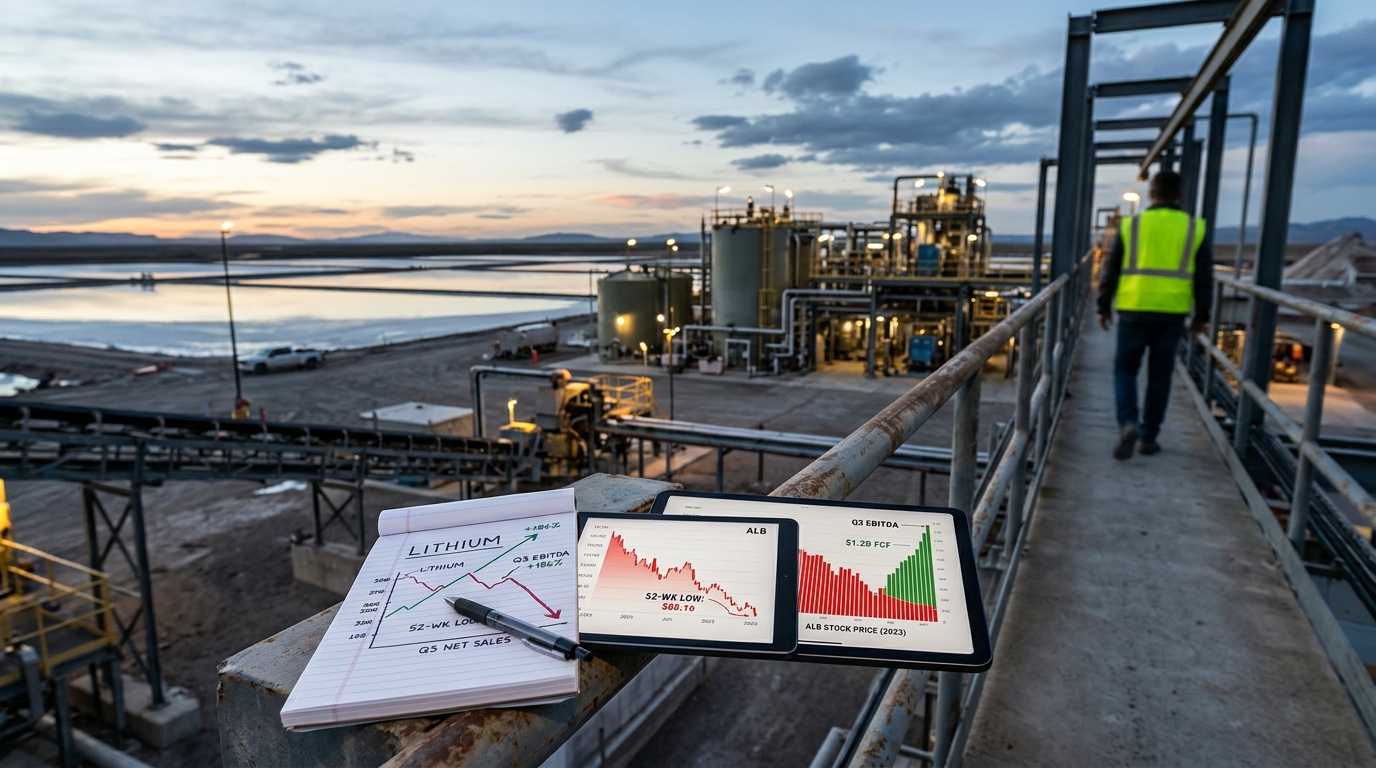
Albemarle closed November 16 at $88.16, its worst close of the year and a new 52-week low, down from a 52-week high of $221. That is a 60% peak-to-trough collapse on a company that just reported its strongest quarterly EBITDA growth in years. The dislocation between the operating results and the share price is the actual trade worth modeling.
What the Numbers Actually Say
Q3 2026: Net sales of $1.55 billion, up 19% year over year. Adjusted EBITDA of $646 million, up 186%. EBITDA margin expanded to 42%. Energy Storage adjusted EBITDA alone surged 351% on the back of a 95% year-over-year improvement in realized lithium prices. Free cash flow came in at $325 million for the quarter, lifting the year-to-date total to $1.2 billion. Management simultaneously cut 2026 capital expenditures to $300–$350 million from roughly $500 million, freeing capital without sacrificing the asset base.
What drove the selloff after those results? Forward guidance. Under the observed market price scenario of roughly $10/kg LCE, full-year net sales are expected at $4.1–$4.3 billion with adjusted EBITDA of $0.9–$1.0 billion, well below Q3’s run rate. Lithium carbonate futures on the Guangzhou exchange dropped as much as 11.8% on a single October session to 104,740 yuan per ton, dragging every lithium name lower. The market is pricing the worst-case scenario and ignoring the structural picture.
The Structural Case the Price Is Missing
Benchmark Mineral Intelligence forecasts a supply shortfall of 171,000 tonnes in 2026 and 44,000 tonnes in 2027 before the market moves to surplus in 2028. Citi’s supply chain research shows global lithium demand reaching 2.179 million tons this year, growing 31%, against supply of only 2.11 million tons. The gap is real, and it is not being created by EVs alone.
Lithium demand from energy storage surged 71% in 2025. Analysts now forecast another 55% growth in 2026, with battery energy storage systems potentially accounting for nearly one-third of all lithium demand by year-end. Albemarle itself raised its 2026 stationary storage battery production forecast to 900–1,100 gigawatt hours. That demand vector is structurally less cyclical than EV uptake and far less exposed to consumer sentiment swings.
Analyst Positioning
Of 23 analysts covering ALB, 15 carry buy or strong buy ratings. Bank of America lowered its target to $120 on November 12 but kept its Buy rating. Deutsche Bank maintained a $125 target. Scotiabank holds Sector Outperform with a $165 target. The consensus sits near $154, implying over 70% upside from current levels. Mizuho, which upgraded ALB to Outperform in October, sees Albemarle as the lowest-cost producer with a balance sheet that provides downside resilience while retaining the flexibility to invest as project returns improve.
Scenario Framework
Bull Case: Lithium carbonate recovers toward Mizuho’s $22,500/ton 2027 target. BESS demand hits the 55% growth forecast. ALB trades back toward the $130–$165 analyst target band. Incoming CEO Ragnar Udd, who joins February 1, 2027, accelerates capital efficiency.
Base Case: Spot lithium stays depressed near $10–$12/kg through Q1 2027. ALB consolidates between $88 and $105 as the market waits for supply-deficit data to materialize. The balance sheet and $1.2 billion in year-to-date free cash flow keep credit risk off the table.
Bear Case: China futures break below 100,000 yuan/ton. CATL restarts production faster than expected, pushing 2027 into a steeper surplus. ALB revisits the $80–$85 zone.
Key Levels to Watch
ALB closed below its prior 52-week low of $89.77 on November 16. Volume-weighted support sits near $87–$88. A hold above that range on today’s early bounce matters. Resistance from the Q3 earnings gap is clustered between $95 and $100. Traders positioning around the structural thesis need a stop framework below $85, where the deep-value case loses structural integrity. The record date is December 18 for the $0.41 per share dividend, adding a secondary timing consideration for swing positions.
The operating business earned $646 million in EBITDA last quarter on a company priced under $12 billion. That math alone is why disciplined traders are watching this level closely, not chasing it.