
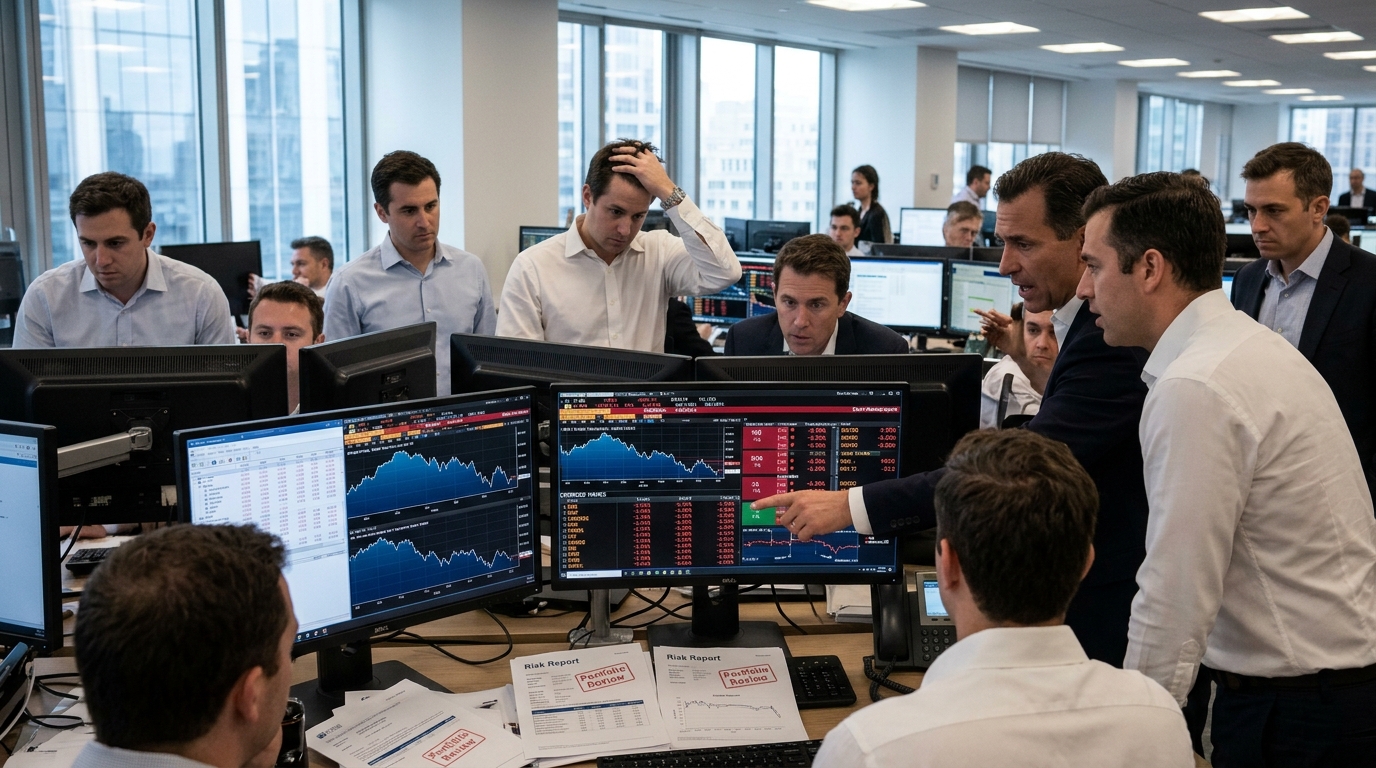
The sellers moving markets this week are not long-term investors who changed their minds about artificial intelligence. They are portfolio managers responding to risk controls, redemption letters, and loss limits. That distinction matters enormously for anyone trying to read the price action in megacap tech right now.
Equity long-short funds that primarily invest in tech fell more than 4% on Thursday alone, leaving year-to-date returns “roughly flat” by Goldman Sachs estimates, against a peak gain of 24% in June. Five months of AI-driven profits, erased in a single session. That is not a rotation. That is a forced exit.
What Walleye Tells Us
Walleye Capital, the $17 billion multi-strategy fund, cut its head of equity long-short, Anil Gondi, and a substantial portion of its internal long-short investment teams, according to a letter to investors reported by Business Insider. The firm posted a 5.9% loss in October, its worst monthly performance since March 2020.
CEO and CIO Will England wrote that the firm is examining “every aspect” of its business, saying that recent efforts including bringing in new leadership “did not produce the results we expected,” and that the opportunity cost was “too high relative to the return.” Gondi had only joined Walleye in July 2025, recruited from Balyasny Asset Management. His tenure lasted less than 18 months.
Walleye emphasized it will not exit long-short equity investing entirely and will allocate more resources toward volatility, quantitative strategies, and external investments. That framing is important: this is not a fund deciding stock-picking is dead. It is a fund concluding it was doing stock-picking badly, in a structure that was too expensive relative to what outside managers could deliver.
The Crowding Problem Is Bigger Than One Fund
Walleye’s announcement did not arrive in isolation. Research firm PivotalPath warned in a note this week that it observed a high and increasing degree of overlap among the 10 largest multi-strategy hedge funds, meaning their unwind could fall on many of the same securities. When every major platform owns the same book, risk reduction stops being a fund-level decision and becomes a market event.
Borrowing swelled the combined assets of the largest funds to $2.2 trillion against just $360 billion in investor capital, magnifying the shared bets. That leverage amplifies every forced sale. Goldman Sachs reported $20 billion of tech-stock selling over the two weeks preceding October 26. Thursday’s session added substantially to that total.
The financial research community Special Situations noted that internal teams from Axebrook, Engineers Gate, Lone Pine, Millennium, and Verition, as well as Samlyn, have experienced liquidations, large redemptions, or team adjustments this week. Walleye is the most prominent name, but it is not an outlier.
Nvidia sits at the center of every overlapping book being unwound. Nvidia’s gross-margin guide for Q3 already gave fundamental investors a reason to hesitate before stepping in front of forced sellers.
What Investors Are Missing
The conventional read on a hedge fund unwind is that it creates a buying opportunity once the forced selling clears. That may be right eventually. But the more important question today is whether the forced selling is finished.
PivotalPath warned that when the 10 largest multi-strategy funds look increasingly similar, everyone de-risking becomes the same trade at the same time, pushing prices lower as liquidity thins, and the most crowded positions become the market’s pressure-release valve. With teams still being cut and capital still being returned, there is no clean signal that the unwind is complete.
Credit markets may be pricing the stress before equities fully acknowledge it. Corporate bond spreads have already begun widening in ways equity markets have not yet reflected.
Several large multi-manager platforms have cut leverage and laid off loss-making teams in recent weeks, and market participants expect more layoffs if declines continue. The selling, in other words, may be generating its own next chapter.
Stocks to Watch
- Nvidia (NVDA): The most widely held name across overlapping hedge fund books. Every forced exit in a tech long-short fund has NVDA near the top of the liquidation list. Watch daily volume for signs the institutional exit is slowing.
- Microsoft (MSFT) and Meta (META): Identified repeatedly as crowded longs heading into this selloff. Their relative resilience versus the broader tech slide will be the clearest measure of whether fundamental buyers are stepping in.
- Goldman Sachs (GS) and JPMorgan (JPM): Both banks are prime brokers to the funds cutting risk today. Rising prime brokerage activity and volatility products revenue are a direct, often overlooked, beneficiary of hedge fund instability.
- Cboe Global Markets (CBOE): Walleye’s pivot toward volatility strategies points to a broader industry shift. As multi-strategy funds rebuild around vol and quant, options market infrastructure becomes a quieter winner.