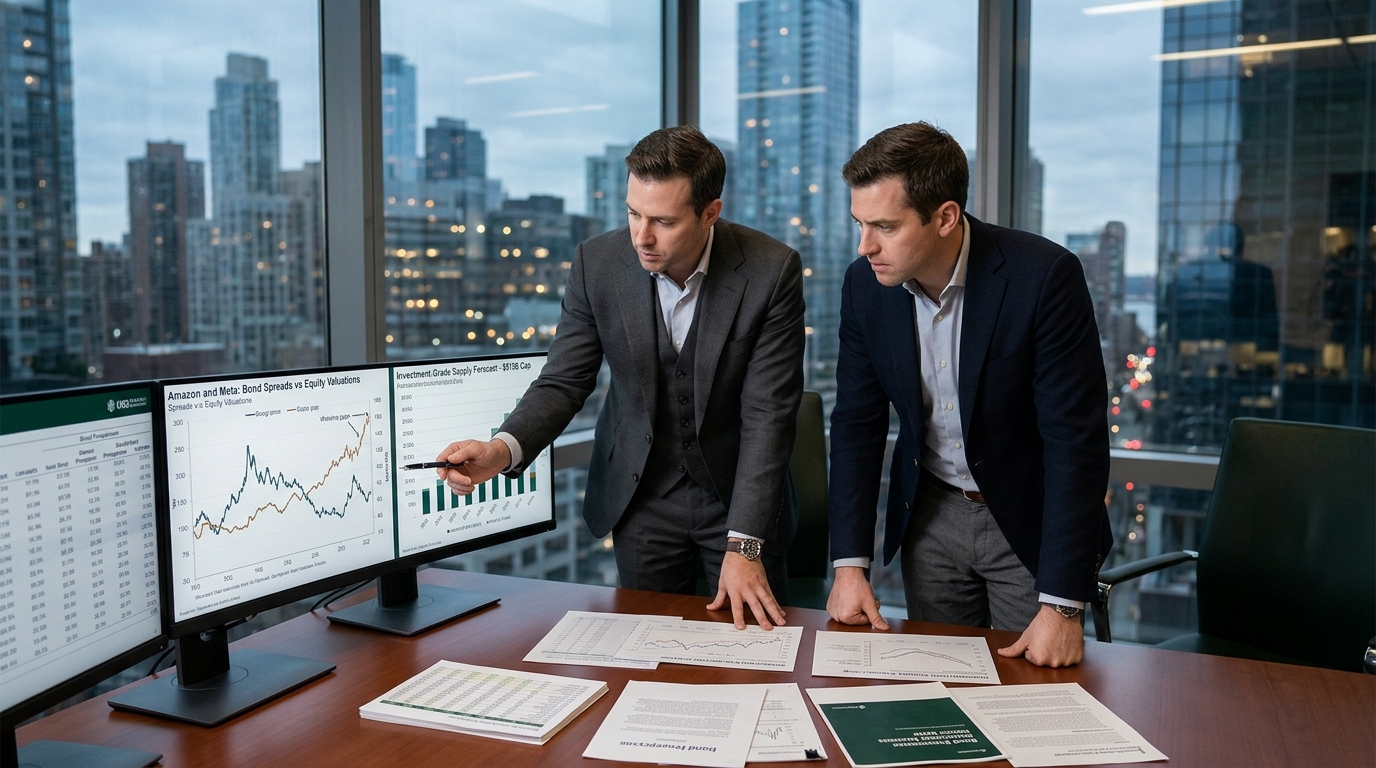
The investment committee conversation this week is not about earnings beats or cloud growth rates. It is about whether the bond market has become the more honest appraiser of the AI build-out than the equity market.
The evidence landed Thursday night. Amazon’s aggressive AI spending ate into its cash flow, with the company reporting a free cash flow outflow of $42.4 billion on a trailing twelve-month basis through September 30, 2026, versus a $14.8 billion inflow a year earlier. Capital expenditures are also surging: Amazon’s quarterly filing shows purchases of property and equipment of $77.3 billion for the quarter ended September 30, 2026. Meta fared slightly better but not by much: the company reported negative $2.12 billion in quarterly free cash flow. That leaves Microsoft as the lone hyperscaler still in the black on cash generation.
Bond investors noticed before the earnings releases. Hyperscaler spreads have widened by around 30 basis points year to date, compared with just 2 basis points widening in the broader USD investment-grade index. As of October 28, Microsoft’s 5-year CDS spread stood at 53 basis points, Alphabet’s at 80 basis points, and Amazon’s at 81 basis points. Friday’s session extended the pain, with risk spreads widening further across the lower-quality part of the market.
The $510 Billion Ceiling
Goldman Sachs ran the arithmetic on how much concentrated tech risk the investment-grade market can actually digest. The answer is sobering. Using the Bloomberg Index, none of the hyperscalers have more than $175 billion of index-eligible debt, and none represent more than 2.3% of the index. Bringing them up to the level of the US banks implies roughly $510 billion of incremental debt capacity in the US investment-grade bond market alone. The binding constraint is not issuer credit capacity but market absorption capacity.
That ceiling matters because the pipeline is still open. A meaningful share of Big Tech’s capital expenditures this year are expected to be financed with debt, and Goldman has been warning that concentrated AI-linked issuance is pushing up against absorption limits. Goldman has also discussed 2026 US investment-grade issuance running at multi-trillion-dollar scale, with AI-related borrowers making up a large share of nonfinancial supply.
Where Bonds and Equities Disagree
Here is the disagreement that should be in every investment committee room: equity markets spent much of 2026 pricing the hyperscalers as if the return on AI capital was largely certain. Credit markets never agreed. In PIMCO’s framing, AI-related borrowers have accounted for nearly a quarter of nonfinancial USD supply year to date, yet rather than spreading the pain broadly, hyperscaler spreads widened specifically, suggesting the market is absorbing the AI supply shock at its source.
Spreads in technology and communications have widened meaningfully as 2026 progressed, while several other sectors have not moved in lockstep. The bond market is essentially voting that the AI trade is a sectoral crowding story, not a rising-tide story.
The sectoral crowding story has a supplier dimension that bond markets are also pricing. Nvidia’s disclosed financing commitments to AI cloud partners raise questions about whether some of the demand it sells into is self-funded.
Stocks to Watch
Amazon (AMZN): The company held its 2026 cash capital expenditure expectation at approximately $220 billion despite a cash-flow hole that is growing faster than consensus modeled. Credit is already pricing this risk; equities are still deciding.
Meta (META): Negative quarterly free cash flow combined with rising CDS spreads creates the starkest valuation question among the social-media-turned-infrastructure plays. Its equity multiple was priced for cash generation, not cash consumption.
Microsoft (MSFT): Microsoft has said its calendar-year 2026 CapEx investment expectations remain unchanged, while also noting that a shift in how it uses finance versus operating leases affects how the total is described. Bond markets have rewarded it with the tightest CDS of the group.
Oracle (ORCL): Oracle also issued a force majeure notice to the developer of its Project Jupiter data center in New Mexico, adding an operational risk layer that bond holders appear to be repricing in real time.
CoreWeave (CRWV): The purest read on where credit stress leads when balance sheet leverage is extreme. With its bonds yielding around the mid-teens in late October 2026, credit markets are pricing it closer to distressed debt than a growth company, and bond pricing often turns before equity sentiment does. That sequencing is worth keeping in mind as the broader AI credit cycle matures.