
Dear Reader,
Amazon built a robot that can “feel.”
Not emotions like happiness or sadness.
It can work with items as different as socks and fragile electronics… while sensing contact and adjusting the force it applies.
As you probably know, Amazon has spent years automating its warehouses.
But strangely, this breakthrough has nothing to do with faster software, smarter chatbots, or more powerful AI chips.
Instead, it involves a new robot called Vulcan that can sense and handle objects using touch and force feedback.
Amazon says Vulcan can pick and stow approximately 75% of the item types inside its fulfillment centers.
Why does that matter?
Because it shows where AI may be headed next: out of computer screens and into the physical world.
See the story, including why physical AI could become the next major act of the AI boom.
|
Regards,
Matt McCall
Editor, McCall’s Innovation Report
P.S. Amazon says Vulcan can already pick and stow approximately 75% of the item types in its fulfillment centers. Click here to see why that matters for investors.
Deere’s Nitrogen Tech Saves Farmers. Not Deere.
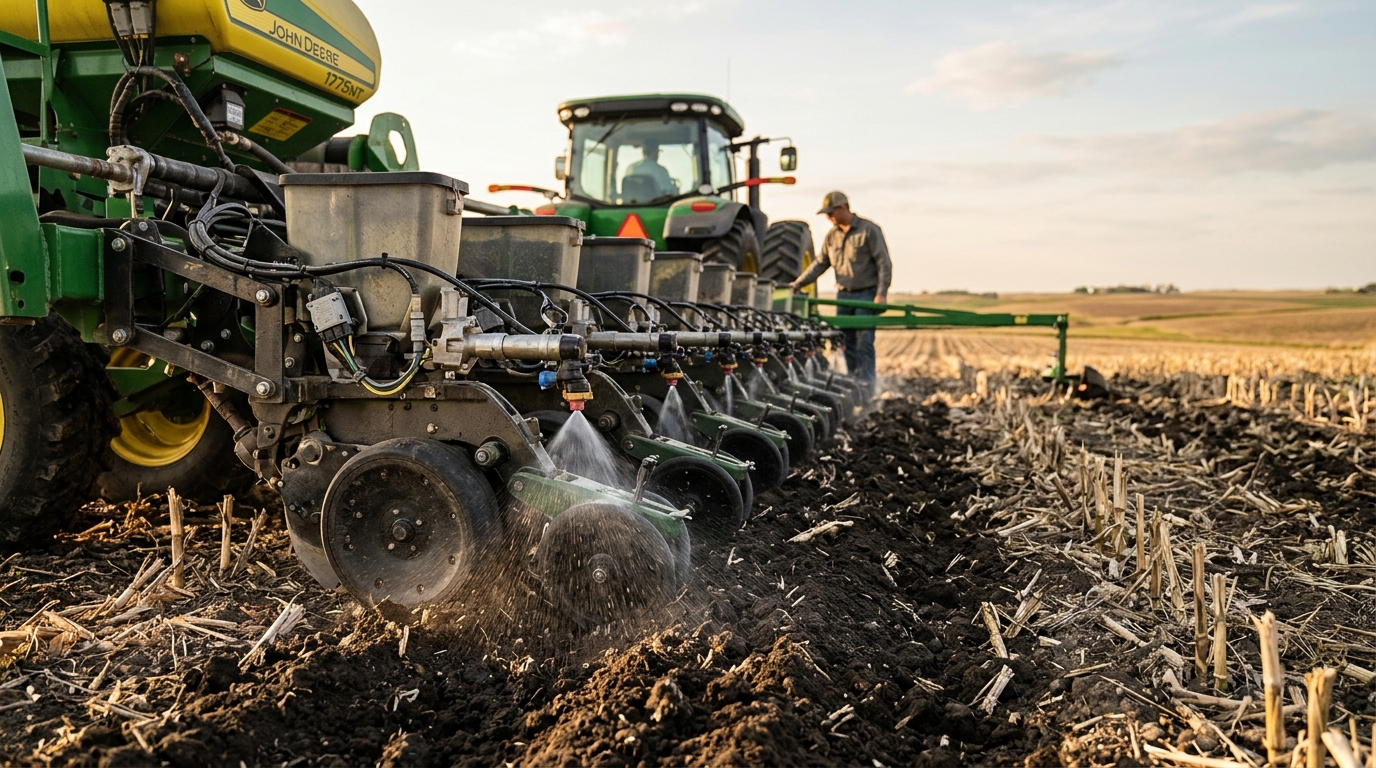
The pitch is compelling. John Deere’s ExactShot system uses sensors to detect when each individual seed is going into the soil and fires about a 0.2-milliliter dose of starter fertilizer directly onto it, skipping the empty ground between seeds entirely. Based on Deere’s internal tests across 21 farms in six Midwestern states, the result can be a reduction in in-furrow nutrient use of up to 66%. J.P. Morgan estimated that scaled across the full U.S. corn crop, ExactShot could save American farmers roughly $650 million annually at prevailing input prices.
That is genuinely useful technology. The question institutional investors should be asking is whether Deere captures any of that value, or whether it all flows to the farmer.
The numbers from Moline are uncomfortable. Deere’s Production and Precision Agriculture segment posted net sales of $3.998 billion in Q3 fiscal 2026, down 6% year over year, with operating profit falling 9% to $527 million. Through the first nine months of fiscal 2026, net income totaled $3.808 billion, below the prior year’s $3.962 billion pace. Management has guided PPA net sales down roughly 10% for the year. The company raised its full-year net income outlook to $4.75 billion to $5.0 billion after strong quarterly results and cost discipline.
Precision agriculture is supposed to be the reason to own Deere through a down cycle. See and Spray, the machine-vision herbicide system built on the 2017 Blue River Technology acquisition, has scaled to more than 5 million acres, with Deere citing roughly 50% savings on non-residual herbicide and 50% to 60% savings in some customer use cases. Deere has also said Precision Essentials renewal rates exceed 90% for second-year customers, a metric that looks like a real software business forming underneath the iron.
But Deere’s 2025 annual report acknowledged that SaaS subscription revenue did not represent a significant percentage of total revenues in 2025. The free Operations Center base platform is a deliberate choice, functioning as an adoption engine rather than a revenue line.
The honest read is that the nitrogen precision race is a farmer margin story today, not yet a Deere margin story. ExactRate, the complementary variable-rate system, has been marketed as delivering an average 4.3% reduction in inputs through row-by-row section control. For a large Corn Belt operation, that is real money. For Deere’s income statement, it remains a selling feature rather than a recurring revenue stream.
Stocks to Watch
- Deere (DE): The cycle bottom thesis requires precision ag software to compound into a recurring revenue layer. The hardware volumes are not there to carry the stock alone.
- Corteva (CTVA): Precision placement reduces fertilizer waste but increases demand for high-value biologicals and micronutrients applied in the same furrow pass, a direct product opportunity.
- CF Industries (CF): Any sustained reduction in nitrogen application rates is a volume headwind. The efficiency gains that benefit farmers compress demand for the product CF sells.