
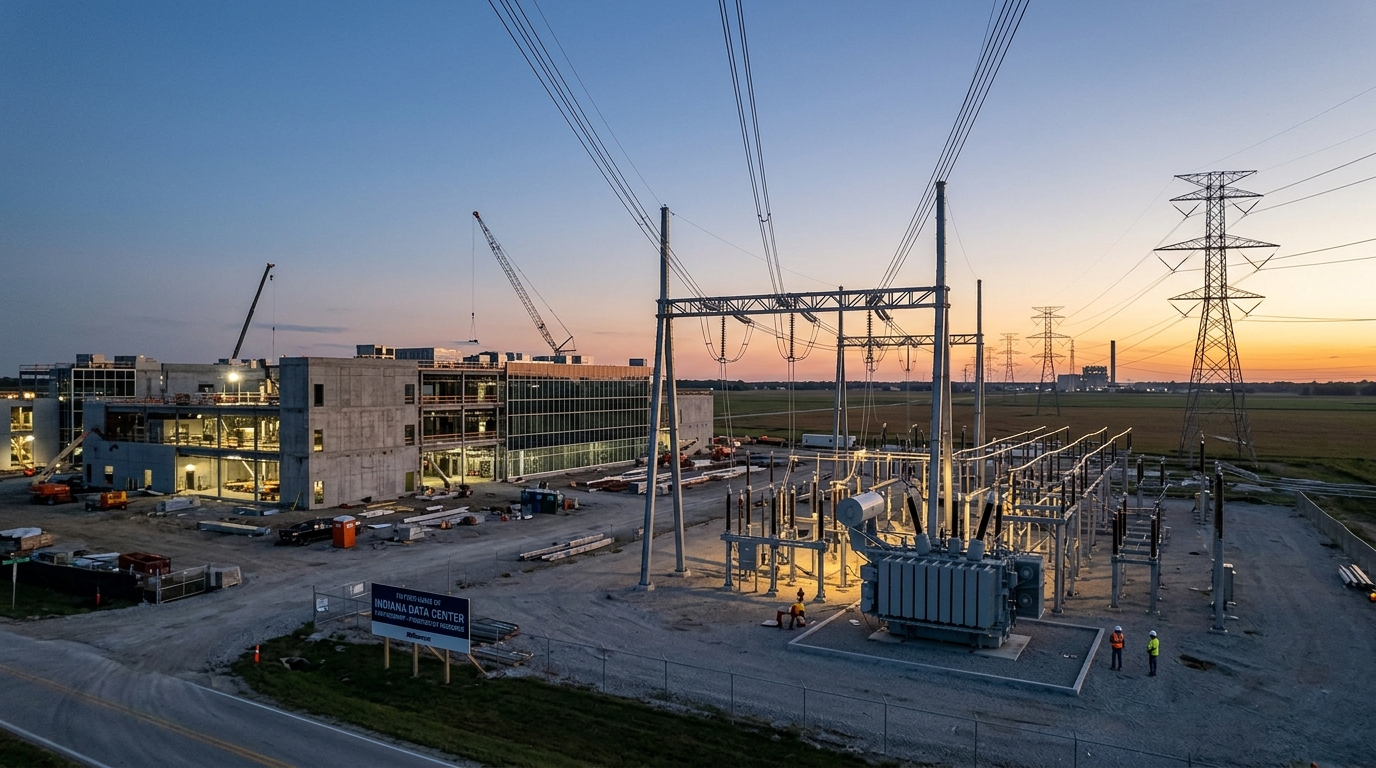
The AI land rush is relocating. Not slowing down: relocating. U.S. purchases of land for future data centers reached about $6 billion in the first half of 2026, up 79% from a year earlier, according to Avison Young. The capital is not hesitating; it is simply chasing the one input that chips and capital cannot manufacture on demand. Electricity.
The clearest proof arrived this week from two directions at once. Microsoft’s plan to anchor a major UK AI data center ran into a problem that money and GPUs cannot quickly solve: grid access. Multiple outlets reported Microsoft terminated its agreement for Nscale’s planned facility in Loughton, Essex, after expected power availability slipped into the 2030s. The same week, Microsoft signed a 20-year commitment in northern Indiana.
Where the Electrons Already Are
Microsoft has signed a long-term energy agreement with Indiana-headquartered regulated utility NiSource to power its planned data center campus in northern Indiana. The 20-year contract is expected to begin in 2028. As part of the agreement, NiSource said its power portfolio will be increased by about 1.1 gigawatts, with the company providing the transmission and generation infrastructure to serve the campus.
The deal’s structure is worth studying. NiSource said the agreement will be implemented through NiSource Generation Company LLC (GenCo) and structured so the additional infrastructure costs are not passed on to existing Northern Indiana Public Service Company electricity customers. Microsoft funds the wires. Existing ratepayers benefit. NiSource also said it increased its projected customer savings associated with its data center agreements to approximately $1.75 billion over the life of the contracts, up from a previously announced estimate of $1.4 billion.
This is not NiSource’s first rodeo. In April, Reuters reported NiSource signed a long-term supply agreement with an Alphabet unit for a northern Indiana data center and expanded an Amazon agreement to speed up power delivery and bring forward bill credits for households. Microsoft, Google, Amazon: the three largest hyperscalers in the world have now each chosen the same Midwest utility as their power partner.
Kokomo and the Weight of a Gigawatt
Fifty miles north of Indianapolis, a city that made its name building auto parts is now being proposed as the site of one of the largest data center campuses on the continent. Digital Realty has announced it is looking to develop three single-story data centers on 476 acres in Kokomo. The campus could total around 1 gigawatt of IT capacity across some three million square feet of data center space. The campus could be fully built out by 2033.
The city projects the site will generate between $1.3 billion and $1.7 billion in taxable property value. This could result in $44 million to $55 million in annual property tax revenue once the project reaches completion. Notably, local reporting has said the project would not include tax abatements, suggesting the location is attractive enough on its own terms. The reason is straightforward: Duke Energy and other large utilities have been explicit in public statements that they are structuring large-load arrangements so data centers cover the infrastructure costs needed to serve them. Committed power at scale is the scarce input, and Indiana has it.
The Mogul Mindset on Utilities
The conventional AI investment focus lands on chipmakers, hyperscalers, and data center REITs. That framing misses what is becoming structurally scarce. “The biggest thing right now is speed to power,” said John Andril, manager of market intelligence at Avison Young. In Northern Virginia, entitled land without power can sell for roughly $4 million an acre, compared with at least $6 million an acre for powered land. The premium is not for silicon. It is for certainty.
NiSource’s GenCo model creates something a chipmaker cannot: a recurring, long-duration, regulated revenue stream funded by the largest corporations in the world, structured so that ordinary ratepayers benefit rather than subsidize. The 9% to 10% annual consolidated adjusted EPS growth NiSource has guided through 2033 is not a stretch target given the contract backlog now accumulating. It is what happens when you hold the toll booth on a road everyone has to use.
What Could Go Wrong
Regulated utilities carry their own risks. Capital intensity is high: NiSource has told investors it is executing a $28.6 billion 2026 to 2030 consolidated capital investment plan. If load forecasts prove optimistic or a hyperscaler renegotiates, that spending does not reverse easily. Regulatory lag in Indiana could compress returns if GenCo’s cost-recovery mechanisms face political headwinds. And the very grid advantages that make Indiana attractive today can erode if transmission buildout stalls or competing states accelerate their own capacity additions.
Still, the direction of capital is clear. In the U.K., an AI Growth Zone proposal in North Yorkshire was reported as having been rejected for failing criteria that included credible plans for energy delivery, environmental considerations, and local economic benefit. Indiana passed that test. The lesson for long-term capital allocators is not that AI infrastructure spending is slowing. It is that the geography of that spending is hardening around places where the power exists today, and the utilities anchoring those places are quietly becoming indispensable.