
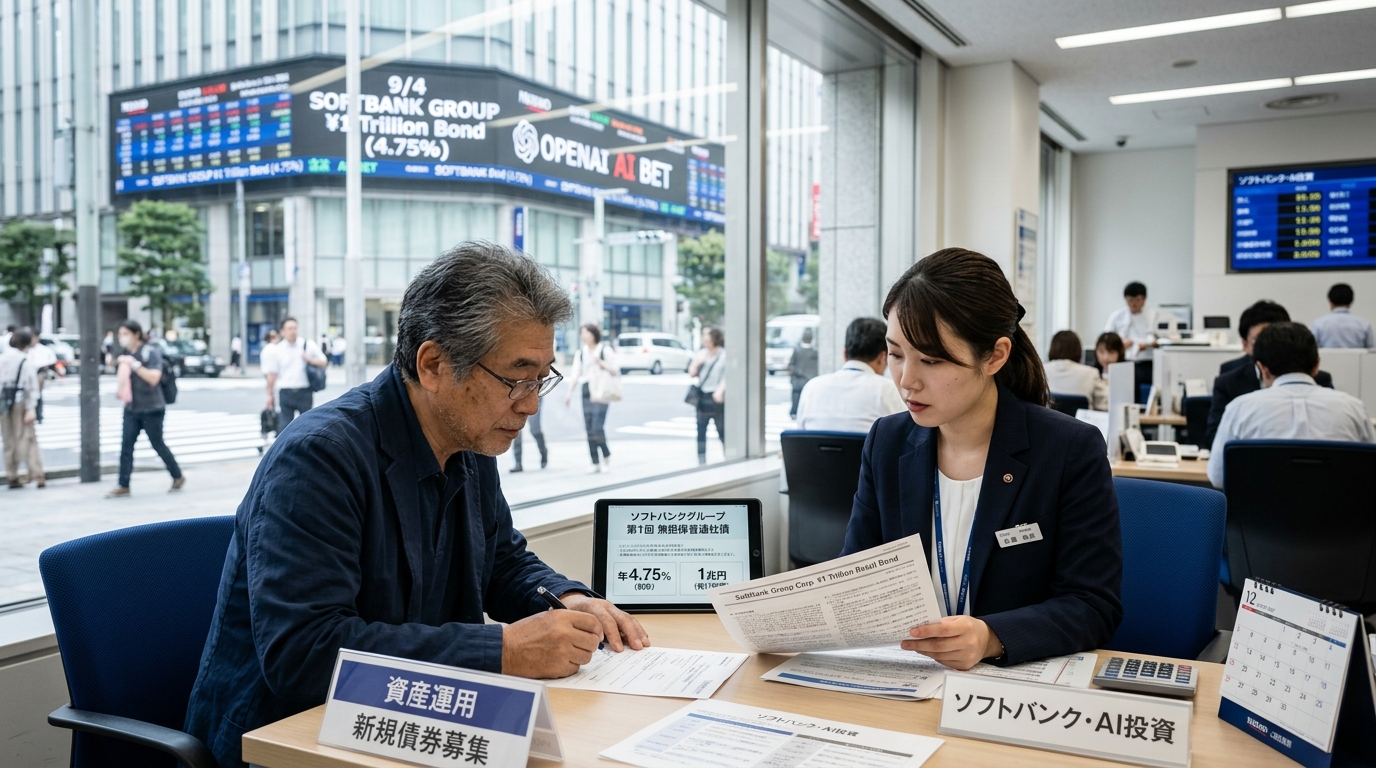
There is a moment in every Masayoshi Son cycle when the ambition outruns the available capital, and banks start saying no. That moment arrived again this autumn. When Son needed fresh billions to complete his commitment to OpenAI, SoftBank leaned on retail funding in Japan.
SoftBank priced a ¥1 trillion ($6.3 billion) retail bond with a coupon of 4.75% on September 4, 2026, the day the coupon was set. The issuance is set to be the largest-ever retail bond offering by a Japanese company. Bonds are set for issuance on September 17, 2026. The seven-year notes priced at the higher end of the 4.3% to 4.9% indicative range, against an average coupon of 2.3% on yen-denominated retail corporate bonds issued in Japan this year, according to data compiled by Bloomberg. For a saver accustomed to near-zero deposit rates, 4.75% looks like a windfall. Whether it adequately compensates for the risk is a different question.
Analysts have described the deal as leaning heavily on retail demand. S&P Global Ratings has SoftBank Group at BB+, one notch below investment grade, after revising its outlook to stable from negative in July 2026. Japan Credit Rating Agency rates SoftBank Group A. The gap between those two opinions is the gap individual bondholders are now bridging with their savings.
The capital allocation logic here is audacious and worth examining carefully. SoftBank’s total investment in OpenAI is expected to reach $64.6 billion, giving it approximately a 13% stake, based on SoftBank disclosure. A first $10 billion follow-on tranche was executed on April 1, 2026, with a second tranche paid in July and a third tranche of $10 billion due in October 2026. The retail bond proceeds will help cover that October payment while also refinancing near-term debt maturities.
This is SoftBank’s third retail bond issuance this year, following a ¥418 billion domestic hybrid bond issued in April 2026. SoftBank has also issued other yen bonds this year, and the frequency tells its own story. SoftBank is also talking with investment banks about a potential $10 billion to $20 billion bond offering in dollars and euros to help refinance the bridge facility, meaning the ¥1 trillion is not the end of the fundraising but rather one piece of a much larger capital stack being assembled in real time.
The stock market responded with striking conviction. SoftBank closed at ¥5,590 on September 4, 2026, up 11.78%.
What it was pricing in is the OpenAI position itself. SoftBank booked a yearly gain of about $46 billion at its Vision Fund, driven in large part by the rise in value of its investment in OpenAI. OpenAI has been widely reported to be exploring an IPO, but public reporting in early September 2026 indicates it is still in earlier stages of the process rather than on the verge of a near-term filing.
This is the capital-allocation case study of the AI era, and it is not simple. Son is pledging $64.6 billion to a single private company, financing the commitment with retail bonds, bridge loans, and asset sales, all while carrying a below-investment-grade credit rating from S&P. The financing could magnify SoftBank’s gains if OpenAI’s valuation continues to rise, but it also increases balance-sheet risk because the collateral is tied to a privately held company with uncertain future returns.
A disciplined long-term investor must weigh concentration risk as directly as return potential. If OpenAI lists at or above current private valuations, Son’s leverage looks like genius. If that listing slips or valuations compress, Japanese households will discover what the institutional lenders already decided they did not want to own.