
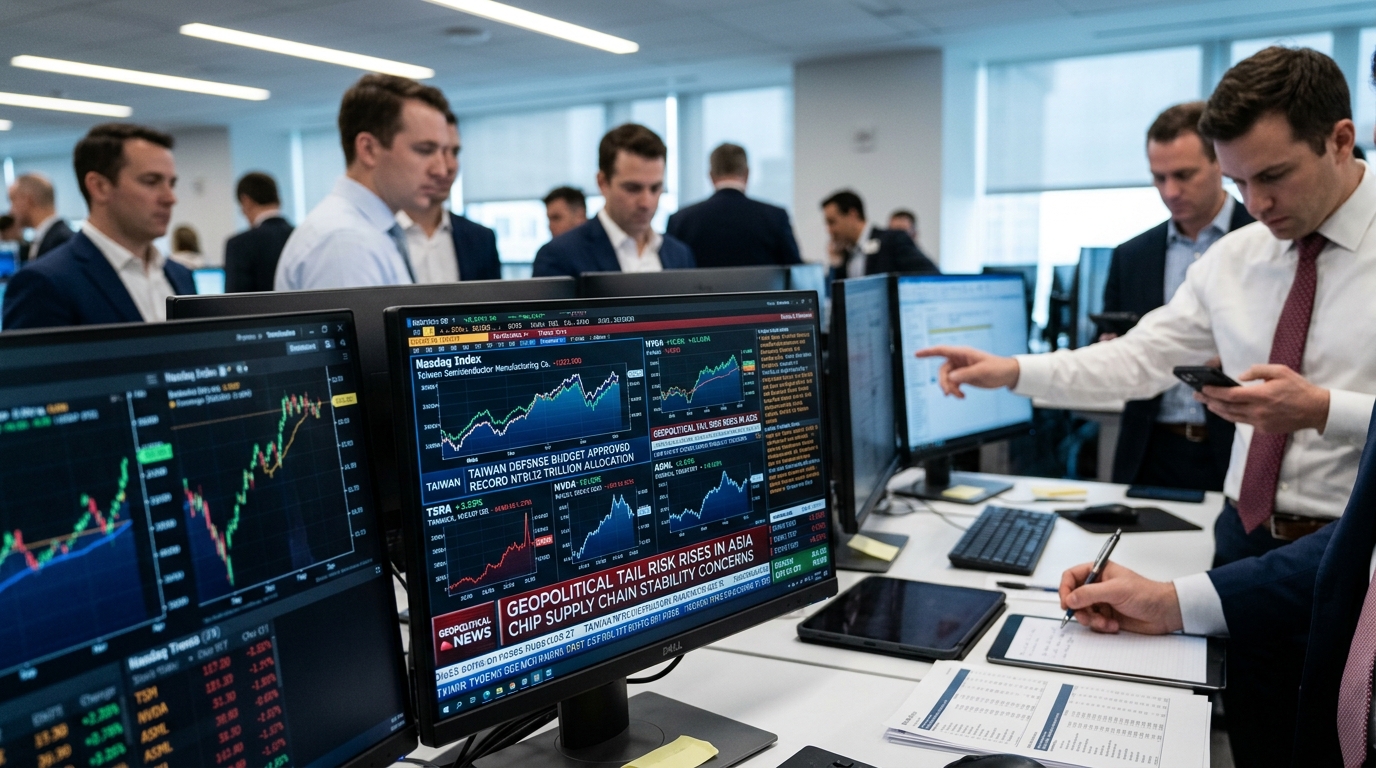
Taiwan’s cabinet approved a record NT$1.12 trillion (about $35 billion) defense budget for 2027 last Thursday, the first time that figure has crossed the NT$1 trillion mark and the first time defense spending will exceed 3% of GDP. The proposed spending is NT$173 billion, or 18.2%, higher than this year’s allocation. President Lai Ching-te has set a longer target: raise overall defense spending to 5% of GDP by 2030 to strengthen the island’s deterrence.
The investment committee question is not whether Taiwan is serious. It clearly is. The question is what the Nasdaq is embedding as its own probability.
The Budget Tells You What Taipei Believes
Governments do not double their defense outlays in two fiscal years out of habit. The proposed sum amounts to a near-doubling of Taiwanese defense outlays in two fiscal years. For context, outside estimates put Taiwan’s 2025 military spending at about $18.2 billion, roughly 2.1% of GDP, up from about $12.0 billion in 2020. And the Han Kuang 42 exercises are scheduled for August 5 to 14, with Taiwan’s defense ministry saying the drills will test relocating weapons production lines and converting civilian factories for military use if supply hubs are hit. That is a materially different exercise from previous years. It signals that Taipei’s planners are now war-gaming sustained industrial attrition, not just an acute strike scenario.
The political path for this budget is its own risk variable. The opposition-controlled legislature cut a previously proposed NT$1.25 trillion special defense budget to NT$780 billion and excluded funding beyond certain U.S. arms procurement, including stripping out domestically commissioned production projects that had supported the indigenous drone push. The spending plan must be approved by the opposition-controlled legislature, a process that is likely to be difficult. That tension matters less to equity investors than the directional signal: both the government and the opposition have implicitly confirmed the threat environment is acute enough to argue about how much to spend.
The Gap Between the Macro Estimate and Market Multiples
The disruption estimates are not new, but they have grown. A US-China conflict over Taiwan would cost the global economy about $10.6 trillion, roughly 9.6% of global GDP, in the first year alone, eclipsing the impact of the Covid-19 pandemic and the 2007-09 global financial crisis, according to Bloomberg Economics modeling. Even a blockade short of full conflict carries a staggering price. Bloomberg Economics has also modeled a blockade scenario at around $5 trillion, roughly 5% of global GDP, in the first year.
Now compare those macro estimates to what chip stocks are actually priced for. It is widely cited that TSMC controls roughly 70% of global foundry revenue and more than 90% of the world’s most advanced chip production at leading-edge nodes, a concentration that represents arguably the single largest unpriced supply-chain risk in global markets. TSMC’s valuation reflects this discount partially but not fully, but the exact forward multiple moves with the market and the estimate period. NVIDIA and AMD, both heavily dependent on TSMC for advanced production, carry significantly higher multiples. Many major AI accelerator designs, including NVIDIA and AMD, as well as hyperscaler custom silicon, rely on TSMC manufacturing at leading-edge nodes.
What a Professional Hedge Actually Costs Today
The off-island diversification picture looks better than it did two years ago, but the timeline is not investable for near-term risk management. TSMC has said construction of its second Arizona facility has been completed and it is installing systems for 3-nanometer and more advanced technologies. But the Arizona expansion provides long-run diversification and won’t be at meaningful scale until 2027-2028. A conflict in the Taiwan Strait before then leaves essentially no substitute at leading-edge nodes. TSMC remains the volume leader at the leading edge by a meaningful margin. Samsung is a credible second source for customers that need it, and Intel has re-entered the foundry business, but it is not yet in TSMC’s volume tier at the leading edge.
The practical hedge for most institutional holders is not a full exit but a position-size discipline question, combined with optionality on companies that benefit from supply-chain bifurcation. If the worst-case scenario plays out, every chip equity drops, not just TSM. Your portfolio is already exposed.
Stocks to Watch
TSM carries the most direct exposure and the clearest discount. TSMC reported 2025 revenue of $122.42 billion, up 35.9% year-over-year. NVDA has the widest earnings multiple in the group and the sharpest sensitivity to any CoWoS capacity disruption. AAPL sources its most advanced silicon from TSMC, with Arizona Fab 21 positioned as a partial U.S. manufacturing alternative on a later timeline. QCOM retains some Samsung foundry optionality at certain nodes, giving it marginally better supply-chain flexibility than AMD, which has almost none. INTC is the asymmetric beneficiary: if geopolitical pressure accelerates customer decisions to qualify Intel Foundry at 18A, every month of stress in the Taiwan Strait makes that conversation easier to have.