
May 13, 2026
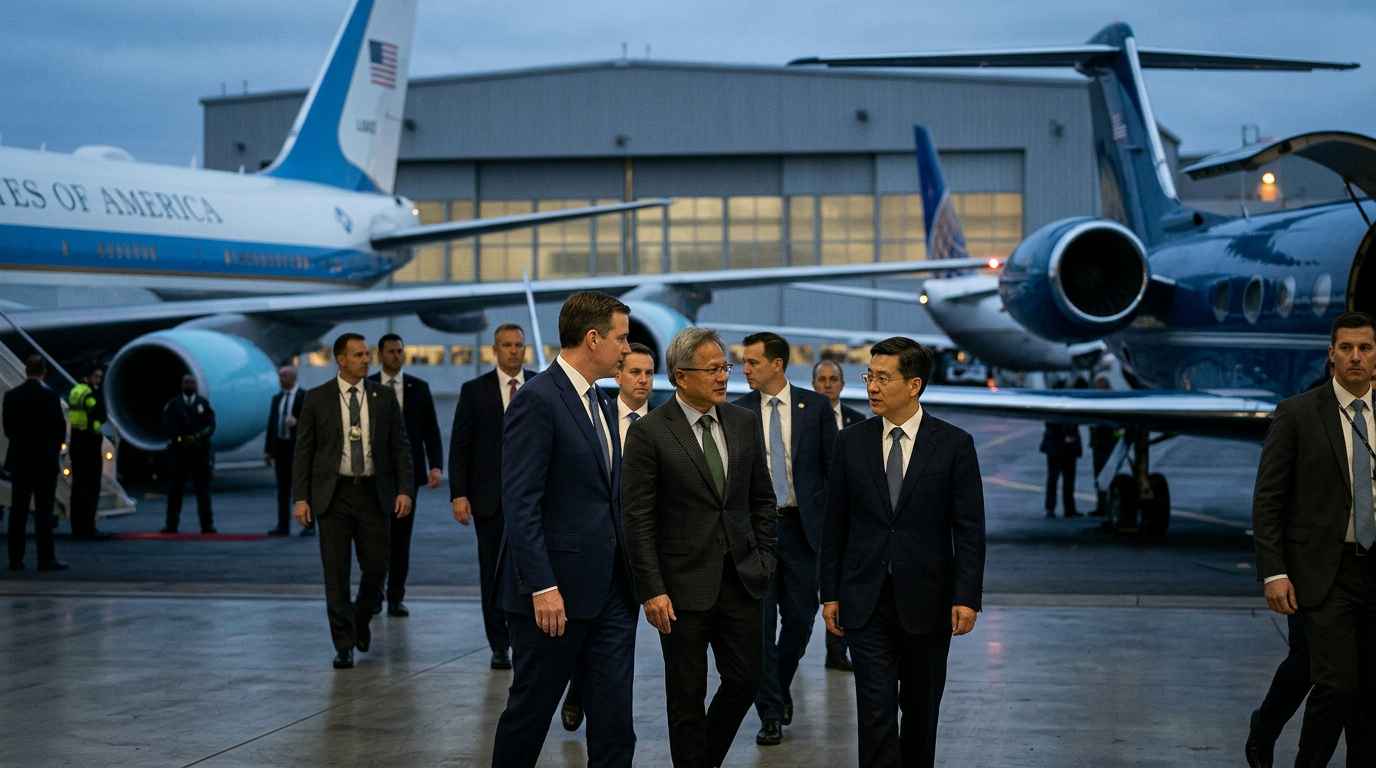
Huang on Air Force One
What the Beijing meetings could change for chips, tariffs, and leverage.
- Today (May 13, 2026): Trump arrived in Beijing to meet Xi. The meetings run Thursday and Friday.
- The headline: Nvidia CEO Jensen Huang wasn’t on the original corporate delegation, then boarded Air Force One in Anchorage after Trump personally called him.
- The clock: A tariff truce announced May 12 cut U.S. tariffs from ~145% to 30% and lasts 90 days (into mid-August).
- The money: Nvidia reported fiscal 2026 revenue of $215.9B; its outlook assumes no China data center revenue.
- The pressure: Export controls have pushed Nvidia’s China business close to zero, while Beijing still has leverage via energy and rare earth processing.
There are lots of ways for Washington to tell you who matters.
One of the cleanest is this: a billionaire CEO gets a last-minute call from the president… then shows up on Air Force One anyway.
That’s what happened with Jensen Huang this week. He wasn’t listed with the big-name corporate group traveling with President Trump to China, then Trump called him, and Huang boarded the plane during the fuel stop in Anchorage, Alaska. If you’re trying to figure out where the real pressure points are in U.S.-China talks right now, it’s a pretty strong clue.
And it’s not subtle: this isn’t about “tech” in the broad sense. It’s about the one company that sits at the choke point of modern AI compute.
Beijing, right now
Trump arrived in Beijing on Wednesday, May 13, 2026, for talks with Xi Jinping. The schedule matters because it’s tight: formal meetings are expected Thursday and Friday, and both sides want something they can call “progress” without looking like they blinked.
Here’s where I’m at: the tariff piece is the easy part. The chip piece is the hard part. And the hard part is the only part the market will actually care about a month from now.
On May 12, the U.S. and China announced a 90-day tariff truce: U.S. tariffs fell from around 145% to 30%, while Chinese tariffs fell from 125% to 10%. Ninety days sounds generous until you do the calendar. That pushes the real deadline into mid-August. Not far away.
So yes, trade de-escalation is happening. But if this ends as “we lowered tariffs for a quarter,” that’s not a strategy. That’s a pause button.
The Opportunity Often Comes Before the Listing
Med-X is preparing for a potential Nasdaq listing under the reserved ticker MXRX, giving early investors an opportunity to invest before broader public market exposure.
The company has already generated millions in sales, operates across 41 markets, carries zero long-term debt, is backed by Maxim Group Investment Bank, and has retail distribution through Amazon, Walmart, and Kroger.
As demand continues to grow for safer, plant-based pest control solutions, Med-X is positioning itself within the rapidly expanding $17.6B biopesticide market.
Explore Med-X and become a shareholder at $4/share ahead of its planned Nasdaq listing
Disclosures: This is a paid advertisement for Med-X’s Regulation A+ Offering. Please read the offering circular at invest.medx-rx.com.
Why Nvidia is in the middle of this
Nvidia’s own numbers explain the urgency better than any political statement.
In its fiscal 2026 results, Nvidia reported $215.9B in revenue, with a record quarter at $68.1B and data center revenue at $62.3B. In the outlook, Nvidia explicitly said it is not assuming any Data Center compute revenue from China. That’s not a throwaway sentence. It’s a flag. It tells you the baseline expectation inside the company: “we’re building plans that work even if China stays shut.”
But shutting China out has costs. When U.S. licensing requirements tightened around the H20 product line, Nvidia disclosed a $4.5B charge tied to excess inventory and purchase obligations, and said the restrictions would create an $8B revenue hit in the following quarter period. This is why the “just comply” argument breaks down in practice. You can comply and still get kneecapped.
Slight tangent, but it matters: investors sometimes treat export controls like a clean on/off switch. They’re not. They create a slow bleed – inventory, orders, redesigns, approvals, reversals – and it shows up as noise in financials until it suddenly becomes the whole story.
Huang has also put a rough size on what’s at stake: he’s described the China AI chip opportunity as roughly a $50B addressable market. If you’re wondering why he’d rearrange his life to hop on a plane in Alaska, that’s a reasonable starting point.
What China can trade, and what it won’t
There’s a tendency in U.S. commentary to assume Beijing “needs” this deal more. I’m not convinced. Not this week.
The Iran conflict and the Strait of Hormuz disruption have dragged energy into the center of geopolitics again. China buys the vast majority of Iran’s exported crude. That fact alone changes the posture: it’s leverage that doesn’t require a press conference. It just exists.
Then there’s materials. China’s role in rare earth processing is one of the quiet constraints on everyone’s “we’ll just build it here” ambitions. Even a small tightening there ripples across electronics, defense supply chains, and the upstream inputs that make modern compute hardware possible.
And Taiwan is the third rail. Not because either side will “solve” it in a meeting, but because a few words said the wrong way can raise the perceived risk level immediately. Taipei is watching closely for any shift in tone around U.S. arms sales and defense commitments.
Elon Musk And The Most Valuable Rock In The World
This rock looks ordinary. But inside this rare-earth metal lies the power to move every Tesla, SpaceX rocket, and Optimus robot on Earth. The problem? China controls 90% of it. Musk may have just discovered a way out of this stranglehold – igniting a $3 trillion boom.
Watch this shocking briefing before Musk goes live with an announcement any day now.
The part people skip
Huang getting a seat on the plane is not the same thing as export rules changing. It’s not even close.
It does, however, suggest something I don’t think is priced properly by most people: the administration wants room to maneuver. If the goal was simply to hold the line and keep tightening, there’s no reason to create the optics of “Nvidia is in the room.” You’d keep the delegation clean and the message simple.
So what could maneuvering look like? Not a full reopening. Something narrower. Tighter customer lists. More licensing. More conditions. Slow approvals that can be turned on and off.
That kind of half-step is frustrating, messy, and politically survivable. Which is exactly why it’s plausible.
What I’m watching next
- Language. Not the headlines. The exact phrasing around “licensing,” “advanced compute,” and “guardrails.” If it’s vague, it’s intentional.
- Silence. If Taiwan barely comes up publicly, that can be a sign both sides agreed not to touch it in front of cameras.
- Time. Mid-August is the real date. A 90-day truce that expires into an election cycle is not designed for comfort.
Anyway. If you’re looking for the single clean takeaway: Nvidia’s guidance is built on “no China,” but the political leadership clearly doesn’t want to fully shut the door. Huang didn’t hop on a plane in Alaska for symbolism alone.
We’ll see what comes out of Beijing. And we’ll see what doesn’t.
If you still haven’t downloaded my free “Simple Options Trading For Beginners” guide…
…please take a few seconds and download it right now before your new temporary download link expires.
I eventually plan to charge money for this training, so do yourself a favor and download it now…
That way, no matter what it costs in the future, you’ll have a free copy on your computer.
Make sense?